
 English
  Deutsch
  Español
  Français
  Italiano
  Português
  Svenska
  Suomi
Suomi  Dansk
Dansk  Norsk bokmål
  Nederlands
  العربية
  עברית
עברית  Polski
  Türkçe
  Русский
  Uzbek
Uzbek  Tiếng Việt
  ไทย
ไทย  한국어
한국어  日本語
日本語  简体中文
简体中文 Many commercial buyers feel comfortable once they see a two-year or three-year charger warranty on a quotation. That confidence often disappears during the first service event. A failed module may be covered, but the technician visit is not. Remote troubleshooting may be required before any claim is approved. The warranty may start at shipment instead of commissioning. Damage caused by unstable site power, networking issues, or installation errors may sit outside the supplier’s obligation entirely.
That is why commercial EV charger warranty terms should be treated as a risk-allocation document, not a comfort statement. For site hosts, fleet operators, distributors, and procurement teams, the real question is not whether a charger has a warranty. It is whether the warranty meaningfully protects uptime, operating cost, and replacement risk after deployment.
Why Warranty Language Matters Before the First Failure
Commercial charging infrastructure is rarely a one-box purchase. It sits inside a larger operating system that includes utility capacity, civil works, network connectivity, payment workflows, installer handoff, and sometimes fleet scheduling or public-access obligations. If the warranty only addresses factory defects in a narrow sense, buyers may still carry most of the real-world service burden.
This matters most when procurement teams compare multiple suppliers that appear similar on hardware price. A lower-priced offer can become more expensive if warranty claims require long approval cycles, if spare parts are not stocked regionally, or if labor and travel are excluded. Buyers who already use a broader commercial EV charging project checklist are usually in a better position to catch these issues before contract signature.
What a Commercial EV Charger Warranty Usually Covers
Commercial EV charger warranties often cover defects in materials or manufacturing for defined hardware assemblies. That sounds straightforward, but the scope can vary significantly by charger class, supplier model, and service structure.
| Component or Obligation | Often Covered | Common Limitation Buyers Should Check |
|---|---|---|
| Power modules, control boards, and internal electronics | Usually yes | Coverage may be parts-only, with diagnosis required before approval |
| HMI, RFID readers, screens, and communication boards | Often yes | Cosmetic damage, misuse, or environmental exposure may be excluded |
| Connector, cable, and plug assembly | Sometimes | Wear-and-tear treatment may be different from core electronics |
| Enclosure, locks, seals, and mechanical parts | Sometimes | Corrosion, vandalism, impact damage, or water ingress may be limited or excluded |
| Firmware defect remediation | Often partially | Updates may be covered, but version management and site compatibility may not be |
| Shipping for replacement parts | Varies | Inbound or outbound logistics responsibility may shift by claim type |
| On-site labor | Varies widely | Many warranties do not automatically include technician time, travel, or crane/lift access |
| Charger replacement during long repair cycles | Rarely automatic | Advance replacement or swap-stock support usually needs to be defined separately |
The practical point is simple: a commercial warranty is usually strongest on component eligibility and much weaker on the total cost of getting the charger back into service.
The Terms That Change Real-World Warranty Value
The headline duration matters, but it is rarely the most important term. Commercial buyers usually get more value by understanding the operational language behind the warranty.
| Term | Why It Matters | What Buyers Should Confirm |
|---|---|---|
| Warranty start date | A shipment-based start date can shorten effective field coverage | Does coverage begin at shipment, delivery, commissioning, or acceptance? |
| Duration by subsystem | Different assemblies may carry different coverage periods | Are power modules, cables, displays, and accessories treated differently? |
| Parts-only vs. parts-and-labor | A covered part does not guarantee a low-cost repair | Who pays technician labor, travel, lift equipment, and return-to-service testing? |
| Claim approval path | Slow workflows increase downtime | Is remote diagnosis mandatory, and what documents are required? |
| Replacement lead time | Repairable coverage still hurts if parts arrive slowly | Are critical spare parts stocked locally or built to order? |
| Exclusions | Many commercial failures fall into exclusion zones | Are grid events, surge damage, flooding, vandalism, installer error, and misuse excluded? |
| Site dependency language | The charger may rely on third-party systems | Is networking, payment hardware, SIM service, or backend compatibility part of warranty scope? |
| Transferability | Ownership or operator changes are common in commercial projects | Can the warranty transfer to a site host, distributor, or end customer? |
Commercial buyers should also check whether repeated failures trigger a replacement threshold or only repeated repair attempts. That clause can materially change fleet availability and public-site reliability.
Certification, Compliance, and Warranty Are Different Protections
One common procurement mistake is treating certification as a substitute for warranty strength. Certifications can be important evidence that the charger was designed and tested against relevant standards, but they do not automatically define service response, replacement obligations, or field-labor support. Buyers comparing supplier claims should keep technical compliance and commercial warranty terms in separate columns, much like they would when reviewing CE and TUV certification for EV chargers.
In the same way, installation sign-off does not guarantee that all future failures are the manufacturer’s responsibility. Many warranty disputes start at the boundary between product defect, installation quality, and site conditions. If the agreement does not define that boundary clearly, the buyer often absorbs the ambiguity.
AC and DC Chargers Do Not Carry the Same Warranty Risk
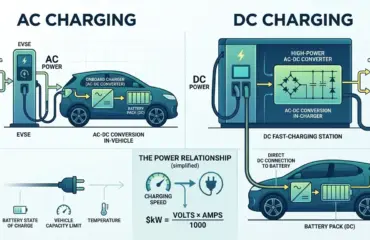
Warranty expectations should not be identical across every charger format. Lower-power AC charging deployments often involve simpler power architecture, lower thermal stress, and easier field replacement paths. That does not make AC chargers risk-free, but it can make claim handling and service logistics more straightforward when failures occur.
By contrast, higher-power DC charging equipment usually carries more complex power electronics, greater thermal management demands, heavier installation dependency, and tighter integration with backend diagnostics. In practice, that means buyers should look harder at fault isolation, parts availability, technician qualification, and remote-support procedures rather than focusing only on the length of the hardware warranty.
| Charger Type | Typical Warranty Risk Profile | Buyer Focus |
|---|---|---|
| AC smart charging | Lower hardware complexity, longer dwell, simpler replacement events | Cable treatment, comms stability, enclosure durability, installer boundary |
| DC fast charging | Higher component stress, greater uptime sensitivity, more expensive field service | Power-module scope, cooling systems, remote diagnostics, labor coverage, spare strategy |
| Mixed AC/DC portfolio | Different failure modes across the same network | Separate warranty assumptions by charger class, not one blended support model |
For commercial portfolios, the right question is not whether AC or DC has the better warranty. It is whether the warranty structure matches the service reality of that charger class.
Warranty, Service Plans, and Uptime SLAs Should Not Be Blended
A charger warranty typically promises a remedy for eligible product defects. It does not automatically promise routine inspections, proactive parts replacement, firmware management, network monitoring, or guaranteed response times. Those obligations usually live in separate service plans, managed-support agreements, or uptime frameworks.
This distinction becomes especially important when hardware and backend platforms interact. A communications failure may look like charger downtime to the site host, even if the root issue sits in configuration, network policy, or software behavior. Buyers reviewing this boundary should keep the hardware promise separate from the operational logic described in EV charger software vs firmware.
Likewise, a network operator or fleet customer may need escalation workflows that go far beyond warranty language. Commercial uptime usually depends on remote monitoring, event triage, replacement approvals, and service coordination, so warranty review should sit alongside a broader uptime and escalation plan rather than replacing it.
| Protection Layer | Main Purpose | What It Usually Does Not Solve |
|---|---|---|
| Product warranty | Covers eligible defects in defined components | Routine maintenance, guaranteed response time, site operations |
| Preventive maintenance plan | Reduces avoidable failures and inspection gaps | Major defect replacement unless separately stated |
| Remote support agreement | Speeds diagnosis and configuration support | Automatic free hardware replacement |
| Uptime SLA or managed service | Defines response, escalation, and performance expectations | Full product-defect remedy unless linked to warranty terms |
Commercial buyers should assume these are separate commercial layers unless the contract explicitly combines them.
Questions Commercial Buyers Should Ask Before Signing
Warranty review works best when procurement, operations, and technical teams ask the same set of questions before purchase approval.
- When does the warranty start: shipment, delivery, commissioning, or site acceptance?
- Is the warranty parts-only, or does it include on-site labor and travel?
- Which assemblies have shorter or different coverage periods than the main charger?
- What evidence is required to open a claim, and who performs first-line diagnosis?
- Who pays shipping, customs, and failed-part return logistics?
- Are surge events, unstable site power, networking failures, or installer mistakes excluded?
- Is replacement stock available regionally for critical components?
- What happens if the same fault repeats multiple times?
- Does the supplier support firmware compatibility through the covered period?
- If the charger is sold through distribution, OEM, or ODM channels, who is the legal warranty counterparty?
These questions often reveal more than the headline warranty period. They also help buyers compare factory-direct suppliers, distributors, and brand partners on a like-for-like basis.
OEM and ODM Buyers Need a Different Warranty Conversation
Commercial buyers sourcing through OEM or ODM programs should treat warranty responsibility as a channel-design issue, not just a technical clause. Branding flexibility can be useful, but it creates more room for confusion if the agreement does not clearly define who owns field claims, who stocks spare parts, who approves replacements, and who communicates with the end customer.
This is especially important when a manufacturer supports both standard charger lines and white-label programs. The buyer should confirm whether the warranty follows the physical product, the local brand, the importing entity, or the integration partner. For distributors and private-label operators, batch traceability, root-cause reporting, spare-parts stocking, and local service coordination can matter as much as the nominal warranty duration.
For OEM and ODM relationships, the strongest structure usually includes:
- a clear responsibility matrix between manufacturer, channel partner, and site host
- defined turnaround rules for spare-part approval and dispatch
- version-control rules for firmware and supported accessories
- failure-analysis reporting for repeated or batch-level faults
- written rules for when a repair becomes a full-unit replacement case
Without that structure, the buyer may end up holding the commercial relationship while lacking the authority to resolve warranty events quickly.
Practical Summary
Commercial EV charger warranties are most useful when buyers read them as an uptime and cost-control document rather than a marketing reassurance.
- Focus on start date, labor coverage, exclusions, and replacement lead times, not just the number of years.
- Separate certification, installation compliance, product warranty, remote support, and uptime obligations.
- Expect different warranty risk profiles for AC chargers and DC fast chargers.
- Ask how claims work in practice, especially for regional spare parts and technician dispatch.
- For OEM and ODM programs, define channel responsibility before the first field failure happens.
- Treat any unclear clause as future downtime risk, not minor legal wording.
For commercial buyers, the best warranty is rarely the longest-looking one. It is the one that most clearly explains who does what, who pays for what, and how quickly the charger gets back into service when something goes wrong.