
 Deutsch
  Español
  Français
  Italiano
  Português
  Svenska
  Suomi
Suomi  Dansk
Dansk  Norsk bokmål
  Nederlands
  العربية
  עברית
עברית  Polski
  Türkçe
  Русский
  Uzbek
Uzbek  Azərbaycan
  Tiếng Việt
  ไทย
ไทย  한국어
한국어  日本語
日本語  简体中文
简体中文 
The electric vehicle (EV) charging landscape in 2026 has officially crossed the threshold from fragmented early-stage infrastructure to a highly standardized, mission-critical extension of the global energy grid. For fleet operators, charge point operators (CPOs), and commercial developers, EV infrastructure is no longer simply a sustainability milestone—it is a core operational asset and a primary revenue driver.
Driven by stringent federal uptime mandates, rapid advancements in bidirectional power flow, and the universal standardization of hardware, the market is demanding rigorous technical reliability and scalable economics. Success in this highly competitive arena requires partnering with manufacturers who control the entire hardware ecosystem—from the foundational power semiconductors to the intelligent software platforms managing the grid load.
As a global leader operating a 28,000-square-meter advanced manufacturing base, PandaExo brings a deep heritage in power electronics to the forefront of e-mobility. Here is your comprehensive guide to the technologies, standards, and commercial strategies defining EV charging stations in 2026.
The New Baseline: NACS Standardization and ISO 15118
The most significant operational shift in the North American and global EV markets has been the aggressive consolidation of charging standards. The widespread adoption of the SAE J3400 standard, commonly known as the North American Charging Standard (NACS), has eliminated the physical fragmentation that previously plagued public and commercial charging networks.
For B2B stakeholders, this standardization removes a major friction point in hardware deployment. You no longer need to over-capitalize on redundant connector types or complex cable management systems to service a diverse fleet.
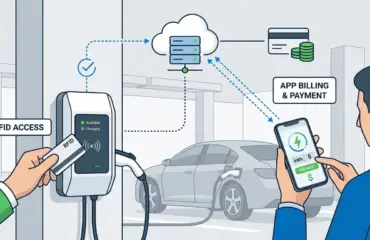
Simultaneously, the maturation of ISO 15118 has made “Plug & Charge” technology the uncompromising industry standard. This protocol allows the vehicle and the charging station to authenticate, authorize, and process billing instantaneously without the need for RFID cards, mobile applications, or point-of-sale terminals. This seamless cryptographic handshake drastically reduces user error, accelerates throughput at public stations, and streamlines back-end accounting for commercial fleets.
The Rise of Ultra-Fast DC and Megawatt Charging Systems (MCS)
As battery densities increase and heavy-duty electric trucks become viable for long-haul logistics, charging infrastructure has been forced to scale its power output exponentially. The 50kW and 150kW chargers of the early 2020s have been rapidly superseded by ultra-high-power architectures.
Dynamic Power Sharing Architectures
Modern DC fast charging stations deployed in 2026 frequently utilize centralized power cabinets capable of dispensing 400kW or more, dynamically routed across multiple dispensers. Instead of hard-capping a single stall at a fixed kilowatt output, these intelligent systems monitor the real-time battery acceptance rate of up to six connected vehicles simultaneously. The system routes peak power to the vehicle with the lowest state of charge (SoC) and tapers the output as batteries near capacity. This maximizes hardware utilization and significantly reduces the total capital expenditure (CapEx) per charging stall.
Megawatt Charging for Heavy-Duty Transport
For the commercial trucking, marine, and aviation sectors, the Megawatt Charging System (MCS) is reshaping operational logistics. Delivering up to 3.75 megawatts (3,000 amps at 1,250 volts), MCS enables Class 8 electric trucks to add hundreds of miles of range during a legally mandated 45-minute driver rest period. The deployment of these ultra-high-power hubs requires specialized liquid-cooled cables, robust grid interconnects, and heavy-duty thermal management systems to prevent equipment degradation.
Next-Generation Power Electronics: Smaller, Cooler, Faster
The true battleground for EV charging supremacy in 2026 is not just the exterior enclosure, but the internal power conversion modules. To deliver higher power without exponentially increasing the physical footprint of the charging station, the industry has fundamentally re-engineered the internal components.
- Silicon Carbide (SiC) Integration: The transition from traditional silicon to Silicon Carbide MOSFETs has dramatically reduced switching losses and improved thermal efficiency. SiC technology allows chargers to operate at higher voltages and frequencies while generating a fraction of the heat.
- High-Density Modules: By utilizing sine-amplitude converters and planar power factor correction (PFC) inductors, manufacturers have quadrupled the power density of modern charging modules.
- Component-Level Reliability: The durability of a high-capacity charger relies entirely on its core architecture. Mastering the engineering of critical components like bridge rectifiers ensures that AC power from the grid is cleanly, efficiently, and consistently converted to the DC power required by the vehicle’s battery pack, even under continuous heavy-duty cycles.
PandaExo’s unique advantage stems from its factory-direct precision and deep heritage in these exact power semiconductors, ensuring that every charging station operates with aerospace-grade reliability.
Smart Energy Management and Bidirectional Charging
EV chargers are no longer one-way valves for electricity. They are intelligent nodes within a decentralized smart grid. As grid capacity constraints become a primary hurdle for large-scale fleet electrification, intelligent energy management is non-negotiable.
V2G, V2H, and V2X Maturation
Vehicle-to-Grid (V2G) and Vehicle-to-Building (V2B) technologies have moved from pilot programs to commercial viability. Bidirectional charging allows fleet operators to leverage their parked electric vehicles as mobile energy storage systems (BESS).
During peak demand hours—when utility rates are highest—connected vehicles can discharge power back into the facility or the local grid, effectively erasing peak demand charges and generating ancillary revenue. Reliable AC smart chargers equipped with bidirectional inverters are critical for executing these load-shifting strategies efficiently.
Predictive Maintenance and the 97% Uptime Mandate
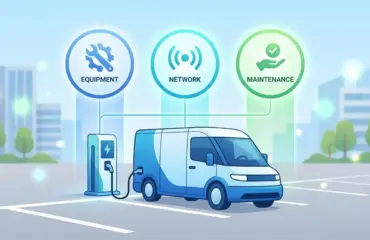
To qualify for federal funding like the National Electric Vehicle Infrastructure (NEVI) formula program, public charging networks must maintain a stringent 97% uptime. To achieve this, modern software platforms utilize AI-driven predictive maintenance. By analyzing telemetry data—such as temperature spikes in a specific connector pin or voltage irregularities in a power module—the system can automatically dispatch technicians or reboot software before a catastrophic hardware failure occurs.
Strategic Sourcing: The Advantage of OEM/ODM Partnerships
For CPOs, auto dealerships, and enterprise fleets looking to deploy infrastructure at scale, relying on fragmented supply chains or white-labeled middlemen introduces severe financial and operational risks. The key to profitable scaling in 2026 is vertical integration.
Partnering directly with an original equipment manufacturer (OEM) and original design manufacturer (ODM) like PandaExo provides unparalleled advantages:
- Customization: Tailor the hardware aesthetics, software interface, and power configurations precisely to your brand and operational needs.
- Scalability: With a 28,000-square-meter manufacturing facility, production can scale seamlessly from a pilot program of 50 units to a national rollout of 5,000 units.
- Total Cost of Ownership (TCO): Factory-direct sourcing bypasses distributor markups, significantly reducing initial CapEx and improving the return on investment (ROI) timeline.
Whether you are seeking robust commercial DC fast chargers, intelligent wallboxes for employee parking, or exploring our full product catalog to build a customized regional network, aligning with a primary manufacturer ensures hardware longevity and dedicated technical support.
The transition to electrified transport is moving at an unprecedented velocity, and the hardware deployed today must be engineered to withstand the demands of tomorrow. To future-proof your infrastructure investments, minimize grid constraints, and explore our full range of factory-direct solutions, reach out to the engineering and deployment teams at PandaExo.