
 Deutsch
  Español
  Français
  Italiano
  Português
  Svenska
  Suomi
Suomi  Dansk
Dansk  Norsk bokmål
  Nederlands
  العربية
  עברית
עברית  Polski
  Türkçe
  Русский
  Uzbek
Uzbek  Azərbaycan
  Tiếng Việt
  ไทย
ไทย  한국어
한국어  日本語
日本語  简体中文
简体中文 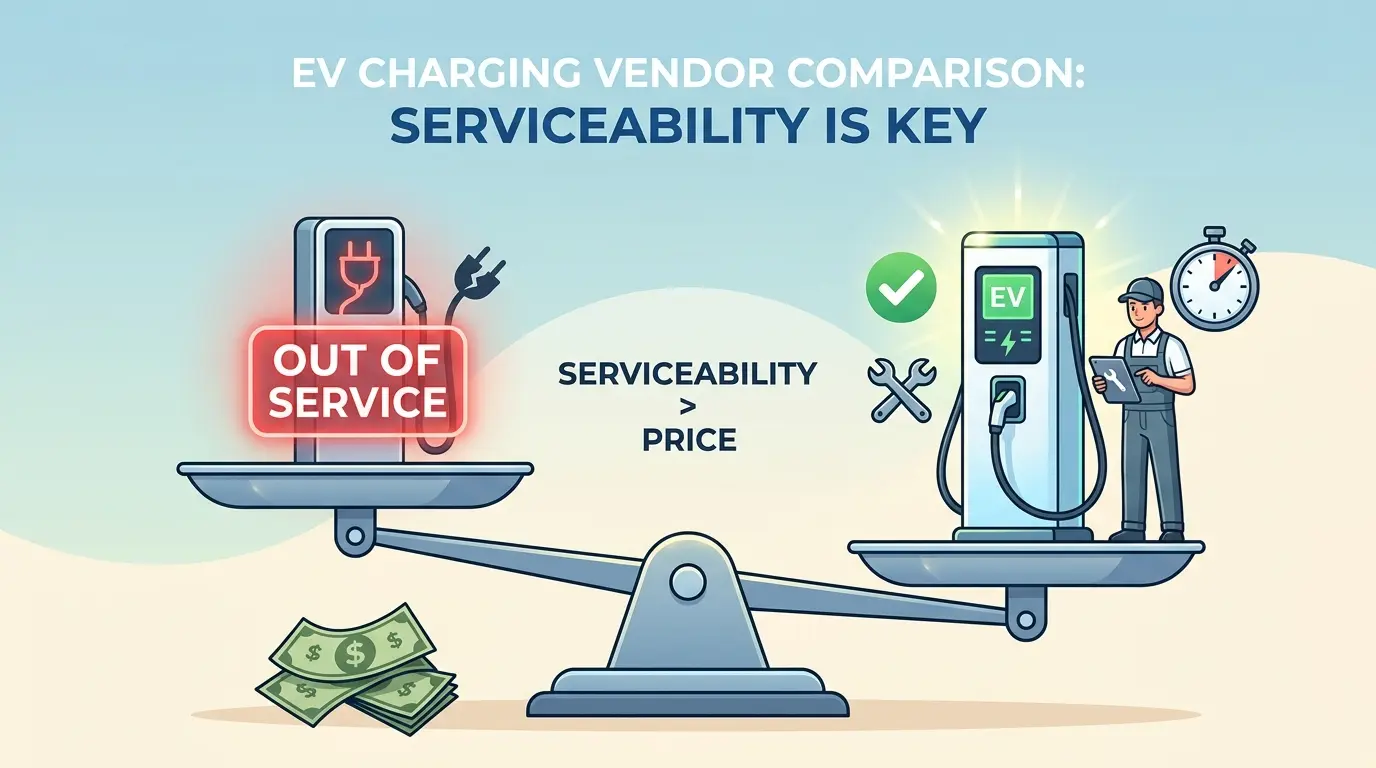
The lowest bid can look attractive during procurement and still become the most expensive choice six months later. One failed connector, one unavailable power module, or one backend issue that nobody owns can turn a reasonably priced charger into a recurring operating problem.
That is why serious EV infrastructure buyers should compare vendors on serviceability, not only on hardware price, software fees, or installation scope. In commercial charging, the real question is not just what the charger costs to buy. It is how quickly the vendor can diagnose faults, restore service, manage updates, supply parts, and support the site as the network grows.
Why Lowest Price Can Create the Highest Operating Risk
In EV charging procurement, price is visible early and service risk usually appears later. Buyers often receive clean spreadsheets comparing charger cost, commissioning fees, warranty terms, and annual software subscriptions. Those numbers matter, but they do not explain what happens when a charger stops authorizing sessions on a busy retail site or when a fleet depot loses a critical DC unit before the morning dispatch window.
That gap matters because charging infrastructure is not a static asset. It is a working system made up of power electronics, connectors, firmware, communications, payment flows, remote monitoring, and field support. A cheaper vendor can become more expensive over time if every service event requires long parts lead times, unclear escalation, or repeated site visits just to identify the fault.
For lower-intensity environments, buyers may accept a simpler support model. For sites where uptime affects turnover, revenue, fleet continuity, or tenant satisfaction, serviceability should carry more weight than a small difference in upfront capex.
What Serviceability Actually Means in EV Charging Procurement
Serviceability is broader than warranty language. It is the vendor’s ability to help the site recover from routine faults, software problems, compatibility issues, and component failures without long operational disruption.
In practice, serviceability usually depends on five things working together:
- how easily faults can be identified remotely
- how modular and repairable the charger hardware is
- how quickly spare parts can be sourced and matched to the installed revision
- how clearly field service responsibility is defined
- how well software, firmware, logs, and data access support lifecycle operations
This is also why buyers should distinguish between service promises and service mechanics. A vendor can promise strong support in a sales meeting, but the stronger comparison is whether the operating model behind that promise is mature enough to protect the site in real conditions.
Start With the Failure Path, Not the Sales Deck
When comparing vendors, begin with a practical question: what happens after a fault appears?
If a charger drops offline, derates unexpectedly, rejects payment, fails session authorization, or throws a connector fault, the buyer should ask for the exact recovery workflow. Who sees the alarm first? What can be diagnosed remotely? Which events trigger a simple remote reset, and which require dispatch? How is severity prioritized when a low-use AC charger and a high-priority DC charger fail at the same time?
Vendors with disciplined monitoring, remote support, and escalation workflows are usually easier to operate over time because they can separate remote fixes from true field failures and reduce wasted truck rolls.
Buyers should also ask for examples of incident reporting. A strong vendor should be able to show how alarms are classified, how response times are logged, and how root cause is documented after resolution.
Compare Hardware Architecture for Repairability
Not all chargers are equally easy to service, even when their feature set looks similar on paper.
Two vendors may both offer smart AC chargers or high-power DC chargers, but one may use a more modular architecture with replaceable assemblies, standardized communication boards, clearer cable routing, and common components across multiple models. The other may rely on a design that is harder to open, harder to diagnose, or more dependent on model-specific parts.
That difference becomes important when the installed base grows. Buyers should ask whether critical components can be replaced at the assembly level, whether field technicians can isolate likely failures without stripping down the unit excessively, and whether the vendor uses common parts across a broader EV charging portfolio.
This point becomes even more important when a buyer expects mixed deployments. AC charging for long-dwell locations and DC fast charging for higher-throughput sites may require different equipment, but they should not force the operator into completely different service logic if the vendor can avoid it.
Check Parts Availability Before You Compare Warranty Length
Warranty duration matters, but parts availability usually has more influence on real downtime.
Buyers should ask where critical spare parts are stocked and how the vendor decides what stays local, what is regional, and what ships from the factory. A two-year or three-year warranty will not protect operations if the failed assembly has a long replenishment cycle or if the exact revision is difficult to match.
The most useful questions are practical:
- Which components most commonly stop a charger from serving drivers?
- Which of those parts are stocked locally or regionally?
- Are replacement assemblies common across models or revision-specific?
- Can the vendor identify the likely failed part before the technician arrives?
- What is the process if the installed model is no longer the current production revision?
This is one area where buyers should think differently about AC and DC chargers. AC chargers often involve lower-power components and simpler service events. DC systems usually introduce more complex power modules, cooling elements, cable assemblies, and controller dependencies. The vendor should show that its parts strategy reflects that difference.
Review Field Service Coverage and Escalation Ownership
Serviceability is not only about whether a technician can be sent. It is about whether the right party owns the problem from first alarm to final repair.
Some vendors use in-house service teams. Others rely on channel partners, regional contractors, or a layered support model. None of those approaches is automatically wrong. The issue is whether the buyer can see a clear escalation chain, defined severity rules, and ownership when hardware, firmware, and backend systems overlap.
This is where buyers should push past generic statements such as “we provide after-sales support.” A stronger answer explains who performs remote triage, who authorizes dispatch, who carries replacement stock, who closes the incident, and who remains accountable if the root cause sits between charger hardware and the software platform.
For fleet depots, transport sites, or revenue-sensitive public charging locations, buyers should also ask whether restoration targets vary by asset criticality. A nonessential charger and a site bottleneck should not be treated the same way.
Evaluate Software Visibility, Firmware Discipline, and Interoperability
Many charging failures are not mechanical failures. They happen in communications, device configuration, firmware behavior, authorization flows, or platform integration.
That is why serviceability depends heavily on software visibility. Buyers should ask whether the vendor provides meaningful alarm detail, remote configuration tools, reboot controls, event logs, connector-level status, and enough transparency to distinguish network faults from hardware faults.
It is also worth testing the vendor’s position on open charging network models. A charger that works only within a narrow proprietary stack can make service recovery harder when buyers need third-party integrations, network changes, or multi-vendor operations.
Firmware governance is another decisive area. A vendor with a weak update process can create downtime through its own maintenance work. Buyers should ask how releases are tested, whether rollouts are staged, how rollback is handled, and how post-update issues are monitored. A disciplined firmware update strategy is not just an IT concern. It is part of the service model.
Protect Data Access Before You Need to Change Support Models
One of the most overlooked serviceability questions is whether the buyer can access the operational data required to audit performance or change providers later.
If charger logs, configuration data, firmware records, fault history, and service tickets are difficult to export, the buyer becomes more dependent on the original vendor for every major support event. That can weaken negotiating leverage and make support transitions unnecessarily risky.
Before signing, buyers should confirm what data they can access directly, how long records are retained, and what the vendor must provide if the site changes backend provider, service partner, or operating model. A practical data handover checklist is often more valuable than buyers realize until the first migration or dispute occurs.
Data access is not only a future exit issue. It also improves day-to-day service governance because buyers can validate recurring faults, compare repair cycles, and see whether the vendor’s service claims match the actual history of the site.
Compare Vendors With a Serviceability Scorecard
Procurement teams often compare vendors with strong financial discipline and weak operational discipline. A serviceability scorecard helps correct that.
| Evaluation Area | What to Ask | Stronger Signal | Red Flag |
|---|---|---|---|
| Fault Isolation | Can most common failures be diagnosed remotely before dispatch? | Clear alarm hierarchy, remote triage, connector-level visibility | Every issue requires site attendance |
| Hardware Repairability | Are major assemblies modular and replaceable? | Replaceable modules, common components, documented repair logic | Opaque architecture and model-specific disassembly |
| Parts Availability | Where are critical spares stocked and how are revisions managed? | Local or regional stock for critical failures, clear lead times | Warranty exists but parts timing is vague |
| Field Service Ownership | Who owns the incident across hardware, software, and communications? | Named escalation path and severity-based workflow | Vendor and platform partner can blame each other |
| Firmware Governance | How are updates tested, staged, and rolled back? | Controlled release process and monitored rollout | Broad updates with weak rollback discipline |
| Platform Openness | How does the charger behave in multi-system or third-party environments? | Interoperability planning and documented integration support | Service model depends on vendor lock-in |
| Data Access | Can the buyer export logs, configurations, and service history? | Defined ownership, retention, and export path | Limited visibility outside the vendor dashboard |
| Documentation and Training | What support materials exist for operators, partners, and technicians? | Clear service manuals, escalation guides, and training structure | Knowledge held informally inside one support team |
This kind of scorecard does not replace commercial negotiation. It gives buyers a way to compare operational maturity with the same discipline they already apply to price.
Do Not Separate Vendor Fit From Long-Term Expansion Plans
A vendor can be serviceable for one small site and still become difficult to manage at portfolio scale.
That is why buyers should connect vendor comparison to future deployment logic. Will the site portfolio remain AC-heavy, or is DC fast charging likely to expand later? Will the buyer need stronger software visibility as utilization grows? Will the business need white-label, regional customization, or channel-specific product changes? Those questions affect serviceability because they shape parts planning, technician training, software governance, and how many systems the operator must manage.
For distributors, developers, and OEM or ODM partners, this is especially important. A vendor that combines charger hardware coverage, platform visibility, and customization support inside one operating model is often easier to service than a fragmented stack assembled from unrelated suppliers.
Practical Summary
The right EV charging vendor is not always the one with the lowest equipment price. It is often the one that makes faults easier to identify, repairs easier to execute, updates easier to control, and long-term operations easier to manage.
For buyers, serviceability should be treated as a commercial metric, not a technical afterthought. If a charger is easy to restore, parts are accessible, field ownership is clear, and operational data remains visible, the site is better protected against downtime and less exposed to lifecycle surprises.
Price still matters. But in EV charging, price should be compared alongside remote diagnostics, repairability, parts strategy, firmware discipline, interoperability, and escalation ownership. That is how buyers move from a cheaper quote to a better infrastructure decision.