
 Deutsch
  Español
  Français
  Italiano
  Português
  Svenska
  Suomi
Suomi  Dansk
Dansk  Norsk bokmål
  Nederlands
  العربية
  עברית
עברית  Polski
  Türkçe
  Русский
  Uzbek
Uzbek  Azərbaycan
  Tiếng Việt
  ไทย
ไทย  한국어
한국어  日本語
日本語  简体中文
简体中文 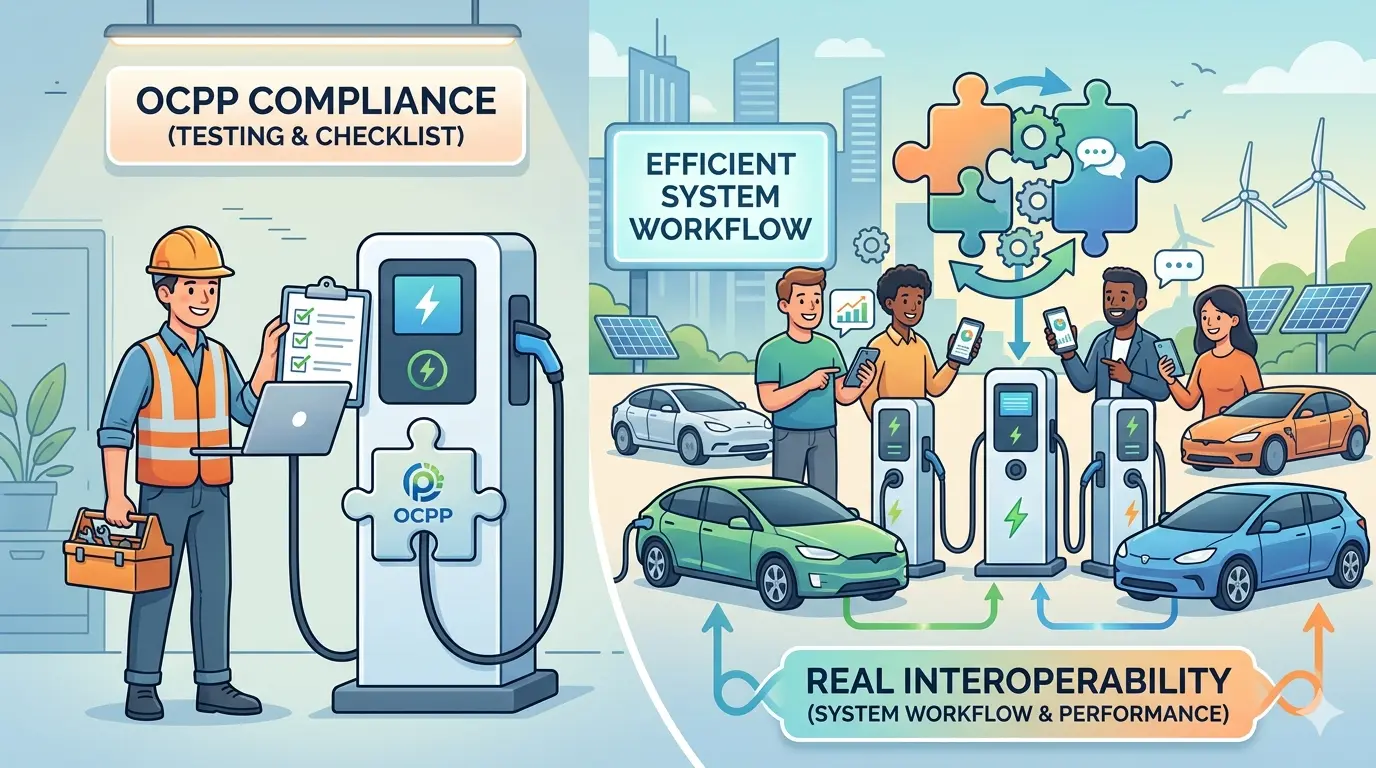
The procurement problem often starts with a reassuring phrase in a proposal: “OCPP compliant.” On paper, that sounds like the interoperability risk has already been solved. In practice, commercial buyers usually discover the difference much later, when a charger connects to the selected backend but fails on tariff logic, remote reset behavior, session recovery, or smart charging commands.
That gap matters because EV charging operations are not judged by protocol support alone. They are judged by whether drivers can start sessions reliably, whether operators can see accurate data, whether billing reconciles, and whether the site can scale without costly rework.
For commercial buyers, OCPP compliance is still important. It is the baseline. But it is not the same thing as real interoperability. The safer buying question is not “Does this charger support OCPP?” It is “Has this exact charger, on this firmware, with this backend and this operating model, been tested under real site conditions?”
What OCPP Compliance Actually Confirms
At a basic level, OCPP compliance means a charger and a central system can exchange messages using the Open Charge Point Protocol. That is the right starting point, and PandaExo’s overview of what the OCPP protocol means for commercial stations explains why buyers should still require it.
But compliance usually confirms protocol alignment, not total operating alignment. It does not automatically prove that every optional feature is implemented the same way, that the backend interprets all charger messages correctly, or that edge cases will behave cleanly in the field.
This becomes more important as buyers move beyond basic session control. OCPP 1.6J may cover many common deployment needs, while OCPP 2.0.1 is designed to support richer device management, security, transaction handling, and smart charging logic. Even so, two systems can both claim support for the same version and still behave differently when real authorization workflows, load controls, or recovery events are introduced.
In other words, compliance tells you the two sides speak the same language. Interoperability proves they can actually work together under operational pressure.
Where Real Interoperability Breaks Down
Most field failures do not come from total protocol incompatibility. They come from mismatches in implementation detail, operating assumptions, or change control.
| Area | A Compliance Claim May Suggest | What Buyers Still Need to Prove |
|---|---|---|
| Charger-to-backend connection | The charger can register and communicate | The charger stays stable under real network conditions and reconnects cleanly after outages |
| Authorization | RFID, app, or remote start is supported | Each access path works consistently across user types, connector states, and failed-session scenarios |
| Smart charging | Load or power control commands are supported | Setpoints arrive correctly, are enforced at the charger, and recover safely after communication loss |
| Metering and billing | Energy data is available | Meter values, timestamps, transaction boundaries, and pricing events reconcile correctly in the billing workflow |
| Remote operations | Operators can restart, unlock, or stop sessions remotely | Commands succeed consistently and do not leave connectors or transactions in ambiguous states |
| Fault handling | The charger reports alarms and statuses | Faults are classified clearly, escalated correctly, and recover without repeated truck rolls |
| Firmware and configuration | The charger can be updated remotely | Updates do not break backend behavior, local settings, or previously validated workflows |
| Future migration | The charger uses an open protocol | Data export, configuration handover, and network changes are commercially manageable |
Several failure patterns show up repeatedly in commercial deployments:
- Optional functions are supported differently across charger and backend vendors.
- Meter values arrive, but not at the intervals or formats needed for accurate billing or reporting.
- Remote commands technically work, but not fast enough or consistently enough for live operations.
- Offline behavior, local authorization caching, or session recovery does not match site policy.
- Multi-connector behavior causes unexpected conflicts in transaction handling.
- A firmware update changes behavior that was previously stable.
None of those issues are theoretical. They directly affect uptime, customer experience, site economics, and support cost.
Why Buyers Should Treat Interoperability as a Commercial Risk
When interoperability gaps surface after commissioning, the cost is rarely limited to a technical support ticket.
First, uptime suffers. A charger that is visible in the dashboard but unreliable in the field still creates driver frustration, operator escalation, and avoidable site visits.
Second, revenue quality suffers. If sessions start but billing logic, meter reconciliation, or transaction closeout is inconsistent, the site host may see underbilling, dispute exposure, or manual cleanup work.
Third, rollout speed suffers. Multi-site owners and fleet operators need repeatable deployment logic. If each new site requires backend workarounds or special firmware coordination, scaling becomes slow and expensive.
Fourth, supplier flexibility suffers. Buyers planning larger charging programs should understand broader open charging network interoperability trends because interoperability is not only about the charger and the CSMS today. It also affects roaming, future integrations, portfolio expansion, and the cost of changing platforms later.
For that reason, interoperability should be evaluated like any other commercial risk: with test cases, evidence, ownership, and acceptance criteria.
What Commercial Buyers Should Test Before Issuing a Full Purchase Order
The most useful test is not a generic compliance statement. It is a structured witness test or pilot using the intended hardware, intended firmware, intended backend, and intended operating workflows.
| Test Area | What Buyers Should Simulate | What a Pass Condition Looks Like | Why It Matters |
|---|---|---|---|
| Initial commissioning | Register the charger on the target backend from a clean install | Charger commissions without manual workaround logic | Confirms the deployment team can repeat the process at scale |
| Authorization workflows | Test RFID, app-based access, remote start, and blocked-user scenarios | Session start and stop behavior is predictable across all approved user paths | Prevents access-control surprises after launch |
| Communication loss and recovery | Interrupt connectivity during idle and active sessions | Charger reconnects, reports status correctly, and does not corrupt transaction state | Protects uptime under real network conditions |
| Smart charging commands | Apply power limits, schedules, and dynamic setpoint changes | Charger follows commands accurately and safely reverts when commands are removed | Critical for constrained sites and portfolio load management |
| Metering and tariff logic | Compare charger data against backend session records and billing events | Energy, time, and transaction records reconcile to the expected commercial logic | Reduces billing disputes and reporting noise |
| Remote operations | Test reboot, unlock, stop transaction, and configuration changes | Commands execute reliably without leaving the port in a faulted or unknown state | Determines whether remote operations will reduce field service cost |
| Fault handling | Trigger realistic fault states such as plug errors, emergency stop events, or thermal alarms | Faults are visible, clearly classified, and recoverable through defined workflows | Helps buyers judge support burden and escalation quality |
| Firmware updates | Update the charger in the intended management environment | Functionality remains stable before and after update, with rollback path documented | Protects long-term stability after deployment |
| Data export and migration readiness | Request transaction, configuration, and asset data in a usable format | The operator can retrieve usable records without vendor friction | Reduces future switching and handover risk |
This is also why firmware governance deserves special attention. Buyers should not assume that a charger validated once will remain operationally stable forever. PandaExo’s guide to EV charger firmware update strategy is relevant here because backend compatibility can change quietly when firmware releases are not controlled carefully.
What Buyers Should Ask Vendors to Provide
A credible vendor should be able to provide more than a protocol badge. Commercial buyers should ask for evidence that reduces ambiguity before rollout.
- The exact OCPP version supported on the quoted hardware and firmware
- A feature matrix showing which relevant functions are implemented, enabled, or optional
- The firmware version used in any claimed interoperability testing
- The name of the backend or CSMS environments already tested with that hardware line
- Clear behavior notes for offline operation, transaction recovery, metering intervals, and remote commands
- The update process, rollback path, and change-control ownership after commissioning
- Escalation responsibility when charger vendor and backend vendor disagree about root cause
If the buyer is comparing more than one backend, the same test script should be run against each target environment. That is the only way to distinguish a generally capable charger from a charger-backend combination that is operationally ready for the buyer’s actual business model.
When a Light Test Is Enough and When a Full Interoperability Program Is Needed
Not every commercial project needs the same testing depth. The right test scope depends on site complexity, user volume, billing model, and expansion plans.
| Buyer Scenario | Minimum Test Depth |
|---|---|
| Small private workplace with simple employee access and limited reporting needs | Basic commissioning, authorization, connectivity recovery, and remote restart testing |
| Semi-public commercial site with paid access | Add metering validation, tariff logic, and exception handling tests |
| Fleet depot with managed charging or dispatch-sensitive operations | Add smart charging, communication loss under load, scheduling, and fault recovery testing |
| Multi-site portfolio with central operations | Add repeatability checks, firmware governance, reporting consistency, and migration-readiness review |
| CPO or channel partner planning long-term growth | Run a formal interoperability matrix across charger models, firmware versions, and backend environments |
The higher the operational complexity, the less useful a generic compliance statement becomes.
Do Not Ignore Data Handover and Platform Exit Risk
Many buyers focus heavily on session start success and overlook the exit problem. That is a mistake.
If a platform migration becomes necessary later, the buyer may need charger inventory data, configuration records, transaction history, pricing records, maintenance logs, and user-related operating data in structured form. If those records are difficult to retrieve, a nominally open deployment can still behave like a commercial lock-in.
That is why PandaExo’s EV charger data handover checklist is useful for procurement teams as well as operators. The right time to understand handover risk is before contracts are signed, not after a network transition becomes urgent.
What This Means for PandaExo and Other Commercial Suppliers
From a buyer perspective, the strongest suppliers are usually the ones that treat interoperability as a deployment discipline rather than a marketing claim. That means aligning hardware, firmware, backend assumptions, and site workflows early in the sales and pilot process.
This is also where a broader EV charger portfolio becomes commercially useful. Buyers rarely operate a single site type forever. A charging program may start with lower-power workplace or multifamily AC charging, then expand into higher-throughput commercial or fleet scenarios. Interoperability testing has to hold across those operating realities, not just inside a narrow demo environment.
For PandaExo specifically, the practical relevance is clear: AC and DC hardware choices, firmware behavior, platform visibility, and OEM or ODM adaptation all have to support the buyer’s real operating model. That is the conversation serious buyers should want from any supplier.
Practical Summary
OCPP compliance still matters. Buyers should require it because open protocol support is better than a closed operating model. But compliance alone does not prove that a commercial site will run smoothly, bill correctly, recover cleanly, or scale predictably.
Real interoperability is the result of testing the exact charger, exact firmware, exact backend, and exact operating workflow that the business plans to deploy. That includes authorization, metering, remote commands, smart charging, fault recovery, firmware governance, and data handover.
Commercial buyers do not need to reject OCPP claims. They need to go one step further and validate operational behavior before full rollout. The most effective procurement teams treat protocol compliance as the entry requirement and interoperability testing as the real acceptance standard.