
 Deutsch
  Español
  Français
  Italiano
  Português
  Svenska
  Suomi
Suomi  Dansk
Dansk  Norsk bokmål
  Nederlands
  العربية
  עברית
עברית  Polski
  Türkçe
  Русский
  Uzbek
Uzbek  Azərbaycan
  Tiếng Việt
  ไทย
ไทย  한국어
한국어  日本語
日本語  简体中文
简体中文 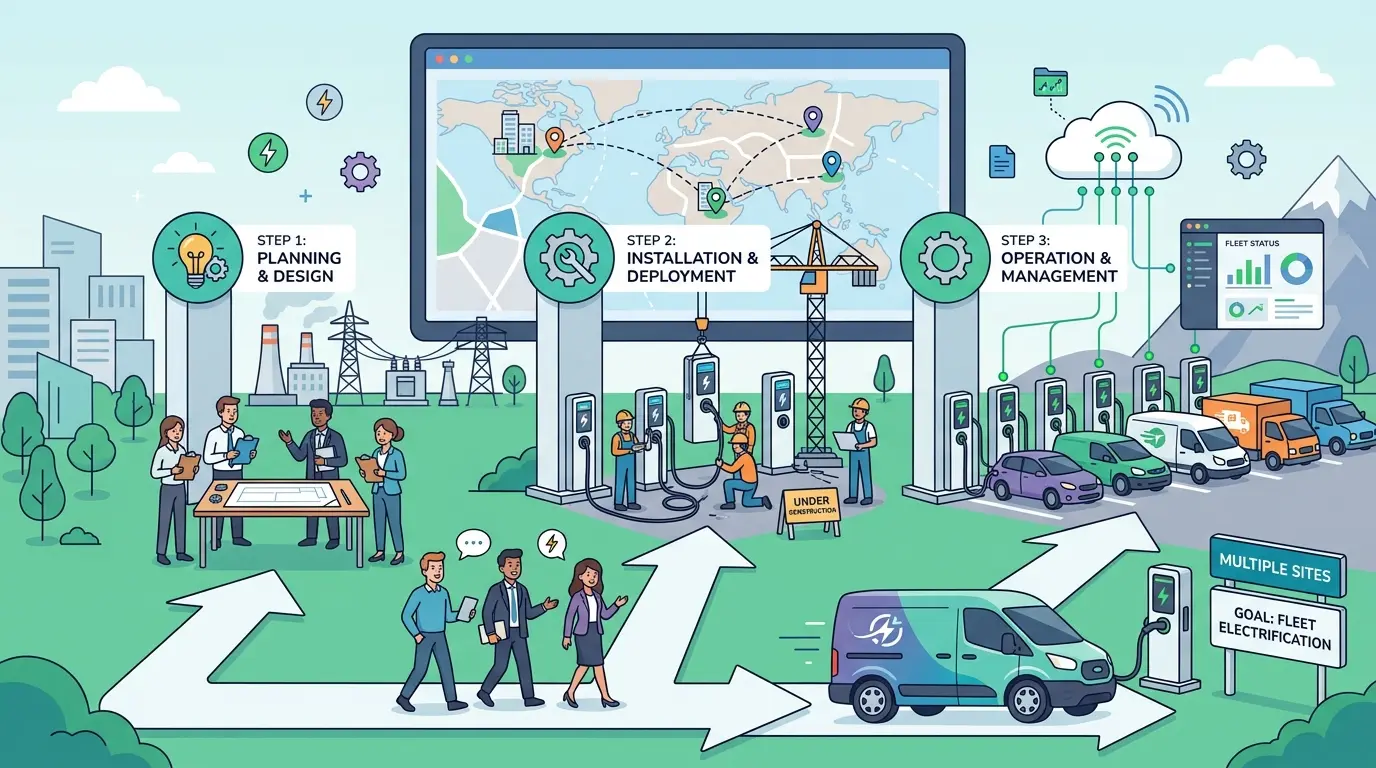
The hardest part of a multi-site fleet charging rollout is usually not choosing between AC and DC hardware. It is building a plan that keeps site decisions aligned while local conditions keep changing.
One depot may have predictable overnight dwell, strong utility capacity, and room for expansion. Another site may be space-constrained, leased, and operationally important but difficult to upgrade. A third may look ideal on paper but fail the moment demand charges, transformer lead times, or parking circulation are added to the model.
That is why a serious rollout plan has to do more than define charger quantities. It needs to prioritize sites, standardize the parts of the program that should stay common, and leave enough flexibility for each location to fit its own operating reality. When that work is done well, fleets can expand charging access without creating avoidable procurement risk, stranded capacity, or inconsistent site performance.
Start With the Operating Model, Not the Hardware
Before comparing charger power classes, define what the rollout is supposed to do for the fleet business. A national or regional rollout can support very different operating models: overnight depot charging, branch-based service fleets, employee charging at office locations, mixed fleet and visitor access, or a combination of all four.
That operating model affects every downstream decision, including site priority, charger mix, authentication rules, software requirements, and budget ownership. A site that protects morning dispatch for route-critical vehicles should not be evaluated by the same logic as an office car park designed for low-intensity daytime charging.
At the portfolio level, the first questions should be simple:
- Which sites protect the most important vehicle movements?
- Which locations have the most predictable dwell windows?
- Which sites are utility-ready, and which will need a longer pre-construction runway?
- Where does charging support core fleet operations, and where is it mainly an employee amenity or future-readiness investment?
If those answers are unclear, the rollout can turn into a hardware shopping exercise instead of an operations program.
Segment Sites by Operational Pressure and Readiness
Multi-site rollouts become easier when sites are grouped by function rather than treated as a flat list of addresses. The goal is to match infrastructure intensity to operational pressure and site readiness.
| Site Type | Typical Fleet Behavior | Main Planning Constraint | Rollout Priority Logic | Likely Charging Mix |
|---|---|---|---|---|
| Main depot | High vehicle concentration, overnight return, structured dispatch | Utility capacity, circulation, phased expansion | Usually first-wave if it supports critical fleet uptime | Mostly AC with selective DC |
| Satellite branch | Smaller fleet count, less consistent utilization | Limited space, uneven dwell, local utility differences | Good early target if demand is stable and upgrades are manageable | AC-first |
| Field-service hub | Vehicles may return at staggered times and need rapid redeployment | Turnaround pressure, parking turnover | High priority when missed charging windows affect service delivery | AC plus targeted DC |
| Office or admin site | Long daytime dwell, lower route sensitivity | Budget ownership, policy, future adoption uncertainty | Often second-wave unless employee charging is a strategic objective | AC smart charging |
| Leased or temporary site | Short investment horizon | Civil works risk, landlord constraints | Lower priority unless operational need is urgent | Modular or limited deployment |
This is also the point where a site should pass a basic readiness review before it enters procurement. The same pre-buy questions covered in a commercial EV charging project checklist are even more important in a multi-site program, because design mistakes repeat quickly when a portfolio template is copied without local validation.
Many fleet operators use a practical scoring model across five variables: daily energy demand, departure criticality, utility readiness, construction complexity, and expansion potential. That creates a much better rollout sequence than simply starting with the most visible site.
Standardize the Portfolio, Not Every Site
One of the most common rollout mistakes is assuming consistency means identical hardware everywhere. In practice, a multi-site program works better when the operating architecture is standardized but the site solution is still allowed to adapt.
| Keep Common Across Sites | Allow to Vary by Site |
|---|---|
| Connector policy and vehicle compatibility rules | Charger power mix |
| User authentication and access logic | Mounting format and physical layout |
| Data fields, reporting structure, and KPI definitions | Number of active chargers in phase one |
| Incident escalation, firmware governance, and maintenance rules | Civil design based on parking flow |
| Software environment and dashboard visibility | Whether a site needs DC contingency |
That balance matters because portfolio consistency is what gives a fleet team clean reporting, simpler training, and easier governance. Site-level flexibility is what prevents overspending on chargers, switchgear, and civil works that do not match how vehicles actually use the location.
In other words, standardize the decision framework, the data model, and the operating rules. Do not standardize away the local site reality.
Match AC and DC to Dwell Time and Service Risk
For most multi-site fleet programs, AC charging should be the default answer anywhere vehicles have dependable dwell windows. Overnight depots, branch parking, office locations, and service fleets with long return windows can usually replenish daily energy demand effectively without carrying the cost and infrastructure burden of high-power charging at every site.
That does not mean DC fast charging is unnecessary. It means it should solve a specific operational problem. If a subset of vehicles must recover energy between shifts, return to service quickly, or protect time-sensitive dispatch, then targeted DC becomes valuable. If those conditions are rare, blanket DC deployment across the portfolio often creates more grid strain, more procurement cost, and more underused power capacity than the fleet really needs.
| Planning Question | AC Smart Charging Is Usually Better When | DC Fast Charging Is Usually Better When |
|---|---|---|
| How long can vehicles stay parked? | Several hours or overnight | Short turnaround windows |
| What is the charging objective? | Daily replenishment | Fast operational recovery |
| How sensitive is the site to installation complexity? | High sensitivity | Throughput pressure justifies more complexity |
| How often do route-critical vehicles need immediate charging? | Rarely | Regularly |
| How easy is future expansion? | Site can scale gradually | Site must protect high utilization from day one |
When a site genuinely has short dwell and service-critical turnaround pressure, DC charging can help operators reduce dwell time and keep higher-value vehicles moving. The key is to reserve that higher-power approach for the sites and vehicle groups that clearly earn it.
Model Power, Utility, and Civil Work at the Portfolio Level
Single-site planning often hides problems that become obvious only when multiple locations move into design at the same time. Utility lead times, transformer availability, demand-charge exposure, trenching scope, and switchgear capacity can all become portfolio bottlenecks, not just site issues.
That is why grid planning should be treated as a rollout workstream, not a late-stage design check. The same utility-side questions covered in PandaExo’s guidance on grid capacity, interconnection, and demand charges should be applied across the entire site list early, so the fleet team can identify which locations are easy wins, which require longer utility coordination, and which should be deferred until the economics improve.
It also helps to separate site preparation from hardware activation. Conduit runs, trenching, spare cabinet space, and future parking layout can be designed once, while charger activation is phased according to demand. That approach reduces rework and gives the fleet room to expand without locking all capital into day-one equipment.
Build the Rollout in Waves With Clear Triggers
The best multi-site charging plans do not treat expansion as a one-time procurement event. They define a phased rollout with clear triggers for when each site moves from preparation to activation to expansion.
This is where portfolio governance becomes more valuable than simple forecasting. A fleet can learn a great deal from the first few sites about arrival patterns, queuing behavior, charging utilization, software settings, and maintenance workload. The same logic that supports portfolio-wide EV charging planning for property operators also applies to fleet managers: growth should follow observed demand and operational evidence, not just headline EV adoption targets.
Typical rollout waves look like this:
- Wave one: prioritize the sites with the strongest combination of operational need, utility readiness, and predictable dwell behavior.
- Wave two: expand to secondary sites using lessons from commissioning, utilization, and dispatch data from the first wave.
- Wave three: add higher-power assets, extra connectors, or broader access rules only where measurable demand justifies them.
Useful expansion triggers include vehicle count growth, repeated charging congestion, new route structures, electrification of heavier-duty vehicles, or a sustained utilization threshold that shows the original build is no longer enough.
Put Software, Governance, and Interoperability in Place From Site One
Multi-site charging does not stay manageable for long if every location behaves like its own isolated project. Portfolio visibility, charging policy enforcement, remote support, alert handling, and reporting discipline should be designed into the rollout from the first live site.
That usually means choosing a software and communications model that can support site-level control and cross-site reporting at the same time. Open architecture matters here, especially when future flexibility, roaming, third-party integrations, or mixed hardware environments may matter later. PandaExo’s explainer on open charging networks is relevant because protocol and interoperability decisions made early can either simplify or complicate future expansion.
From an operating standpoint, the software layer should support at least these functions:
- Load management and charging prioritization by departure time or vehicle class
- Network visibility across every active site
- Fault alerting and maintenance escalation workflows
- User access control for fleet, employee, contractor, or mixed access scenarios
- Consistent reporting on utilization, energy delivery, and incident trends
Without those controls, a multi-site rollout can look standardized on paper while becoming difficult to govern in practice.
Build Procurement Around Scale, Optionality, and Support Depth
At portfolio scale, supplier selection becomes more than a unit-price comparison. Buyers need to know whether a supplier can support multiple charger classes, repeatable commissioning, spare-parts planning, software visibility, and future adaptation as the fleet mix changes.
This is where PandaExo’s positioning is relevant in a practical way. A fleet program that spans different site types benefits from access to both AC and DC charging hardware, smart energy management capabilities, and the option to align product selection with different deployment scenarios under one supplier framework. PandaExo also presents manufacturing scale, semiconductor heritage, and OEM or ODM flexibility as part of that value proposition, which can matter for distributors, channel partners, or operators who need portfolio consistency without giving up site-level fit.
The right procurement outcome is not simply a low initial equipment price. It is a charging architecture that is easier to scale, easier to service, and less likely to force an avoidable redesign when the fleet grows or site conditions shift.
Practical Summary
An effective multi-site EV fleet charging rollout plan should do six things well:
- Rank sites by operational importance and real readiness, not by visibility alone.
- Standardize data, software, and operating rules while allowing the charger mix to vary by site.
- Use AC wherever dwell time makes it practical, and add DC where turnaround pressure clearly justifies it.
- Model utility, civil, and demand-charge constraints across the full portfolio early.
- Phase site activation in waves with measurable expansion triggers.
- Choose suppliers and platforms that reduce long-term scaling friction rather than only lowering short-term purchase cost.
The fleets that scale charging successfully across multiple sites are usually the ones that stay disciplined about rollout logic. They do not assume every site should look the same. They build a common operating model, adapt it to local site conditions, and expand only where data supports the next step. That is what turns a collection of charger installs into a workable charging network for a growing fleet.