
 Deutsch
  Español
  Français
  Italiano
  Português
  Svenska
  Suomi
Suomi  Dansk
Dansk  Norsk bokmål
  Nederlands
  العربية
  עברית
עברית  Polski
  Türkçe
  Русский
  Uzbek
Uzbek  Azərbaycan
  Tiếng Việt
  ไทย
ไทย  한국어
한국어  日本語
日本語  简体中文
简体中文 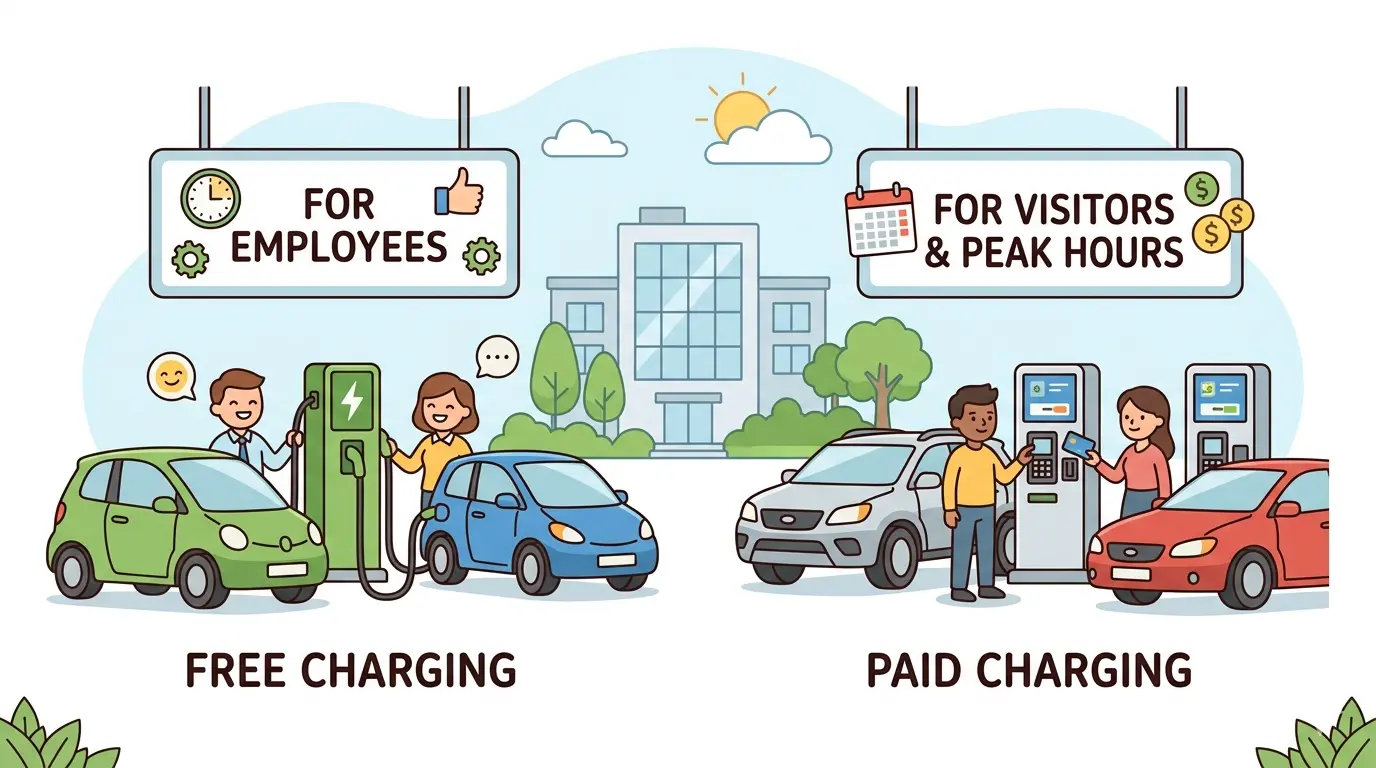
A workplace can offer free EV charging when eight employees use four chargers. The same policy can become difficult when 30 drivers expect access, parking stays full all day, and facilities teams are asked to expand capacity without clear usage data. That is why the real policy question is not just whether charging should be free. It is what behavior the site needs to support.
For most employers, workplace charging is not simply an amenity. It becomes part of parking operations, energy management, employee experience, and long-term facility planning. The right policy should match utilization, power availability, administrative capacity, and the role charging is expected to play inside the organization.
Why Charging Policy Matters Before Utilization Climbs
Many sites install chargers first and define the rules later. That usually works when only a small group of employees drives EVs. It starts to fail when demand grows faster than expected.
Without a clear policy, common problems appear quickly:
- The same vehicles occupy charging spaces all day, even after charging is complete.
- Employees treat charging as an entitlement rather than a shared workplace resource.
- Facilities teams cannot explain why some users get access while others do not.
- Energy costs rise, but there is no reporting framework to understand usage patterns.
- Expansion decisions are made without good data on dwell time, session length, or queue pressure.
This is one reason workplace charging should be treated as an operational system, not just a perk. In most office environments, long parking duration makes AC charging the natural starting point, especially for employers evaluating AC charging solutions for daily employee use rather than rapid public turnover.
What Free Charging Actually Delivers
Free workplace charging can be a sound decision when the employer’s main goal is employee benefit, early EV adoption, or sustainability signaling. It removes friction, simplifies the user experience, and can help organizations move quickly without building a billing workflow before they understand real demand.
Free charging tends to work best when:
- EV adoption inside the company is still relatively low.
- The charging budget is modest compared with overall facilities or employee-benefit spending.
- The site has adequate electrical capacity for the initial phase.
- Leadership wants charging to function as a visible retention or recruitment benefit.
- Administrative simplicity matters more than cost recovery.
There are also cultural advantages. Free charging is easy to communicate internally. It can support ESG messaging and reinforce the idea that the company wants to reduce commuting emissions. For organizations still building the business case, it can also help establish baseline demand before more formal controls are introduced. PandaExo’s own overview of the benefits of providing EV chargers for employees at the workplace reflects why many employers start here.
But free charging is not automatically the most employee-friendly model over time. If no guardrails exist, free access often rewards the earliest arrivals and the drivers with the most schedule flexibility, not the employees with the greatest charging need. What starts as a benefit can turn into a fairness problem.
Where Free Charging Starts to Break Down
The main weakness of free charging is that it does very little to shape behavior. When users pay nothing, they have limited incentive to unplug promptly, rotate spaces, or think carefully about whether they need a charge that day.
The most common failure points are:
- Overstaying after the vehicle is sufficiently charged
- Uneven access across teams, shifts, or office locations
- Electricity and maintenance costs that expand faster than charger availability
- Friction between EV drivers and non-EV drivers over parking allocation
- Pressure to add more chargers before the site has optimized use of existing ones
This problem becomes more pronounced when the site mixes employee charging with visitor use, pool vehicles, or company fleets. At that point, a purely free policy can obscure which sessions are mission-critical and which are simply convenient.
What Paid Access Solves
Paid access introduces discipline. It gives employers a way to recover electricity costs, support software subscriptions, budget for maintenance, and reduce unnecessary charging sessions. More importantly, it turns the charging network into a measurable operating asset rather than an untracked expense line.
Paid workplace charging is often a better fit when:
- Utilization is already high or expected to rise quickly.
- The employer wants the charging program to scale across multiple sites.
- Visitors, contractors, or mixed user groups share the same infrastructure.
- Facilities teams need usage data tied to cost centers, user groups, or operational rules.
- Leadership wants fairer access without relying on manual enforcement.
Payment does not need to mean profit-taking. Many employers simply charge at or near cost. That may include electricity, network management, and a portion of maintenance overhead. The goal is often not revenue generation. It is behavior management and program sustainability.
To make that work, access control and session management need to be straightforward. If billing is confusing, reimbursement is unclear, or payment setup takes too many steps, employees will see the system as punitive rather than practical. That is why semi-public environments often rely on structured tools such as RFID credentials, app authorization, and clear tariff logic, similar to the workflow described in how RFID and app billing work in semi-public AC charging stations.
Free Vs. Paid Access: A Decision Table
| Policy model | Best fit | Main strength | Main weakness |
|---|---|---|---|
| Free charging | Early-stage workplace rollout with low EV penetration | Maximum simplicity and strong employee goodwill | Weak control over turnover and cost growth |
| Paid at cost | Mature employee program with growing utilization | Fairer allocation and sustainable operating model | Requires billing setup and user communication |
| Paid above cost | Sites treating charging as a revenue line | Strong cost recovery and behavior control | Can depress adoption and weaken employee-benefit value |
| Hybrid model | Most medium-to-large workplace programs | Balances benefit, fairness, and scale | Needs clear rules and software support |
For many employers, the hybrid model becomes the most practical destination even if the initial rollout starts free.
The Questions That Should Decide the Policy
Instead of asking whether charging should be free or paid in principle, employers get better outcomes by answering five operational questions.
First, what is the real dwell pattern? If most employees park for six to nine hours, AC charging is usually the right foundation. The policy question is then about rotation and fairness, not rapid fueling. If the site serves field teams, pooled vehicles, or short-stay commercial traffic, some DC charging may deserve consideration, but that is a different operating model entirely.
Second, how constrained is site power? If the electrical system can easily support growth, the company has more room to subsidize employee charging. If power capacity is tight, charging policy needs to work hand in hand with energy management, load scheduling, and site planning. This becomes especially relevant for employers comparing charger sizing, circuit allocation, and daily throughput in installations such as 11kW AC pedestal deployments for corporate parking lots.
Third, what is the organization’s objective? Some employers want charging to function like free coffee: a visible but limited employee perk. Others want it to become a durable workplace infrastructure program that can scale without constant budget exceptions. Those are different goals and should not be managed with the same policy.
Fourth, who must be prioritized? A site serving only office staff may accept a simpler benefit-driven model. A site shared by executives, shift workers, visitors, service vehicles, and future fleet assets needs policy tiers, not open-ended access.
Fifth, what does expansion look like? If leadership expects more EV drivers next year, the policy should be designed for the future state rather than the current pilot stage. A charger network that begins with four ports can become a portfolio decision much faster than many facilities teams expect.
Why Workplace Charging Usually Starts With AC Infrastructure
Most employers do not need workplace charging to behave like a highway corridor or a retail fast-charging site. Employees typically remain parked for long periods, which makes AC charging a strong match for lower installation complexity, manageable capital cost, and predictable daily energy delivery.
That does not mean all AC deployments are identical. Power level still matters. The right balance depends on vehicle mix, arrival windows, available capacity, and whether the site prioritizes broad access or faster turnover. Employers comparing commercial workplace options often benefit from reviewing the tradeoffs in 7kW vs. 22kW AC commercial chargers, because hardware choice and policy design are tightly linked.
DC fast charging can still have a place in workplace environments, but usually only when vehicles must return to service quickly or when the site serves a blended role beyond employee parking. For example, depot operations, service fleets, logistics hubs, and mixed-use business parks may need faster recovery windows than a standard office campus.
For employers that expect charging needs to evolve over time, a supplier with a broad charger portfolio and network visibility can reduce rework later. PandaExo is designed to support that kind of staged growth through AC and DC hardware options alongside software-oriented operational control.
Why Hybrid Policy Design Often Wins
The sharpest free-versus-paid debates usually disappear once companies model actual usage. A hybrid approach often delivers the best balance between employee benefit and operational discipline.
Common hybrid structures include:
- Free charging for a capped number of hours per day, then a paid rate afterward
- Free charging during working hours for employees, with paid access for visitors or contractors
- Subsidized charging at a below-market rate rather than fully free electricity
- Priority charging for fleet or operational vehicles, with employee charging priced separately
- Idle fees after charging is complete to improve turnover without making energy itself expensive
This approach works because it separates two questions that employers often combine by mistake: who should have access, and what behavior should the policy encourage? A well-designed hybrid model can keep charging attractive while still protecting charger availability, parking turnover, and facilities budgets.
A Practical Rollout Framework for Employers
A strong workplace charging policy does not need to be complex, but it does need to be explicit. A practical rollout sequence looks like this:
- Define the primary objective: employee perk, sustainability support, fleet readiness, or scalable site infrastructure.
- Estimate realistic demand by user group rather than assuming every EV driver needs a daily full session.
- Match charger type and power level to dwell time, parking behavior, and site capacity.
- Choose a policy model: free, cost-recovery paid, or hybrid.
- Set access rules around user groups, time limits, session caps, and enforcement.
- Communicate the policy in operational language so employees know what is fair, what is available, and what changes as utilization grows.
- Review usage data after the first 60 to 90 days and adjust before the next expansion phase.
At larger sites, utility coordination, demand charges, and capacity planning also need to be considered early. Charging policy cannot solve infrastructure bottlenecks on its own. It works best when combined with sound electrical planning, especially for organizations evaluating future load growth and tariff exposure through frameworks such as utility planning for commercial EV charging projects.
The Practical Bottom Line
Free workplace charging is most effective when the program is still small, the employer clearly wants to offer a visible benefit, and utilization is low enough that simple access rules are sufficient. Paid access becomes more attractive when fairness, cost recovery, scaling, and mixed-user management start to matter.
In many real deployments, the best answer is neither fully free nor fully commercial. It is a managed hybrid policy that aligns charger type, user priority, and cost structure with how the site actually operates.
Employers that treat workplace charging as long-term infrastructure rather than a one-time amenity usually make better policy decisions. The most effective model is the one that keeps adoption moving, protects access, fits site power realities, and still works when the number of EV drivers doubles.