
 Deutsch
  Español
  Français
  Italiano
  Português
  Svenska
  Suomi
Suomi  Dansk
Dansk  Norsk bokmål
  Nederlands
  العربية
  עברית
עברית  Polski
  Türkçe
  Русский
  Uzbek
Uzbek  Azərbaycan
  Tiếng Việt
  ไทย
ไทย  한국어
한국어  日本語
日本語  简体中文
简体中文 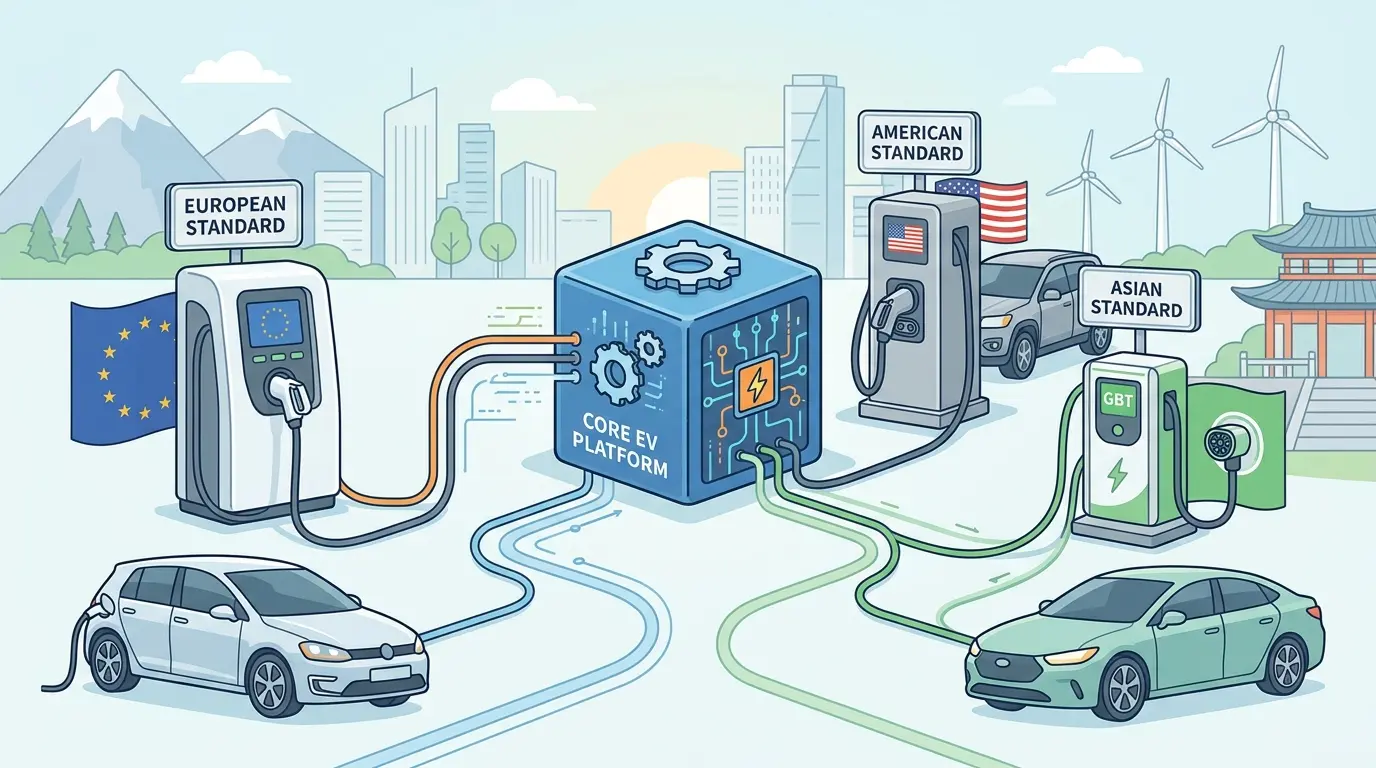
Regional expansion usually looks straightforward on paper. One market asks for Type 2 connectors, another needs J1772. One distributor wants wallboxes for commercial parking, another wants higher-power DC units for fleet turnover. A local team requests new branding, a utility partner asks for a different reporting format, and a compliance team flags another certification path.
None of those requests is unreasonable by itself. The problem starts when each regional requirement becomes a separate product logic, separate firmware branch, separate support process, or separate dashboard rule set. That is how EV charger suppliers and charging-network planners end up with a portfolio that looks broad in the market but becomes expensive to maintain, slow to update, and difficult to scale.
The stronger approach is to treat regionalization as a controlled architecture decision. A regional product strategy should adapt the market-facing layer without breaking the engineering, software, and operational backbone that makes the platform scalable.
Regional Strategy Should Solve Market Fit, Not Create Product Sprawl
An EV charger product strategy is not truly regional just because it offers different housings, labels, or connector combinations. It becomes regional when it reflects the realities of how each market buys, installs, regulates, and operates charging infrastructure.
That means the product strategy may need to account for connector expectations, electrical standards, enclosure requirements, software localization, utility coordination, channel structure, warranty expectations, and the commercial split between AC and DC deployments. PandaExo’s overview of IEC 62196 Type 2 vs. SAE J1772 is a good example of why regional fit is not cosmetic. Interface standards shape procurement, compatibility, and channel acceptance from the start.
But regional fit does not require a separate platform for every geography. In most cases, it requires disciplined variation inside a shared core.
What Actually Changes From Region to Region
Many EV charging teams overreact to local market differences because they fail to separate structural requirements from configurable ones.
| Regional Pressure | What It Really Affects | Common Mistake | Better Response |
|---|---|---|---|
| Connector standards | Output interface and cable configuration | Treating each connector family as a separate platform | Design connector variation inside a common hardware and software architecture |
| Grid conditions and site economics | Power mix, load strategy, and charger class | Rebuilding the full product line around each market | Keep common controllers and data models while adjusting power-class mix |
| Certification and regulatory pathways | Compliance documentation, testing, and approved bill of materials | Creating engineering forks too early | Govern approved regional variants with controlled validation |
| Channel requirements | Branding, packaging, documentation, and service structure | Confusing white-label needs with full product redesign | Use OEM and ODM layers that sit above a stable product backbone |
| Language and billing expectations | UX, payment flows, and platform configuration | Splitting software environments by market | Localize workflows and interfaces inside one platform governance model |
| Climate and installation context | Enclosure, thermal strategy, cable management, and mounting format | Launching disconnected hardware families | Standardize shared modules and adapt the site-facing package |
This distinction matters because not every regional difference deserves a new engineering branch. Some changes belong in product packaging, some in certification control, some in deployment policy, and only a few in the core platform itself.
The Core Platform Has to Stay More Stable Than the Market Layer
If a company wants to scale across regions without losing control, the platform core should remain far more standardized than the regional offer.
In practice, that core usually includes the software architecture, telemetry model, remote diagnostics logic, firmware governance, cybersecurity policy, spare-parts strategy, and service workflows. Those are the layers that protect uptime, support efficiency, and long-term upgradeability.
This is also where interoperability discipline matters. If regional expansion leads to incompatible software stacks, proprietary workflows, or inconsistent protocol handling, the platform will eventually become harder to operate than the market opportunity is worth. PandaExo’s guide to open charging networks is relevant here because protocol choices determine whether regional growth stays manageable or becomes a patchwork of exceptions.
Regional freedom should sit on top of that common spine, not replace it.
Build Around a Reference Architecture, Not Around Individual Country Requests
The easiest way to fragment a charger platform is to let country-level requests arrive directly into product development. The better model is to define a reference architecture first, then decide which layers are allowed to vary.
| Platform Layer | Default Governance | Why It Should Usually Stay Common |
|---|---|---|
| Cloud platform and data model | Global | Keeps reporting, monitoring, and fleet visibility consistent |
| Firmware management and release logic | Global | Reduces update risk and support complexity |
| Core power electronics and controller philosophy | Global | Protects engineering quality and manufacturing efficiency |
| Communication protocols and cybersecurity baseline | Global | Prevents interoperability and compliance drift |
| Connector, cable, enclosure, and mounting combinations | Regional | These are often market- and site-facing requirements |
| UI language, billing workflows, and installer documentation | Regional | These need localization but not a new platform core |
| Branding, packaging, and channel presentation | Regional or partner-specific | Important for market fit, but should not rewrite the technical stack |
With that model, the business can say yes to regional needs without saying yes to uncontrolled complexity.
Use Product Families to Absorb Variation More Cleanly
A regional strategy becomes much easier to manage when the product line is organized as a family rather than a collection of unrelated SKUs.
That means building a portfolio where AC chargers, DC fast chargers, and supporting software share common design rules, operating logic, and service assumptions even when their power classes or market roles differ. A well-structured EV charger portfolio is more useful than a long product list if buyers, distributors, and operators can see how the pieces fit together.
For example, one region may prioritize workplace and multifamily AC deployment because dwell time is long and grid upgrades are costly. Another may need more emphasis on commercial corridor or fleet charging, where turnaround speed matters and DC infrastructure is better suited to the operating model. That does not require two product platforms. It requires one family architecture with a regional mix strategy.
This is one reason PandaExo’s combination of AC charging, DC fast charging, smart platform control, and OEM or ODM capability is commercially relevant. The advantage is not simply product breadth. It is the ability to map different regional needs onto a coherent supplier framework.
Separate Commercial Localization From Technical Fragmentation
Regional product strategy often fails because commercial teams and engineering teams use the same word, “customization,” to mean very different things.
In many markets, customization only needs to cover brand identity, enclosure presentation, connector selection, payment preferences, installer manuals, or route-to-market packaging. Those are legitimate OEM and ODM needs, but they should not automatically trigger unique firmware branches, one-off dashboards, or nonstandard maintenance logic.
That separation is especially important for distributors and local channel partners. They may need a market-adapted offer, but they do not benefit when the underlying platform becomes harder to support, update, or integrate. The regional strategy should help channel growth while preserving a common operational language behind the scenes.
Compliance Must Be Governed Centrally Even When Variants Are Sold Regionally
Certification is one of the fastest ways for a regional strategy to slide into product fragmentation. Different markets may require different test pathways, documentation packages, or approved component combinations, but the governance of those variants should still remain centralized.
That means keeping a controlled matrix of approved regional configurations instead of letting every market create its own informal version of the product. PandaExo’s article on CE and TUV certification for EV chargers points to the underlying issue: compliance readiness is not just a sales checkbox. It changes procurement confidence, channel credibility, and deployment risk.
When certification governance is centralized, regional teams can move faster because they are choosing from validated options instead of improvising new ones.
Keep One Software Operating Model Across Regions Wherever Possible
Hardware variation is visible, so teams talk about it first. Software fragmentation is quieter, which is exactly why it becomes more dangerous over time.
If each region ends up with a different portal, different alert logic, different firmware approval sequence, or different KPI definitions, the company may appear locally responsive while becoming globally inefficient. Product management loses a clean roadmap. Support teams lose repeatability. Fleet and infrastructure buyers lose confidence that multi-region rollouts can be governed consistently.
The software objective should usually be one operating model with regional configuration, not one software environment per market. That includes shared monitoring logic, consistent user roles, harmonized reporting structures, and a common approach to remote diagnostics and updates.
This matters especially for enterprise and network buyers. A regionalized product offer can still be appealing, but only if the buyer does not inherit unnecessary platform management overhead.
A Useful Governance Test for Regional Feature Requests
Before approving a regional product change, leadership teams should ask five practical questions:
- Does this request change market fit, or only local preference?
- Can the need be handled through configuration, approved modules, or channel packaging instead of a new branch?
- Will this create a new firmware, service, or spare-parts burden?
- Can the change still live inside the common monitoring and data model?
- If three more regions ask for something similar, will the platform still remain governable?
If the answer to the last two questions is no, the request is probably not a local adaptation. It is the start of platform fragmentation.
How OEM and ODM Strategy Should Support Expansion
OEM and ODM capability is often essential in regional growth, especially where distributors want differentiated branding, local market positioning, or product-market alignment that fits established channel expectations.
But OEM and ODM should be treated as a structured commercialization layer, not as permission to let every market define its own technology stack. The strongest regional strategies use OEM and ODM to adapt the commercial shell while preserving the core controls that support quality, software consistency, and long-term serviceability.
That balance is what protects both sides of the business. Regional partners get a product that feels aligned to their market. The platform owner keeps engineering efficiency, clearer quality control, and a roadmap that can still scale.
Practical Summary
Regional EV charger strategy should not be built as a collection of country-specific products. It should be built as one governed platform with intentional regional expression.
In practice, that means:
- standardizing the software, data, firmware, cybersecurity, and service backbone
- allowing controlled variation in connectors, power mix, enclosures, documentation, and market-facing packaging
- organizing the portfolio as product families rather than isolated SKUs
- governing certification and approved variants centrally
- using OEM and ODM flexibility to improve market fit without breaking platform discipline
The commercial goal is not to make every region buy the same charger in the same way. It is to let each region buy a solution that fits its infrastructure reality while the supplier still operates one platform that can be supported, updated, and scaled with confidence.
That is the difference between regional growth and regional sprawl. One expands market coverage. The other quietly erodes the platform underneath it.