
 Deutsch
  Español
  Français
  Italiano
  Português
  Svenska
  Suomi
Suomi  Dansk
Dansk  Norsk bokmål
  Nederlands
  العربية
  עברית
עברית  Polski
  Türkçe
  Русский
  Uzbek
Uzbek  Azərbaycan
  Tiếng Việt
  ไทย
ไทย  한국어
한국어  日本語
日本語  简体中文
简体中文 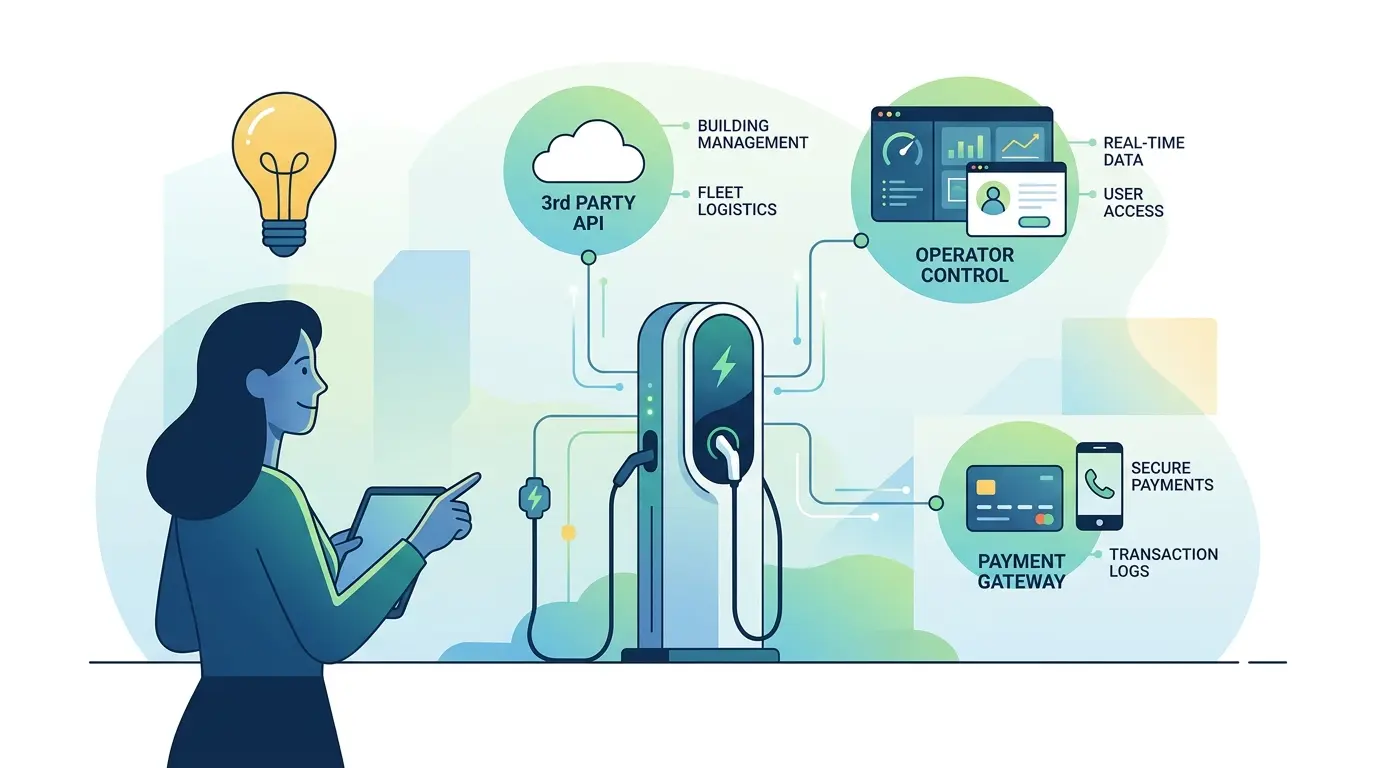
The hardware discussion is usually straightforward. A buyer can compare power classes, mounting formats, warranty terms, and site layouts with reasonable confidence. The harder problem often appears later, when the chargers need to talk to billing software, a fleet dashboard, an energy-management system, a parking platform, or an outside charging network. That is where a project that looked simple at procurement can become operationally expensive.
For commercial buyers, API access is not a technical side note. It shapes whether the site can scale cleanly, whether data can move without manual work, and whether a future platform change becomes a manageable transition or a painful rebuild.
Why Integration Questions Belong in Procurement
A commercial charging project is rarely a standalone asset. It usually sits inside a wider operating model. A fleet depot may need charger status inside dispatch workflows. A retail or hospitality site may need session data to align with customer access and payment rules. A property portfolio may want charger activity, utilization, and energy data inside one reporting environment across multiple locations.
This is why interoperability should be treated as part of infrastructure planning rather than a post-installation task. Buyers already looking at open charging networks, OCPP, OCPI, and roaming are usually asking the right first question: how open does this system remain once the site is live?
If that question is left unresolved, the business can end up with chargers that technically work but are awkward to operate. Reporting may sit in one system, billing in another, and access control in a third. Expansion then becomes less about adding chargers and more about stitching together disconnected software decisions.
Start by Defining What API Access Actually Means
Not every vendor means the same thing when it says an API is available. Some offer only basic reporting exports. Some expose read-only data but no remote control. Others support real-time event delivery, configuration changes, or user and session management.
Before procurement moves forward, buyers should ask whether the platform provides read access to charger, connector, site, and session data; write access for actions such as remote start, stop, reset, pricing changes, or access-rule updates; webhooks or push events for real-time alerts instead of only scheduled polling; historical data retrieval for sessions, faults, utilization, and energy delivery; and versioned documentation, sandbox access, and change notices for future API updates.
A vague promise of “API support” is not enough if the actual use case depends on live monitoring, automated billing, or third-party orchestration.
| API Area | What Buyers Should Ask | Why It Matters Commercially |
|---|---|---|
| Data scope | Which objects are exposed: chargers, connectors, sessions, users, tariffs, alarms, and energy data? | Determines whether internal reporting and automation are realistic |
| Control scope | Is the API read-only or can it trigger operational actions? | Affects remote operations and workflow automation |
| Data timing | Is the data real-time, near real-time, or batch export only? | Changes how useful the integration is for live operations |
| Documentation | Is there a stable developer portal and version history? | Reduces integration risk for internal teams or outside partners |
| Test environment | Is a sandbox available before production cutover? | Helps avoid outages during rollout |
| Change management | How are breaking changes communicated and handled? | Protects long-term system stability |
Ask Which Third-Party Integrations Are Already Proven
Commercial buyers should not start from the assumption that every integration must be custom-built. The practical question is which systems are already supported, which require middleware, and which fall outside the vendor’s standard operating model.
Relevant third-party integrations often include fleet management and dispatch software, payment gateways and invoicing systems, property or parking management platforms, RFID and app-based identity tools, energy-management or load-management software, service-desk platforms, and corporate BI environments.
If the vendor says an integration is possible, the next question should be whether it is already deployed in production somewhere, whether it relies on documented APIs, and who owns implementation and maintenance. “Possible” can still mean months of custom work, extra middleware, and unclear accountability.
Do Not Confuse Protocol Support With Full Business Integration
OCPP support is valuable, but it is not the same as complete platform openness. A charger can be OCPP-compatible and still leave gaps in pricing logic, user mapping, reporting, fault handling, or third-party service coordination.
That distinction matters because many operational workflows sit above the charger protocol layer. Payment reconciliation, fleet authorization, tariff rules, session exports, helpdesk tickets, and portfolio reporting all depend on software behavior, not just charger communications.
This is why buyers should look closely at the difference between charger behavior, backend platform behavior, and firmware management. PandaExo’s explainer on EV charger software vs. firmware is useful here because many integration assumptions break down when teams do not separate those layers clearly enough.
Clarify the Real Integration Boundary Before Contracts Are Signed
One of the most expensive procurement mistakes is assuming a single vendor owns the full integration chain when it actually owns only part of it.
Buyers should ask which APIs are provided by the charger vendor, and which belong to the charging management platform; who owns payment, roaming, and billing integrations; who is responsible when a third-party platform update breaks an existing workflow; who monitors failed webhook deliveries, rejected API calls, or data mismatches; and who provides technical support to the buyer’s internal IT team or outside integrator.
If those answers stay vague, the site may end up with multiple suppliers and no clear incident owner. That creates avoidable delay whenever a business-critical integration stops working.
Treat Data Ownership and Export Rights as Procurement Issues
Commercial buyers often focus on integration during deployment and only think about data access when a contract renewal, platform migration, or ownership change is already underway. That is too late.
Before signing, buyers should confirm ownership and export rights for session history, meter and energy-delivery data, charger configuration records, alarm and incident logs, tariff and pricing settings, user or token mappings, and firmware and software change history.
This is not only about compliance or analytics. It is about future control. If a buyer cannot extract operational data cleanly, changing network providers, unifying dashboards, or moving to a new software stack becomes slower and more expensive. A structured EV charger data handover checklist is a practical way to test that risk before the system becomes deeply embedded.
Review Reliability, Not Just Availability, of the API Layer
An API can exist and still be operationally weak. Commercial buyers should ask how the vendor manages uptime, latency, retries, rate limits, and incident response for the integration layer itself.
Useful questions include whether there is an SLA or service commitment for API availability, whether webhooks are retried automatically if the receiving system is temporarily unavailable, whether rate limits are transparent and workable for multi-site operations, whether production incidents and degraded performance are communicated to customers, and whether there is a release schedule and rollback path for API-related changes.
This matters most when integrations sit in revenue or operations workflows. If a failed API call can interrupt billing, fleet scheduling, or site-level load control, the integration layer is no longer a convenience feature. It becomes part of core infrastructure.
Ask How Integrations Affect Future Migration and Scaling
A buyer with one site can sometimes tolerate manual workarounds. A buyer planning ten or fifty sites usually cannot.
When the charging environment expands, integration design starts to affect almost every operating decision: how sites are onboarded, how performance is reported, how tariffs are managed, and how service teams respond to incidents. Poorly structured integrations often create fragmented dashboards, inconsistent naming, duplicated billing rules, and manual reconciliation between systems.
That is why buyers should ask what happens if the business later wants to add a new software platform, change payment or roaming partners, split one portfolio across multiple operators, centralize reporting across regions, or merge charger data into broader corporate energy reporting.
If the answer is effectively “that would require a rebuild,” the platform may be more closed than it first appears. This is the same reason network migration planning should be considered early, even if a migration is not currently planned.
Security and Permissions Should Be Practical
Commercial buyers do not need to turn procurement into a full cybersecurity audit, but they should still test whether the API model is robust enough for real business use.
At a minimum, buyers should ask about authentication methods and token management, role-based permissions for internal teams and outside partners, audit logs for remote actions and configuration changes, data segregation across sites or customer accounts, and credential rotation and offboarding workflows.
These questions become especially important in multi-site, multi-tenant, or partner-driven deployments, where different teams may need different access rights across the same charging estate.
A Practical Scorecard for Commercial Buyers
| Buyer Question | Why It Matters | Stronger Answer Looks Like |
|---|---|---|
| What data and control actions does the API expose? | Confirms whether the integration can support real operating workflows | Documented endpoints for operational data plus clearly defined control scope |
| Which third-party integrations are already production-proven? | Separates real compatibility from theoretical compatibility | Named systems, existing deployments, and clear ownership of support |
| Is there sandbox access and versioned documentation? | Reduces rollout and maintenance risk | Developer docs, test credentials, release notes, and deprecation policy |
| Who owns failures across charger, backend, and third-party systems? | Prevents blame gaps during incidents | Clear responsibility matrix and escalation path |
| What data can be exported, in what format, and on what schedule? | Protects analytics, compliance, and future migration options | Structured export access for sessions, alarms, configs, and history |
| How are API changes communicated and tested? | Preserves business continuity as systems evolve | Advance notice, backward-compatibility discipline, and rollback process |
| Are there rate limits, webhook retries, or API uptime commitments? | Tests whether the integration is strong enough for scale | Transparent operating parameters and support for production use |
| Which integrations are native and which require custom middleware? | Clarifies total cost and project complexity | Honest split between standard connectors and custom implementation effort |
When Deeper API Openness Matters Most
Not every buyer needs the same level of integration depth. A single-site workplace project with simple access control may not need broad third-party orchestration on day one. A fleet depot, regional property portfolio, or semi-public network usually does.
API depth matters most when the charging system must fit inside an existing business workflow instead of operating as a separate silo. That is especially true for buyers managing multi-site rollouts, mixed AC and DC portfolios, fleet scheduling, third-party billing or roaming relationships, corporate reporting, or channel programs that may need OEM or ODM flexibility.
In those environments, a more open and better-documented integration model helps reduce manual work, lower switching risk, and make future expansion less disruptive.
Practical Summary
Commercial EV charging buyers should treat API access and third-party integrations as part of infrastructure fit, not as optional software extras. The right charger and the wrong integration model can still create manual operations, reporting blind spots, and expensive vendor lock-in.
The best procurement conversations usually push past “Do you have an API?” and into more commercial questions: what can the API actually do, which third-party systems are already proven, who owns integration failures, what data remains portable, and how much rework will be required when the business scales or changes platforms.
For buyers evaluating suppliers such as PandaExo, the real value is not simply that a platform can connect to something. It is whether that connectivity supports the operating model the business wants to run over the next several years.