
 Deutsch
  Español
  Français
  Italiano
  Português
  Svenska
  Suomi
Suomi  Dansk
Dansk  Norsk bokmål
  Nederlands
  العربية
  עברית
עברית  Polski
  Türkçe
  Русский
  Uzbek
Uzbek  Azərbaycan
  Tiếng Việt
  ไทย
ไทย  한국어
한국어  日本語
日本語  简体中文
简体中文 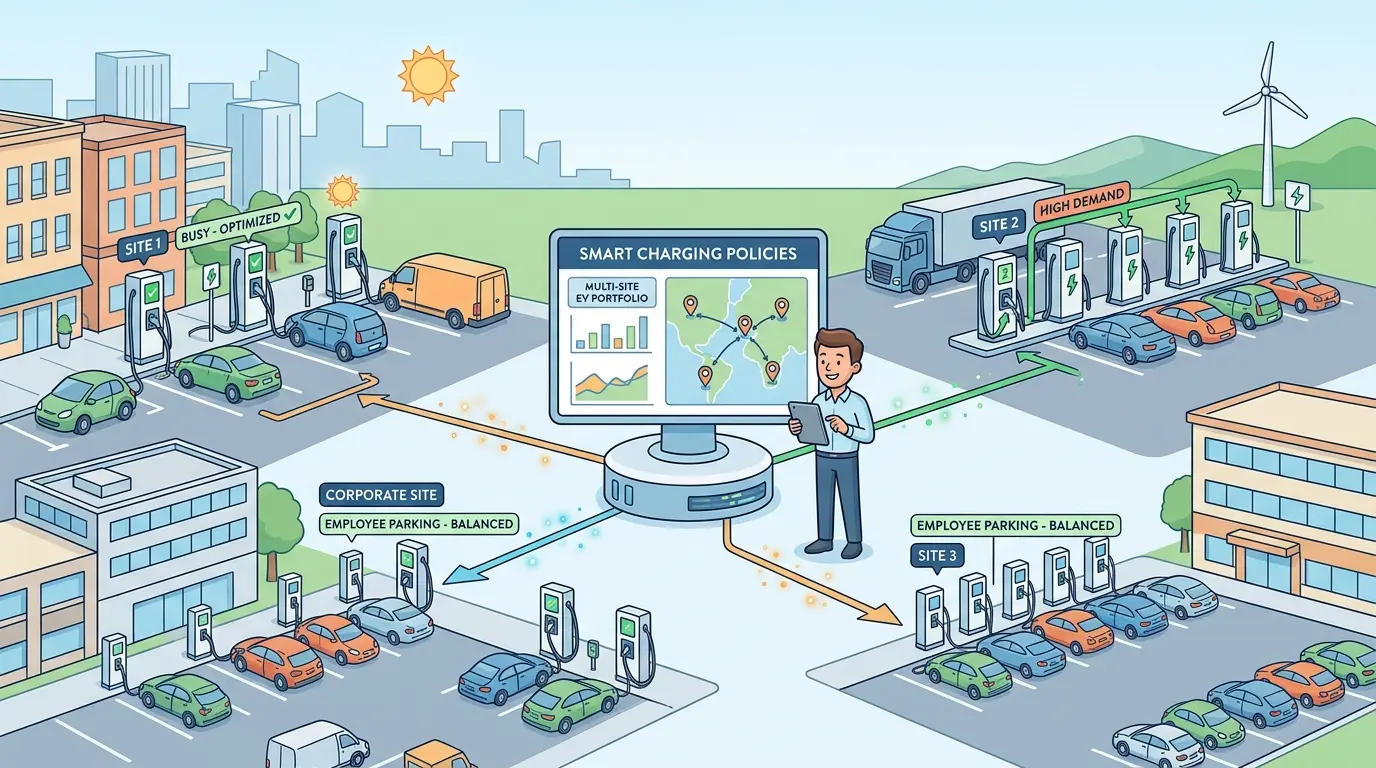
Scaling EV charging across multiple sites is usually less about buying more chargers and more about deciding how charging behavior will be controlled. One office location may need fair employee access. A depot may need guaranteed departure readiness. A multifamily property may need overnight load sharing. A retail site may care more about turnover, guest access, and network visibility.
If each location writes its own rules, a portfolio can end up with inconsistent access logic, uncontrolled power peaks, uneven user experience, and reporting that is almost impossible to compare. That is why smart charging policy should be treated as a portfolio governance layer, not as a collection of isolated site settings.
For operators already thinking about portfolio-wide EV charging planning, policy is what turns planning standards into daily operating behavior. It determines who gets access, when power is allocated, how local constraints are enforced, and which operating signals should trigger policy changes or site expansion.
Define What a Charging Policy Actually Controls
A useful smart charging policy should govern more than charging speed. At portfolio level, it usually needs to cover five control areas: access, prioritization, power allocation, cost discipline, and incident handling.
Without that structure, many organizations reduce smart charging to load balancing alone. In practice, the real value is broader. Strong policy helps reduce avoidable peak demand, improve charger throughput, create cleaner operating discipline across sites, and lower the number of local exceptions that turn into long-term operational friction.
| Policy Domain | Typical Decision | Portfolio Outcome |
|---|---|---|
| Access control | Who can charge, at which sites, and during which windows | Cleaner entitlement rules and fewer user disputes |
| Charging priority | Which users or vehicles move to the front of the queue | Better protection for critical operations |
| Power management | How site capacity is distributed when demand rises | Lower peak exposure and more stable site performance |
| Cost control | When charging should be shifted, capped, or limited | Better alignment with tariffs and demand-charge pressure |
| Incident response | What happens during faults, congestion, or overrides | Faster recovery and more consistent governance |
A portfolio policy should therefore be written as an operating model, not as a technical appendix. The technical settings matter, but only because they support business outcomes such as on-time departures, fair access, lower electrical stress, or better expansion discipline.
Set Rules at Three Levels: Portfolio, Site Type, and Site
One of the biggest mistakes in multi-site charging is choosing between two bad extremes. Some operators centralize every rule and force unlike sites into the same template. Others allow every location to improvise, which creates policy drift almost immediately.
A better model is to define charging policy at three levels.
| Rule Layer | What Should Stay Standardized | What Should Stay Flexible | Why It Works |
|---|---|---|---|
| Portfolio-wide | User classes, KPI definitions, security rules, reporting logic, escalation categories | Very little | Creates cross-site consistency and comparable data |
| Site-type template | Default rules for depots, offices, retail, hotels, or multifamily properties | Priority bands, access windows, pricing logic by asset type | Keeps policy aligned to operating context |
| Site-specific | Utility cap, parking flow, local tariff constraints, emergency overrides | Most local control variables | Protects local fit without breaking portfolio governance |
This three-layer structure gives management teams a common rulebook while still leaving room for local conditions such as transformer limits, lease restrictions, parking circulation, or resident billing expectations. In other words, the policy framework stays consistent even when the charging design does not.
Prioritize Charging by Operational Value, Not Plug-In Time
First-come, first-served charging rarely scales well across a multi-site portfolio. It is simple to explain, but it often gives the same priority to a route-critical van, a resident vehicle parked overnight, an employee car, and a guest session with no business urgency.
A stronger policy sorts charging demand by operational value. The right classes vary by portfolio, but most multi-site programs benefit from separating users into at least four groups.
| User or Vehicle Class | Default Policy Goal | Typical Power Priority | Common Override Trigger |
|---|---|---|---|
| Route-critical fleet vehicles | Protect departure readiness | Highest | Near-term dispatch risk |
| Residents or long-dwell contracted users | Ensure dependable scheduled charging | Medium-high | Persistent under-allocation |
| Employees or regular workplace users | Provide fair shared access | Medium | Low charger availability over repeated days |
| Public, guest, or visitor users | Preserve turnover and controlled access | Lower | Business-specific hospitality or customer-service event |
This does not mean every site needs the same ranking. It means the ranking logic should be explicit and documented. A depot may prioritize departure time and state-of-charge threshold. A mixed-use property may prioritize contractual residents overnight and visitors during the day. An office campus may use session rotation to prevent all-day occupancy by early arrivals.
The important point is that priority should reflect business impact, not just connection time. When policy is built around operational value, the portfolio can use limited capacity more intelligently without assuming every site needs a large electrical upgrade.
Use Power Policies to Protect Both Grid Capacity and Throughput
Many multi-site charging portfolios run into trouble when too many vehicles are allowed to start charging at full power at the same time. The issue is not always a lack of installed chargers. Often it is a lack of rules that determine how site capacity should be distributed as demand rises.
A serious power policy should define site import limits, concurrent charging caps, time-of-use behavior, idle-session handling, and fallback rules when communications or control logic fail. That is especially important when the same portfolio includes offices, depots, multifamily assets, and public-facing locations with very different electrical profiles.
Where capacity is shared across many users, dynamic load management should be treated as part of policy, not just a hardware feature. The control question is not simply whether load can be balanced. It is how and when that balancing should happen, which users can be throttled first, and what minimum charging level should be protected for high-priority sessions.
This is also where AC and DC charging policy should be separated by use case. Sites with reliable dwell windows usually perform better when managed AC charging carries the bulk of daily demand. High-power DC should be reserved for locations where fast turnaround, route recovery, or high-throughput service is truly necessary. A portfolio becomes harder to govern when every location is treated like a fast-charging site, even when the operational need is not there.
Standardize Exceptions Before They Become Routine
Policy quality is often decided by what happens during exceptions. If local staff can bypass controls without clear rules, emergency overrides quickly become normal operating behavior. That leads to queue conflicts, unexpected demand spikes, and inconsistent treatment of users across the portfolio.
Good policy should define who can authorize a priority override, how long an emergency session can hold top status, when guest access should be restricted, and how faults should change site behavior. For example, if a site loses part of its available capacity, does the system protect critical users first, reduce power evenly across all sessions, or suspend lower-priority access entirely? Those decisions should be made before the first disruption, not during it.
Software and interoperability choices matter here as well. Operators that expect mixed hardware environments, external network relationships, or future platform changes should think carefully about portability and standards support. PandaExo’s explanation of open charging networks is relevant because protocol decisions made early can affect how easily policy rules can be enforced, migrated, or extended later.
Make Reporting Policy as Important as Power Policy
A multi-site portfolio is difficult to govern if every location measures success differently. One site may report sessions. Another may track only energy delivered. A third may focus on occupied bays. Those numbers are all useful, but they do not create a comparable portfolio view unless the KPI definitions are standardized.
At minimum, most multi-site charging portfolios should measure session success rate, charging energy by user class, peak-demand events, queue or wait indicators, charger availability, off-peak share, and fault resolution time. Fleet-heavy portfolios may also need missed-departure incidents. Residential or mixed-use portfolios may need resident allocation performance and idle occupancy rates.
The purpose of shared reporting is not to build a larger dashboard. It is to reveal when a policy is no longer doing its job. If one site shows repeated manual overrides, high daytime peaks, and weak off-peak charging share, the problem may be policy design rather than charger quantity. If another site has low utilization but rising complaints, access rules or user communication may be misaligned with actual demand.
Common review triggers are usually more helpful than fixed calendar reviews alone:
- Repeated queue conflicts or missed charging windows.
- A sustained rise in peak-demand exposure.
- Chronic manual overrides by local teams.
- Low off-peak charging share despite available dwell time.
- Rapid growth in a user group that the original policy did not expect.
Match Policy Templates to Site Types
The same hardware family can support different site objectives, but the policy layer still needs to reflect how each site operates. That is why site-type templates are often more effective than one universal ruleset.
| Site Type | Smart Charging Policy Emphasis | Common Mistake |
|---|---|---|
| Fleet depot | Departure priority, overnight load shaping, contingency recovery rules | Letting all vehicles charge immediately on return |
| Office or workplace parking | Fair access, session rotation, user communication, moderate power caps | Allowing early arrivals to occupy chargers all day |
| Retail, hotel, or destination charging | Turnover windows, guest access control, visibility, monetization logic | Treating visitor charging like reserved long-dwell parking |
| Multifamily residential | Resident entitlements, overnight balancing, billing clarity, shared-capacity rules | Promising more guaranteed power than the building can support |
| Mixed-use campus | User-group separation, overlapping access windows, site-level demand caps | Applying one access rule to all users and all time periods |
These templates should not be rigid. They should give each location a structured starting point. That keeps the portfolio manageable while still allowing local refinement based on actual dwell patterns, electrical constraints, and commercial priorities.
Where PandaExo Fits in a Policy-Led Charging Strategy
A policy-led portfolio is easier to scale when the hardware and platform strategy can support both broad daily charging and selective higher-power recovery under one operating framework. That is where PandaExo is relevant in practical terms.
PandaExo’s EV charger portfolio can support operators that need AC smart charging at offices, residential assets, or commercial parking while also reserving DC fast charging for sites with genuine throughput pressure. For distributors, infrastructure buyers, and OEM or ODM partners, that kind of breadth matters because policy standardization is easier when the supplier strategy does not fragment the portfolio unnecessarily.
The broader value is not just product range. PandaExo also positions itself around smart energy management, manufacturing scale, and semiconductor engineering depth. For multi-site portfolios, those factors can help reduce procurement risk, simplify platform alignment, and support a charging program that stays governable as site count and charger diversity grow.
Practical Summary
Smart charging policies for multi-site portfolios work best when they do six things well:
- Define charging policy as an operating model, not just a power-control setting.
- Separate rules into portfolio-wide standards, site-type templates, and site-specific controls.
- Prioritize charging by business value rather than by plug-in time.
- Use power rules to protect both site economics and practical throughput.
- Standardize exception handling before local workarounds become normal behavior.
- Measure policy performance with shared KPIs and clear review triggers.
The strongest multi-site programs do not let every property or depot invent its own charging behavior. They create a portfolio rulebook, allow local adaptation inside clear boundaries, and use data to tighten policy as utilization grows. That is what turns scattered charger deployments into a charging network that can scale without becoming harder to control every quarter.