
 Deutsch
  Español
  Français
  Italiano
  Português
  Svenska
  Suomi
Suomi  Dansk
Dansk  Norsk bokmål
  Nederlands
  العربية
  עברית
עברית  Polski
  Türkçe
  Русский
  Uzbek
Uzbek  Azərbaycan
  Tiếng Việt
  ไทย
ไทย  한국어
한국어  日本語
日本語  简体中文
简体中文 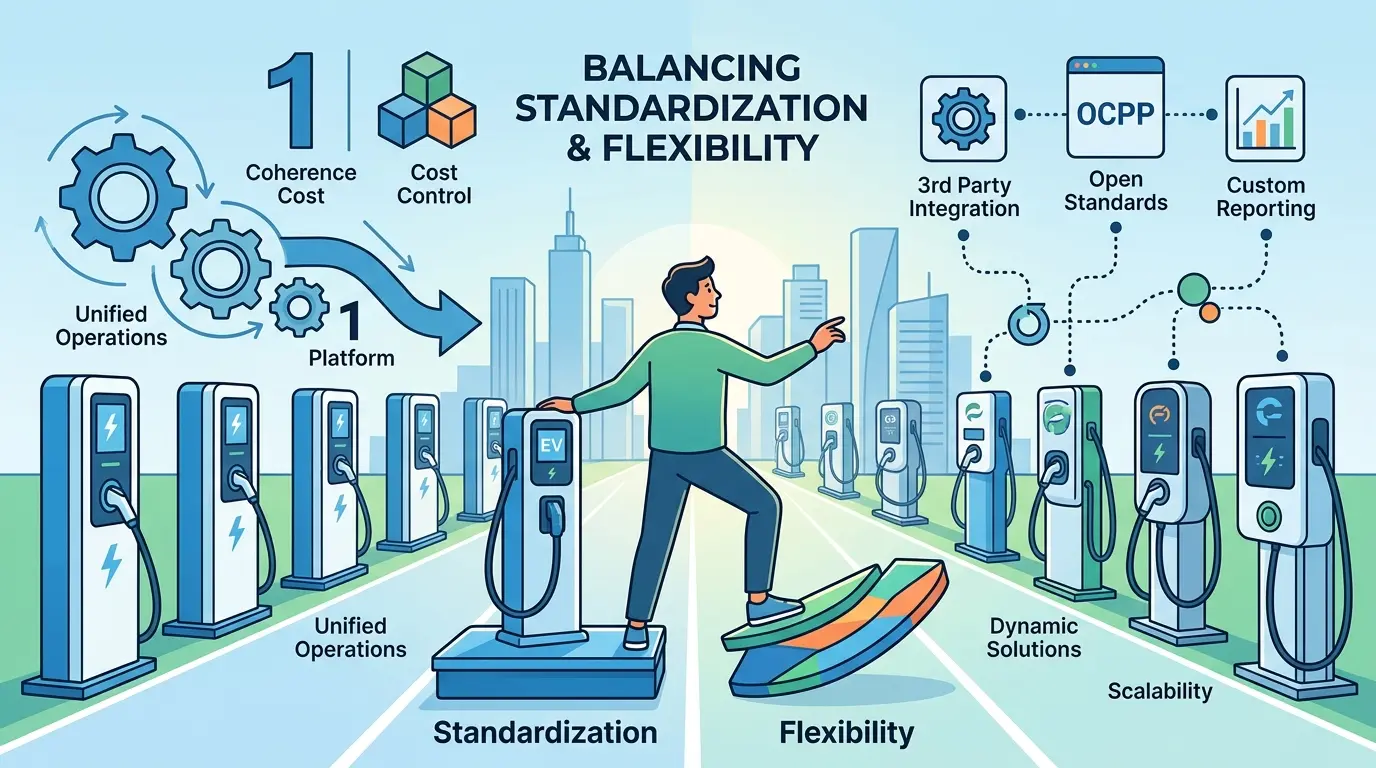
The portfolio problem usually appears after the first few successful installs. A company adds chargers at one site, proves demand, and then tries to repeat the model across ten, twenty, or fifty locations. That is where friction starts.
One site may have long-dwell employee parking and stable utility capacity. Another may be a retail property with short visits and unpredictable peak demand. A third may be a fleet location where dispatch reliability matters more than public-facing convenience. If every site is forced into the same hardware and software template, some locations will be overbuilt, some will be underpowered, and some will become operationally awkward. If every site chooses its own system, the owner ends up with fragmented reporting, inconsistent support, and harder procurement.
For most multi-site owners, the answer is not full standardization or full local freedom. It is controlled flexibility: standardize the parts of the platform that protect governance, uptime, and scale, then keep enough site-level freedom to fit real operating conditions.
The Real Platform Decision Is Bigger Than Hardware
When multi-site owners talk about choosing a charger platform, they are rarely choosing chargers alone. They are choosing a combination of hardware range, remote management, firmware governance, user access rules, reporting logic, maintenance workflows, and future expansion options.
That matters because portfolio performance is shaped by what happens after installation. Can the operations team compare utilization across different sites? Can firmware and alerts be handled consistently? Can a new site be added without introducing a new dashboard, new support process, and new spare-parts list? Those are platform questions, not just hardware questions.
This is why serious portfolio planning starts with operating structure rather than product preference. PandaExo’s guidance on portfolio-wide EV charging planning reflects the same principle: multi-site growth works best when site decisions stay tied to a common operating model.
What Standardization Actually Solves
At scale, standardization is valuable because it reduces friction in the parts of the business that repeat at every site.
It improves procurement leverage. Buying across a more consistent platform framework usually makes commercial terms, service planning, and rollout coordination easier to manage.
It improves operational visibility. If the same reporting logic, KPIs, and access structure apply across the portfolio, owners can compare site performance more confidently and spot underperforming assets faster.
It improves support discipline. A common escalation path, shared maintenance procedures, and a narrower spare-parts environment help internal teams and service partners respond more predictably.
It also improves rollout speed. Once the backbone is defined, new sites do not have to restart every technical and commercial decision from zero.
For owners with lean teams, those benefits are often more important than marginal differences in charger appearance or feature lists.
Where Too Much Standardization Starts to Hurt
The problem is that sites rarely behave the same way, even inside one portfolio.
An office campus with eight-hour dwell does not need the same charger mix as a highway-adjacent convenience site. A multifamily property with tight electrical headroom should not be treated like a fleet depot with predictable overnight returns. A leased site with limited civil-work appetite may need a different rollout phase than an owned property built for long-term expansion.
If the platform decision forces identical power classes, identical mounting choices, or identical deployment phases everywhere, standardization becomes expensive instead of efficient. Owners can end up paying for capacity they do not use, struggling with grid constraints they could have avoided, or limiting charger throughput where faster recovery is actually needed.
The operational risk is just as important as the capital risk. Over-standardized portfolios often look clean in procurement documents but create site-level frustration once real drivers, tenants, dispatch managers, or property teams start using them.
What Should Stay Standard Across the Portfolio
Multi-site owners usually get the best result when they standardize the control layer rather than every field-level hardware choice.
| Decision Area | What Should Usually Stay Standard | Why It Matters |
|---|---|---|
| Software environment | One primary dashboard, reporting structure, and admin logic | Keeps portfolio visibility clean |
| Data model | Common KPI definitions, site naming rules, utilization reporting, and user segmentation | Makes cross-site decisions more reliable |
| Access and governance | Shared rules for authorization, permissions, remote support, and incident escalation | Reduces operational inconsistency |
| Firmware and cybersecurity process | Common approval, update, rollback, and alert handling workflow | Lowers platform management risk |
| Service model | Standard maintenance expectations, warranty handling, and support response structure | Improves uptime management |
| Interoperability policy | Clear protocol and integration requirements before procurement | Prevents future lock-in |
This is also where open standards matter. A platform does not need to be loosely managed to remain adaptable, but it does need enough interoperability to avoid trapping the portfolio inside a dead-end operating model. PandaExo’s explainer on open charging networks is relevant here because protocol choices directly affect future flexibility.
What Should Stay Flexible at the Site Level
Once the operating backbone is defined, site design should still reflect actual site conditions.
| Site-Level Variable | Why Flexibility Helps | Typical Reason It Changes by Site |
|---|---|---|
| Charger power mix | Matches dwell time and throughput need | Office, retail, fleet, hotel, and multifamily sites behave differently |
| Hardware format | Improves layout efficiency and installation fit | Wall-mounted, post-mounted, and ground-mounted choices depend on parking design |
| Rollout phasing | Prevents overbuilding | Some sites need conduit today and more active chargers later |
| Energy management settings | Fits local utility and tariff conditions | Transformer limits, demand charges, and load profiles vary |
| Access policy | Aligns with user type | Staff-only, tenant-only, semi-public, or fleet-priority logic may differ |
| Channel or branding requirements | Supports regional market strategy | Some programs need OEM or ODM flexibility rather than a fixed commercial presentation |
The most practical portfolios are not identical. They are comparable. Site A and Site B should still be governable through the same platform logic even if one leans toward AC charging and the other needs targeted DC fast charging.
A Useful Scorecard for Evaluating Charger Platforms
Before committing to a platform, multi-site owners should evaluate whether it can support both repeatability and controlled variation.
| Evaluation Question | Why It Matters for Multi-Site Owners | Strong Answer Looks Like |
|---|---|---|
| Can the platform support multiple charger classes? | Mixed portfolios often need different power levels by site | One environment can support AC and DC deployments without fragmenting operations |
| Can reporting stay consistent while site configurations vary? | Standardization fails if site differences break visibility | The owner can compare performance across different site archetypes |
| How are firmware, alerts, and remote support managed? | Portfolio scale multiplies small service problems | Update governance and alert handling are centralized and repeatable |
| How open is the platform to future integrations or network changes? | Ownership structures and commercial models change over time | Interoperability is planned early rather than treated as an afterthought |
| Can expansion happen in phases? | Multi-site growth is rarely built all at once | The platform supports staged activation without replatforming |
| Does the supplier support portfolio complexity, not just single-site delivery? | Multi-site programs need operational maturity, not only hardware availability | The vendor can support rollout planning, service structure, and site variation |
Migration risk deserves explicit attention in this scorecard. Owners should ask what happens if a site changes operator, if a property is sold, or if the organization wants to switch software environments later. PandaExo’s guide to EV charger network migration best practices is useful because it highlights how expensive an avoidable migration problem can become once several sites are already live.
Data ownership should be reviewed with the same discipline. If a platform makes it hard to extract charger history, configuration records, or user and site data in a structured way, flexibility is more limited than it looks. PandaExo’s EV charger data handover checklist offers a practical lens for testing that risk before contracts are locked in.
When to Lean More Toward Standardization
Multi-site owners should usually favor a more standardized platform model when most of the portfolio shares the same operating logic.
That is often true when the sites serve similar user groups, the internal team is centralized, the charger rollout needs to move quickly, and the business values simple procurement and repeatable maintenance over local customization.
Examples include:
- workplace portfolios with similar dwell patterns across sites
- hotel groups using a common guest-access and billing model
- fleet operators with standardized dispatch rules across regional depots
- property groups that want one reporting and support framework for all assets
In those cases, higher standardization usually reduces cost-to-scale and lowers operational noise.
When Flexibility Should Carry More Weight
Flexibility should carry more weight when site economics and operating realities differ sharply across the portfolio.
That is common when a business mixes employee charging, semi-public charging, retail dwell, tenant charging, and fleet operations under one ownership structure. It is also common when utility readiness differs widely from site to site, or when the rollout must fit both owned and leased properties.
Examples include:
- portfolios that combine long-dwell and quick-turn environments
- mixed-use real estate groups with different tenant and visitor patterns
- regional expansion programs entering markets with different grid conditions
- channel-driven programs that may need localized branding or OEM and ODM options
In those cases, the wrong kind of standardization can slow expansion or distort site economics.
A Practical Procurement Model for Multi-Site Owners
The safest procurement approach is usually to define a common operating specification first, then test whether a platform can serve multiple site archetypes inside it.
That means identifying two or three real site types across the portfolio, setting the common control requirements, and then checking whether one supplier framework can support those variations without forcing separate operating environments.
For example, an owner may want one support model, one reporting stack, and one governance workflow, while still leaving room for different charger formats and power classes across the estate. That is where a broad EV charger portfolio becomes more useful than a single hardware answer.
This is also where PandaExo’s positioning becomes relevant in a practical sense. Buyers balancing standardization and flexibility often benefit from access to both AC and DC charging options, smart platform visibility, and OEM or ODM adaptability under a coherent supplier framework. The value is not that every site should look the same. The value is that the portfolio can grow without becoming operationally fragmented.
Practical Summary
Multi-site owners should not ask whether standardization or flexibility is better in the abstract. They should ask which parts of the charging environment must stay common to keep the portfolio governable, and which parts must stay adaptable to keep each site economically and operationally sound.
In practice, the strongest platform choices usually follow five rules:
- standardize software, reporting, support workflows, and governance
- keep hardware mix and rollout phasing flexible enough to fit site demand
- require interoperability before signing long-term platform commitments
- review migration and data-handover risk early, not after deployment
- choose suppliers that can support portfolio scale without forcing site-level sameness
That balance is what lets a multi-site charging program scale like a system instead of growing like a patchwork. Owners do not need every site to be identical. They need every site to fit within a platform strategy that stays visible, supportable, and expandable over time.