
 Deutsch
  Español
  Français
  Italiano
  Português
  Svenska
  Suomi
Suomi  Dansk
Dansk  Norsk bokmål
  Nederlands
  العربية
  עברית
עברית  Polski
  Türkçe
  Русский
  Uzbek
Uzbek  Azərbaycan
  Tiếng Việt
  ไทย
ไทย  한국어
한국어  日本語
日本語  简体中文
简体中文 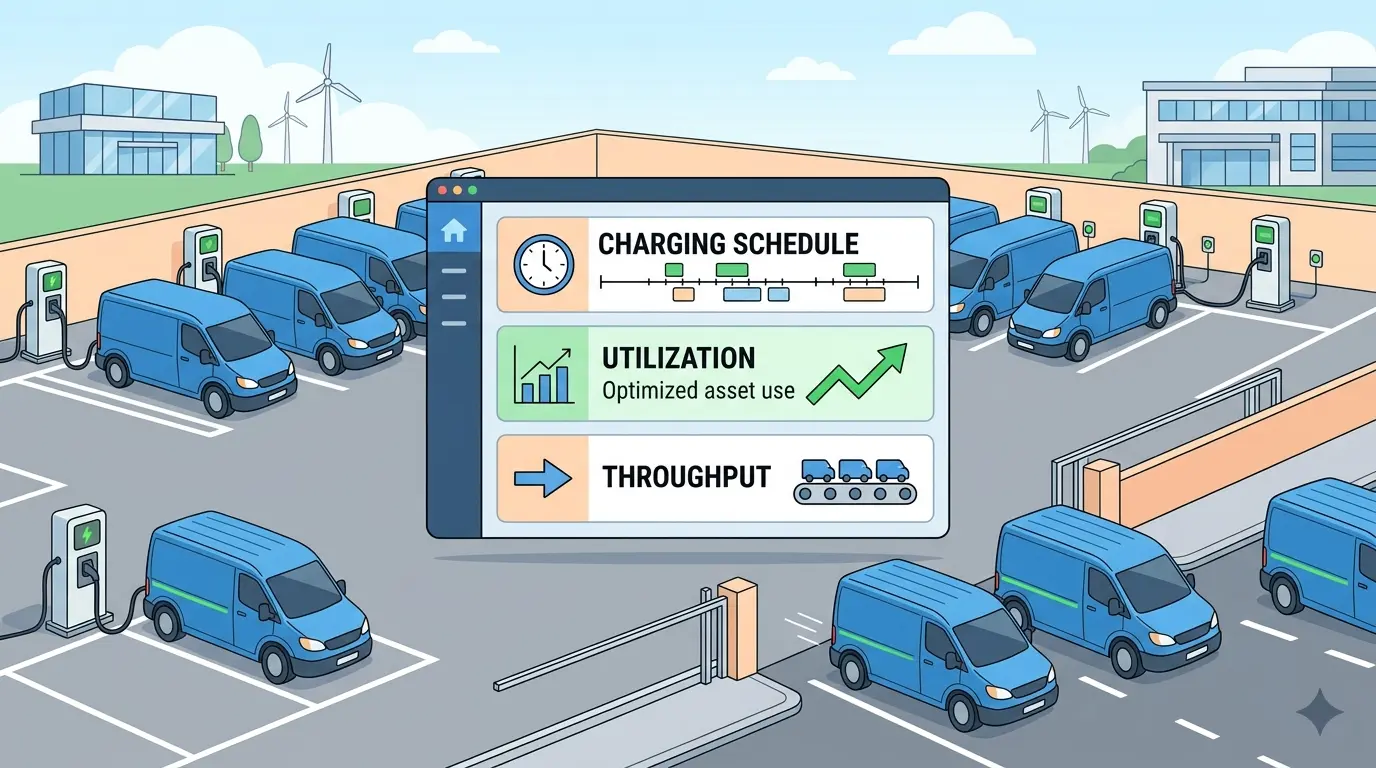
Many fleet charging projects do not fail because the site lacks chargers. They fail because too many vehicles need energy during the same window, too few charging priorities are defined, and throughput is judged by installed hardware rather than by vehicles that leave on time.
That distinction matters. A depot can look well equipped on paper and still struggle with morning departures, charger queues, and underused assets. For fleet managers, the real planning question is not simply how much charging power to buy. It is how to translate charging capacity into reliable operational output across shifts, dwell windows, and route demands.
Start With Operating Windows, Not With Charger Count
The first planning input should be vehicle behavior, not equipment quantity. Charging schedules only work when they reflect when vehicles arrive, how long they stay parked, how much energy they typically need, and how costly a delayed departure would be.
Before selecting a charger mix, define four basics for each vehicle group:
- Typical arrival time and departure time
- Average daily energy requirement
- Minimum departure state-of-charge buffer
- Recovery options if a charging session is interrupted or delayed
This immediately separates flexible charging demand from time-critical demand. A pool vehicle parked overnight can usually absorb delayed charging. A last-mile van that must return to service early the next morning often cannot. Treating both vehicles as equal charging priorities leads to poor schedule design and unnecessary peak loading.
| Planning Variable | What It Tells You | Why It Matters for Fleet Operations |
|---|---|---|
| Dwell time | How long a vehicle can remain connected | Determines whether slower managed charging is practical |
| Energy per duty cycle | How much energy the vehicle actually uses | Prevents sizing around full battery capacity instead of real demand |
| Departure criticality | How disruptive a missed charge would be | Helps prioritize schedules and contingency charging |
| Return pattern consistency | How predictable arrival windows are | Affects whether fixed schedules or dynamic scheduling rules work better |
Define Utilization the Right Way
Fleet managers often hear “utilization” used as if it were one metric. In practice, there are at least three utilization questions that matter:
- Charger utilization: how much of the day a charger is actively delivering power
- Bay utilization: how much of the day a parking and charging position is occupied
- Fleet charging readiness: how often vehicles are sufficiently charged before dispatch
These are related, but they are not interchangeable. A charger can show high occupancy and still create poor throughput if vehicles remain plugged in long after they have recovered the energy they need. Likewise, a site can show low charger utilization and still be well planned if most charging happens during low-cost overnight windows and every vehicle leaves ready.
For fleet planning, readiness should carry more weight than raw plug-in time. The goal is not to maximize charger activity at all hours. The goal is to deliver the required energy to the right vehicles inside the available operating window without creating congestion or unnecessary electrical peaks.
Build Charging Schedules Around Departure Risk
The most effective fleet charging schedules are not first-come, first-served. They are priority-based.
A practical scheduling hierarchy often looks like this:
- Route-critical vehicles with early or non-negotiable departures
- High-utilization vehicles that need rapid recovery between shifts
- Standard overnight vehicles with predictable daily replenishment needs
- Low-priority or reserve units that can absorb delayed charging
This approach is especially important in mixed fleets, where not every asset needs the same energy at the same time. Some operators discover that the schedule, not the hardware, is the real bottleneck. When all vehicles are allowed to start charging at plug-in time, the site may create an artificial peak that stresses electrical infrastructure but adds little operational value.
By contrast, software-controlled charging windows can stage flexible loads later in the evening, keep earlier power available for urgent vehicles, and reduce simultaneous demand without increasing dispatch risk.
Match AC and DC to Turnaround Pressure
For most depots, AC charging should carry the largest share of daily replenishment wherever vehicles have dependable dwell time. It is well suited to overnight parking, workplace fleets, and operations where a vehicle does not need immediate energy recovery after arrival. AC infrastructure can be easier to distribute across parking rows and is often a better fit for scaling daily charging access without escalating site complexity too quickly.
DC charging becomes more valuable when throughput pressure is real rather than assumed. If a subset of vehicles has short dwell windows, double shifts, or turnaround requirements that threaten route continuity, DC charging can reduce recovery time and protect service availability. The tradeoff is that DC infrastructure typically brings greater demands on service capacity, thermal design, installation planning, and project economics.
| Planning Question | AC Charging Usually Fits Best When | DC Charging Usually Fits Best When |
|---|---|---|
| How long can vehicles remain parked? | Several hours or overnight | Short dwell between trips or shifts |
| What is the main charging objective? | Daily replenishment | Fast operational recovery |
| How sensitive is the site to capital intensity and utility burden? | Highly sensitive | Faster turnaround justifies added complexity |
| How many vehicles truly need priority charging? | Most vehicles are flexible | A defined subset is time-critical |
The common mistake is not installing DC fast charging. It is treating fast charging as the default answer for a scheduling problem that better prioritization, better load management, or more distributed AC coverage could solve at lower cost.
Throughput Depends on Queue Design, Not Just on Power Rating
Throughput is often discussed as if it comes directly from charger output. In real fleet operations, throughput is shaped by a wider system:
- How quickly vehicles can access a charger bay
- Whether cable reach and parking geometry slow turnover
- Whether charging priorities are enforced consistently
- Whether drivers know when to move vehicles after useful charging is complete
- Whether site rules prevent low-priority vehicles from occupying high-value positions
This is why depot layout and operations policy matter alongside charger selection. A site can install high-power equipment and still underperform if vehicles queue behind blocked bays or if charging sessions are not aligned to route needs. On the other hand, a well-managed site with moderate power can deliver better practical throughput because vehicles move through the charging process with less friction.
Where fleet managers expect recurring fast-turnaround demand, it helps to review how high-power depot charging infrastructure fits the actual duty cycle instead of assuming every bay needs the same capability.
Software Turns Installed Capacity Into Usable Capacity
In fleet charging, software is not just a reporting layer. It is the control system that turns a fixed electrical envelope into usable operational capacity.
Scheduling logic, load balancing, access control, and charging-session visibility all affect how much throughput the site can actually deliver. If a platform can prioritize vehicles by departure time, cap simultaneous demand, and shift flexible charging into lower-pressure windows, the site may support more vehicles without expanding its peak draw.
That is one reason broader EV charging infrastructure portfolios matter in B2B planning. The value is not simply in offering more charger types. It is in supporting a charging strategy that can combine distributed daily charging, targeted fast recovery, and central visibility as operations grow more complex.
Plan for Peak Days, Not Only for Average Days
Average demand is useful for budgeting, but peak-day stress reveals whether the depot is truly resilient. Fleets should pressure-test charging schedules against conditions such as:
- Late vehicle returns
- Early dispatch compression
- Weather-driven efficiency loss
- Temporary route expansion
- More vehicles than usual requiring immediate recharge
- Utility constraints or partial site outages
This does not mean the site must be sized for every worst-case event at full simultaneous output. It does mean the operator should know what happens when demand tightens. Which vehicles get priority? Which loads can be deferred? Is there enough contingency to protect critical departures without pushing the entire site into an expensive electrical peak?
Those questions become more important when service upgrades, transformer lead times, or tariff exposure constrain the project. Fleet operators should bring grid and utility realities into planning early, especially when evaluating demand charges, available capacity, and infrastructure approval timelines. PandaExo’s own guidance on grid capacity, interconnection, and demand charges is relevant here because electrical limits often define throughput more than the charger catalog does.
Use a Simple Planning Framework Before Procurement
Procurement decisions become clearer when the planning order is disciplined.
- Group vehicles by duty cycle and departure risk.
- Quantify daily and peak-day energy demand by vehicle group.
- Identify where charging schedules alone can solve the demand problem.
- Reserve DC fast charging for vehicles with true turnaround pressure.
- Set a site demand cap and test how software-managed charging performs within it.
- Review bay layout, circulation, and operating rules to remove queue friction.
- Phase deployment so the depot is prepared for growth without over-installing on day one.
This workflow helps fleet managers avoid a common procurement error: comparing chargers before they have defined the operating logic those chargers must support.
Practical Summary
For fleet managers, charging schedules, utilization, and throughput should be planned as one system, not as separate decisions.
Scheduling decides who gets energy first. Utilization shows whether assets are being used productively or just occupied. Throughput reveals whether the depot can convert installed charging capacity into vehicles that leave ready for work.
The most reliable fleet charging strategies usually follow a few consistent rules:
- Start with operating windows and departure risk, not with charger quantity
- Measure readiness and turnover, not just plug-in time
- Use AC for broad daily replenishment where dwell time allows
- Use DC selectively where turnaround pressure justifies it
- Let software manage concurrency before paying for unnecessary peak capacity
- Test the plan against peak-day disruption, not only average demand
When those elements are aligned, fleet charging becomes easier to scale. The result is not just more charging hardware. It is better charger throughput, better use of electrical capacity, and a depot plan that supports operations instead of constantly reacting to them.