
 Deutsch
  Español
  Français
  Italiano
  Português
  Svenska
  Suomi
Suomi  Dansk
Dansk  Norsk bokmål
  Nederlands
  العربية
  עברית
עברית  Polski
  Türkçe
  Русский
  Uzbek
Uzbek  Azərbaycan
  Tiếng Việt
  ไทย
ไทย  한국어
한국어  日本語
日本語  简体中文
简体中文 
The rapid electrification of global transportation presents an unprecedented opportunity for commercial property owners, fleet managers, and Charge Point Operators (CPOs). However, navigating the transition requires more than simply installing plugs in parking spaces. A critical point of confusion in infrastructure planning is the distinction between Battery Electric Vehicles (BEVs) and Plug-in Hybrid Electric Vehicles (PHEVs).
While both vehicle types utilize the electrical grid to offset fossil fuel consumption, their underlying battery architectures, onboard power electronics, and charging capabilities vary drastically. Understanding these technical nuances is essential for designing a cost-effective, future-proof charging hub. Over-investing in high-voltage infrastructure for a PHEV-heavy fleet erodes return on investment (ROI), while under-provisioning power for pure BEVs creates operational bottlenecks and user frustration.
Here is a deep dive into the engineering realities of EV versus PHEV charging, and how businesses can strategically align their hardware selection with vehicle capabilities.
The Technical Divide: Battery Capacity and Onboard Power Electronics
To understand why different electric cars often require different charging strategies, we must examine the internal power electronics of the vehicles themselves—specifically, battery capacity and the On-Board Charger (OBC).
Battery Architecture and C-Rates
- Battery Electric Vehicles (BEVs): Pure EVs are designed exclusively around an electric powertrain. They feature large, high-capacity lithium-ion battery packs, typically ranging from 60 kWh to over 120 kWh. Because the battery is the sole source of propulsion, it is engineered with advanced active thermal management systems capable of handling high charging currents (high C-rates) without degrading cell chemistry.
- Plug-in Hybrid Electric Vehicles (PHEVs): PHEVs act as a bridge technology, combining an internal combustion engine with a much smaller supplemental battery pack, usually between 10 kWh and 25 kWh. Because the battery is small and the vehicle can always fall back on gasoline, manufacturers generally omit the expensive, heavy thermal management systems required for ultra-fast charging.
The On-Board Charger (OBC) Bottleneck
When a vehicle plugs into an alternating current (AC) station, the power must be converted to direct current (DC) to be stored in the battery. This conversion is handled by the vehicle’s OBC.
- PHEVs typically feature lower-capacity OBCs (e.g., 3.6 kW or 7.2 kW) to save weight, space, and manufacturing costs.
- Modern BEVs feature robust OBCs capable of processing 11 kW to 22 kW of AC power.
No matter how powerful the AC charging station is, the vehicle will only draw power up to the maximum limit of its OBC. Connecting a PHEV with a 3.6 kW OBC to a 22 kW AC charging station will still only result in a 3.6 kW charge rate.
The AC Charging Ecosystem: The Universal Solution
Alternating Current (AC) charging, commonly referred to as Level 2 charging, is the common denominator in the electromobility landscape. It is the primary method for charging both BEVs and PHEVs.
Because PHEVs have small batteries, a standard AC charger can easily replenish their pack from 0% to 100% in 2 to 4 hours. For BEVs, AC charging is ideal for “dwell time” scenarios—such as workplace parking lots, residential complexes, and hotels—where the vehicle will remain parked for 4 to 8 hours.
For commercial facilities and mixed-use fleets looking to support both BEVs and PHEVs cost-effectively, deploying a network of smart, load-balanced AC Chargers is the most logical foundation. These reliable charging points provide sufficient daily energy replenishment without the high capital expenditure associated with grid upgrades required for high-voltage systems.

The DC Fast Charging Landscape: Built for the Pure Electric Future
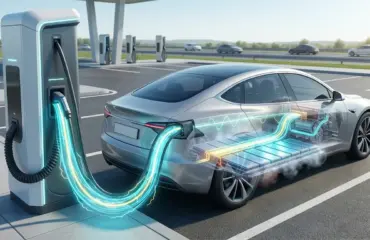
Direct Current (DC) Fast Charging operates on an entirely different architectural principle. Instead of supplying AC power to the vehicle’s onboard converter, a DC charger houses heavy-duty power electronics internally. It converts the grid’s AC power to DC at the station level and pushes it directly into the vehicle’s battery pack, completely bypassing the vehicle’s OBC.
Why PHEVs Rarely Support DC Fast Charging
With a few rare exceptions, PHEVs cannot use DC fast chargers. The reasons are rooted in engineering and economics:
- Hardware Limitations: Most PHEVs lack the necessary high-voltage contactors and the combined charging system (CCS) port required to accept a DC plug.
- Battery Chemistry Constraints: Pushing 50 kW or 150 kW of direct current into a tiny 15 kWh PHEV battery would result in a dangerously high C-rate, causing immense heat generation and rapid cell degradation.
- Cost-Benefit Ratio: Adding DC fast-charging hardware to a PHEV adds significant weight and expense to a vehicle that already carries two separate powertrains, yielding minimal real-world benefit to the driver.
For pure BEVs, however, DC charging is non-negotiable for long-distance travel, logistics operations, and rapid turnaround fleets (like taxis or delivery vans). When rapid energy delivery is the primary operational requirement, deploying high-power DC Chargers ensures that high-capacity BEVs can regain hundreds of miles of range in just 15 to 30 minutes.

Strategic Infrastructure Planning for B2B Environments
When designing a charging hub, the choice between AC and DC infrastructure shouldn’t be based solely on vehicle type, but on use-case behavior and operational workflows.
Assessing Dwell Times
- Short Dwell Times (15-60 minutes): Highway corridors, quick-service retail, and public transit hubs must prioritize DC fast chargers. PHEVs will largely bypass these stations, but the BEV market relies on them.
- Long Dwell Times (4+ hours): Corporate campuses, hospitality venues, and multi-unit dwellings should deploy dense networks of AC chargers. This maximizes the number of available ports, servicing both PHEVs and BEVs effectively over longer periods.
Exploring Comprehensive Solutions
The most resilient infrastructure deployments utilize a mixed-hardware approach. By combining smart AC wallboxes for employee parking with select DC fast chargers for visitor or fleet operations, facilities can optimize their electrical capacity. Property developers and fleet managers should assess a complete EV charging infrastructure portfolio to mix and match solutions based on their site’s specific grid limits and user demographics.
The PandaExo Advantage: Factory-Direct Scale and Precision
Meeting the diverse demands of today’s electrified transport requires hardware that is intelligent, scalable, and relentlessly reliable. As a global leader in smart EV charging stations, PandaExo bridges the gap between complex power electronics and seamless user experiences.
Operating a state-of-the-art 28,000-square-meter advanced manufacturing base, our deep heritage in power semiconductors translates directly into higher conversion efficiencies, superior thermal management, and robust lifecycle durability across our entire product line.
Whether you are a CPO rolling out a national network of ultra-fast DC stations or a property manager integrating smart energy management platforms with AC wallboxes, PandaExo delivers:
- Unmatched Manufacturing Scale: Factory-direct precision that ensures rapid deployment and supply chain reliability.
- Customized OEM/ODM Services: Tailored hardware and software integrations designed to reflect your brand and meet localized grid compliance.
- Smart Energy Management: Advanced load-balancing software that protects local grid capacity while intelligently distributing power between high-demand BEVs and low-demand PHEVs.
The shift to electric mobility is not a one-size-fits-all transition. By understanding the technological boundaries of the vehicles on the road, businesses can deploy the right hardware in the right locations, maximizing ROI and driving the zero-emission future forward.