
 Deutsch
  Español
  Français
  Italiano
  Português
  Svenska
  Suomi
Suomi  Dansk
Dansk  Norsk bokmål
  Nederlands
  العربية
  עברית
עברית  Polski
  Türkçe
  Русский
  Uzbek
Uzbek  Azərbaycan
  Tiếng Việt
  ไทย
ไทย  한국어
한국어  日本語
日本語  简体中文
简体中文 
As the global transition to electric mobility accelerates, businesses and fleet operators are moving beyond the question of “if” they should electrify and focusing on the “how.” For many commercial and residential applications, Level 2 AC charging is the backbone of the infrastructure. However, the time it takes to charge remains one of the most critical variables in operational planning.
Understanding the technical nuances between a 7kW, 11kW, and 22kW station is no longer just for engineers—it is a financial imperative for facility managers and developers. At PandaExo, we combine our heritage in power semiconductors with advanced manufacturing to deliver high-performance EV charging infrastructure that minimizes downtime and maximizes utility.
The Anatomy of Charging Time: Beyond the Kilowatt
While it is tempting to look at a charger’s output and calculate speed using simple division, the reality of EV charging involves three primary “gatekeepers”:
- The Charging Station’s Output: The maximum power the station can deliver (e.g., 7.4kW, 11kW, or 22kW).
- The Vehicle’s Onboard Charger (OBC): This is the internal component that converts AC power from the station into DC power for the battery. If a car has an 11kW OBC, it cannot charge at 22kW, even if the station supports it.
- Battery Capacity and State of Charge (SoC): Larger batteries naturally take longer to fill, and charging speeds often taper off as the battery nears 80% to 100% to protect cell longevity.
Benchmark Charging Times for Level 2 Stations
To provide a clear picture of what to expect in 2026, let’s look at typical charging durations for a standard 75kWh battery (representative of modern mid-range SUVs and sedans) across different power levels.
| Charger Power | Current/Phase Type | Miles/KM Added per Hour | 0% to 100% Charge Time |
|---|---|---|---|
| 7kW / 7.4kW | 32A Single-Phase | ~25 miles / 40 km | 10 – 11 Hours |
| 11kW | 16A Three-Phase | ~35 miles / 56 km | 6 – 7 Hours |
| 22kW | 32A Three-Phase | ~70 miles / 112 km | 3 – 4 Hours |
7kW: The Residential & Long-Dwell Standard
For multi-unit dwellings and workplaces where vehicles remain parked for 8+ hours, our 3.5kW/7kW AC EV Chargers (available in wall-mounted and plastic post-mounted options) offer a cost-effective solution. These reliable charging points are ideal for overnight replenishment, ensuring that even a depleted battery is ready for the morning commute without requiring expensive three-phase grid upgrades.

11kW & 22kW: The Commercial Workhorses
In commercial environments where turnover is higher—such as retail hubs, hotels, or fleet depots—speed is a competitive advantage. An 11kW or 22kW AC EV Charger can effectively double or triple the energy delivery compared to standard residential units. For vehicles equipped with 22kW onboard chargers (increasingly common in premium and heavy-duty models), these stations bridge the gap between slow overnight charging and high-power DC charging sessions.

Why “Smart” Infrastructure Matters
Speed is only one half of the ROI equation. In 2026, the real value lies in how that power is managed. PandaExo’s smart energy management platforms allow operators to:
- Implement Dynamic Load Balancing: Distribute available power across multiple 11kW/22kW units to prevent grid overloads during peak hours.
- Reduce Operational Costs: Schedule charging during off-peak hours when electricity tariffs are lower.
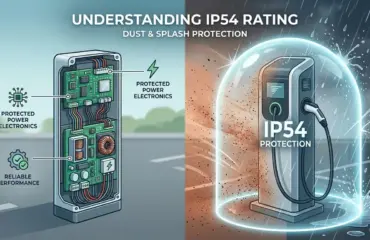
- Enhance Durability: Our stations feature UL 94V-0 flame-retardant materials and up to IP67 ratings, ensuring precision performance in the harshest industrial environments.
Choosing the Right Infrastructure for Your Site
Selecting the right Level 2 station depends on your “Dwell Time” profile. If your users park for less than 4 hours, a 22kW Three-Phase unit is the strategic choice to provide a meaningful “top-up.” For residential developers, 7kW remains the gold standard for cost-to-utility balance.