
 Deutsch
  Español
  Français
  Italiano
  Português
  Svenska
  Suomi
Suomi  Dansk
Dansk  Norsk bokmål
  Nederlands
  العربية
  עברית
עברית  Polski
  Türkçe
  Русский
  Uzbek
Uzbek  Azərbaycan
  Tiếng Việt
  ไทย
ไทย  한국어
한국어  日本語
日本語  简体中文
简体中文 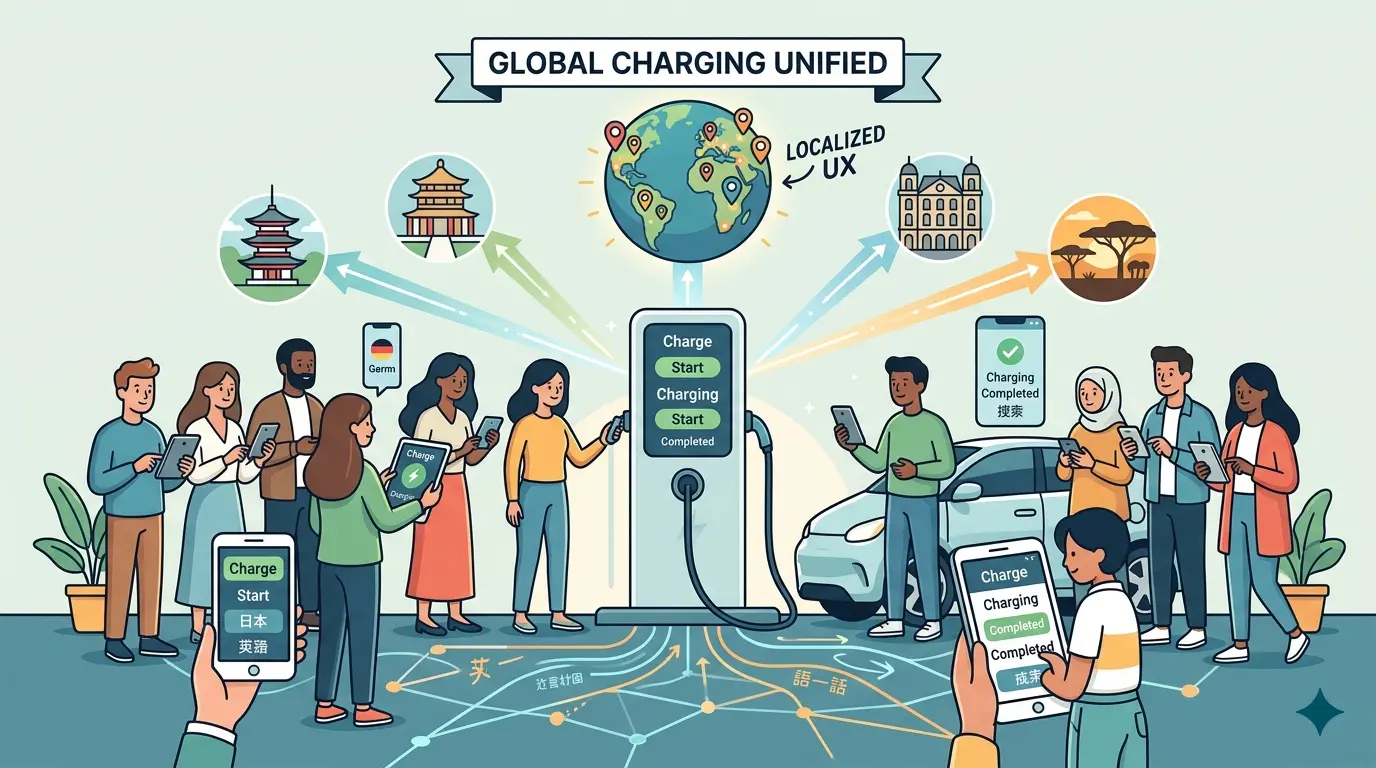
A charging network can meet the right electrical standard, support the correct connector, and still create avoidable friction if drivers cannot understand the interface in front of them. That problem becomes much more serious when a charging rollout crosses borders.
In global EV charging deployments, multilingual UX is not a cosmetic layer added at the end of product design. It affects session completion, support workload, site-host confidence, and how quickly a network can scale from one country to the next. For distributors, CPOs, fleet operators, and OEM or ODM partners, market localization should be treated as part of deployment strategy rather than a translation task delegated after hardware is already locked.
Why Localization Is an Operational Requirement, Not a Marketing Detail
When a driver arrives at a charger, the interface has to answer practical questions immediately. Is this charger compatible with the vehicle? How is pricing displayed? Which payment or authorization method is expected? What does a fault message actually mean? How long will the session remain active if charging is interrupted?
If those answers are only partially localized, the risk is not just a weaker brand impression. The real cost shows up in abandoned sessions, repeated calls to support, longer site dwell caused by onboarding confusion, and inconsistent usage across regions that should otherwise be comparable.
That is why multilingual UX belongs inside the operating model of a charging business. A network that wants to expand internationally needs consistent session logic, but it also needs interfaces, workflows, and support language that fit each market’s expectations. In practice, that means localization should be planned alongside hardware selection, site design, software rollout, and service procedures.
Translation Alone Does Not Solve the Problem
Many cross-border charging programs start by translating app text and charger-screen labels. That helps, but it does not fully localize the deployment.
| Localization Layer | What It Covers | Why It Matters in EV Charging |
|---|---|---|
| Language translation | Interface text, instructions, prompts, notifications | Reduces immediate user confusion |
| Market conventions | Currency, tax display, date and time format, decimal style, units | Prevents pricing and billing misunderstandings |
| Charging terminology | Connector naming, AC/DC labels, power descriptions, session states | Improves driver confidence and compatibility decisions |
| Payment behavior | RFID, QR flow, app login, card expectation, invoicing format | Aligns the session start experience with local habits |
| Safety and compliance messaging | Warnings, emergency-stop guidance, installation labels, public signage | Supports safe use and regulatory fit |
| Support and escalation | Help content, fault messaging, call-center flow, field-service instructions | Reduces downtime and support friction |
In other words, translation changes the words. Market localization changes whether the charger feels usable, trustworthy, and operationally aligned in the country where it is installed.
The UX Elements That Usually Break First in Cross-Border Rollouts
The most common localization failures do not always happen in the main app dashboard. They usually appear at the edges of the charging workflow, where the driver or site host needs clarity under time pressure.
One frequent issue is connector and standard terminology. A technically correct product family may still confuse users if market-facing labels do not match local expectations. That is especially important in deployments spanning regions that use different charging standards, cable assumptions, or common naming conventions. PandaExo’s guide to global connector selection shows why connector strategy and market language have to move together rather than as separate decisions.
Another weak point is roaming and session-start logic. In one market, drivers may expect an app-first flow. In another, QR-based guest access may matter more. In another, RFID access or operator-to-operator roaming visibility may be critical. If the charger technically supports interoperability but the user journey around it is unclear, the deployment still underperforms. That is one reason open charging networks should be considered from both a protocol perspective and a UX perspective.
Error messaging is another recurring problem. A literal translation of a fault code rarely helps a local installer, fleet manager, or driver understand what action to take next. Good localization turns technical status language into market-appropriate guidance: wait, retry, move to another port, contact support, or escalate to field service.
What Should Be Localized in Every Market Entry
Before a network expands into a new country or region, operators should check more than language packs.
| Deployment Component | What Should Be Reviewed Locally | Operational Benefit |
|---|---|---|
| Charger HMI | On-screen text, fallback language, button labels, session-state wording | Faster user comprehension at the charger |
| Mobile or web UX | Registration flow, tariff display, map labels, payment steps, help content | Lower abandonment during onboarding |
| Site signage | Parking instructions, connector guidance, pricing notice, emergency actions | Better site usability and fewer disputes |
| Tariff and billing display | Currency, tax treatment, receipt format, session summary | Stronger trust and cleaner commercial communication |
| Authorization methods | Card flow, RFID logic, QR expectations, guest access rules | Better fit with local driver behavior |
| Support workflow | Local-language support path, escalation copy, installer-facing troubleshooting | Shorter recovery time when problems occur |
This review matters because EV charging is a physical-digital service. Drivers interact with a charger body, a screen, a mobile workflow, a parking layout, and a payment model at the same time. If only one of those layers is localized, the whole session can still feel unreliable.
Hardware Strategy and Localization Need To Be Planned Together
Localization is often discussed as a software matter, but the strongest global deployments treat it as a combined hardware, software, and operations question.
For example, the right charger mix may vary by market. Some deployments are built around reliable daily AC charging in workplaces, residential sites, or commercial parking. Others need higher-power DC charging because the business case depends on shorter dwell time and faster turnover. The site economics may change by country, but the user-facing experience also changes with that decision. Pricing transparency, cable handling, parking flow, and queue expectations are different at a long-dwell AC site than at a fast-turn DC location.
That is why international rollouts benefit from a supplier framework broad enough to support multiple deployment types without forcing each country into a separate operating model. A scalable EV charger portfolio is useful here because it gives operators and OEM or ODM partners room to adapt hardware choices to local market conditions while still keeping procurement and platform governance coherent.
This is also where product configuration and UI governance intersect. Many localization changes live in the software layer, but they still need to align with hardware capabilities, charging logic, and service procedures. PandaExo’s explanation of EV charger software vs firmware is relevant because localization teams, product managers, and infrastructure buyers need to know which changes can be deployed remotely and which ones require deeper product-level planning.
Global Deployments Need a Localization Governance Model
The biggest localization mistake in international charging programs is treating each country as a one-off exception. That may work for the first few launches, but it becomes expensive once the network needs shared reporting, repeatable support, and faster expansion.
The stronger model is to separate the deployment into three layers:
| Governance Layer | What Should Stay Standard | What Should Stay Local |
|---|---|---|
| Global platform layer | Core terminology library, session logic, KPI definitions, release governance, protocol framework | Very little |
| Regional or country layer | Language pack, tax and pricing presentation, payment expectations, support routing | Most market-facing workflows |
| Site layer | Signage, parking instructions, host policy, access control details, escalation contacts | Site-specific operations |
This structure gives operators a stable backbone without forcing every market into the same user journey. It also makes quality control easier. If a charger rollout fails in a new country, the operator can isolate whether the issue is platform logic, country localization, or site execution.
For OEM and ODM programs, that governance model is even more important. Channel partners may need localized branding, region-specific naming, local documentation, or payment integration that differs by market. Without a defined governance layer, those changes can fragment the product and make support harder over time.
What Buyers Should Ask Before Expanding Into a New Market
Localization quality is heavily influenced by decisions made during procurement, not just during content review. Infrastructure buyers, network planners, and channel partners should test a supplier’s international readiness with practical questions.
- Can the charger interface support multiple languages with a clear fallback hierarchy?
- Can pricing, tax presentation, and session summaries be adapted to local commercial expectations?
- Can connector naming, access flow, and support content be adjusted without creating a separate product branch for each market?
- Does the operating platform support regional payment behavior and roaming expectations?
- Can the supplier handle localized documentation, signage, and OEM or ODM requirements under a controlled release process?
- Can support teams and local installers understand error states in language that is actionable rather than merely translated?
These questions matter because localization problems tend to surface after deployment, when the cost of correction is higher. A charger can be technically valid and still create adoption friction if the first session feels uncertain or inconsistent.
A Practical Rollout Sequence for Market Localization
For global EV charging projects, a practical localization sequence usually works better than a large, all-at-once language effort.
First, define the global charging vocabulary. Core terms such as session start, authorization, connector type, charging complete, unavailable, and out-of-service should be standardized centrally before any country adaptation begins.
Second, localize the highest-risk user moments first. That usually includes charger-screen prompts, pricing screens, payment steps, error states, support instructions, and public signage.
Third, test the rollout with local stakeholders who actually use or support the equipment. That includes drivers, local installers, site hosts, field-service teams, and support staff. A localization review that happens only inside a central marketing or product team often misses real operational friction.
Fourth, connect localization to release management. Language packs, signage changes, new payment flows, and updated support instructions should be version-controlled in the same disciplined way as platform releases. Otherwise, a charger estate can quickly end up with inconsistent market behavior across supposedly identical sites.
Practical Summary
Multilingual UX in global EV charging deployments is not about making the interface sound more local. It is about making the deployment operate more cleanly in each market.
The strongest international charging programs usually follow five rules:
- treat localization as part of deployment planning, not post-launch cleanup
- localize workflows, pricing, support, and safety messaging, not just interface text
- align market language with connector standards, payment expectations, and site behavior
- separate global platform governance from local market adaptation
- choose hardware and software frameworks that can support regional fit without fragmenting operations
For CPOs, distributors, fleet operators, and OEM or ODM partners, that discipline reduces adoption friction and makes cross-border expansion more repeatable. A global charging network does not need to look identical in every market. It does need to feel clear, usable, and operationally credible wherever the charger is deployed.