
 Deutsch
  Español
  Français
  Italiano
  Português
  Svenska
  Suomi
Suomi  Dansk
Dansk  Norsk bokmål
  Nederlands
  العربية
  עברית
עברית  Polski
  Türkçe
  Русский
  Uzbek
Uzbek  Azərbaycan
  Tiếng Việt
  ไทย
ไทย  한국어
한국어  日本語
日本語  简体中文
简体中文 
As the global transition to electric mobility accelerates, the commercial EV charging landscape is expanding at an unprecedented rate. However, scaling an EV infrastructure network involves more than just pouring concrete and plugging in hardware. For Charge Point Operators (CPOs), facility managers, and fleet operators, building a profitable and manageable network requires seamless communication between the charging stations and the central management software.
This is where the Open Charge Point Protocol (OCPP) becomes the most critical element of your charging infrastructure.
Below, we explore what the OCPP standard is, how it functions, and why integrating OCPP-compliant hardware is non-negotiable for modern commercial EV networks.
What is the Open Charge Point Protocol (OCPP)?
The Open Charge Point Protocol (OCPP) is an open-source, vendor-neutral communication standard that allows EV charging stations and Central Management Systems (CMS) to speak the same digital language. Maintained by the Open Charge Alliance (OCA), OCPP functions much like the universal protocols we rely on daily, such as USB for hardware or Wi-Fi for wireless data.
Before OCPP became the industry standard, the EV charging market was heavily fragmented. Manufacturers built proprietary communication protocols, meaning that if a commercial operator bought hardware from “Brand A,” they were forced to use “Brand A’s” software to manage it. OCPP shatters this closed ecosystem, enabling a client-server architecture where any OCPP-compliant charger can seamlessly interface with any OCPP-compliant management platform.
Why Commercial EV Stations Demand OCPP Compliance
For B2B organizations, deploying a charging network is a heavy capital expenditure. OCPP mitigates risk, maximizes operational efficiency, and future-proofs that investment. Here are the core reasons commercial stations require it:
1. Eliminating Vendor Lock-In
Without OCPP, your software dictates your hardware, and vice versa. By standardizing on this protocol, commercial operators gain the freedom to source the best general EV chargers for their specific needs. If your current software provider raises prices or fails to innovate, OCPP allows you to migrate your entire hardware network to a new software platform without replacing a single physical charging station.
2. Advanced Remote Management and Diagnostics
Commercial charging profitability depends on uptime. OCPP allows operators to monitor network health in real-time. Through the protocol, the central system can reboot stalled stations, authorize firmware updates, unlock connectors remotely, and diagnose hardware faults before rolling a maintenance truck. This drastically reduces Operating Expenses (OpEx) and improves the end-user experience.
3. Dynamic Load Management and Smart Charging
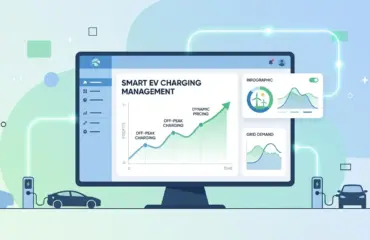
Commercial facilities often have strict grid capacity limits. OCPP enables Smart Charging profiles, allowing the central software to dynamically distribute available power across multiple stations. Whether you are balancing a dozen overnight AC Smart Charging stations in a commercial parking garage or managing ultra-rapid DC Fast Charging networks on a highway corridor, OCPP ensures you never trip the site’s main breaker or incur exorbitant peak-demand utility charges.
4. Simplified Billing and Fleet Authorization
For public stations and commercial fleets, tracking energy consumption down to the kilowatt-hour is essential for accurate billing. OCPP instantly transmits authorization requests (via RFID, mobile app, or Plug & Charge) to the central network and securely relays transactional data back for automated invoicing and roaming agreements.
The PandaExo Advantage: Intelligent Hardware Meets Manufacturing Scale
At PandaExo, we understand that exceptional EV infrastructure requires a marriage of robust hardware engineering and intelligent software communication. As a global leader in smart EV charging solutions, every station we manufacture is engineered with strict OCPP compliance to guarantee seamless integration into your existing networks.
Operating a state-of-the-art 28,000-square-meter manufacturing base, PandaExo controls the entire production lifecycle. This deep manufacturing heritage means we ensure quality at every level of the hardware—from the fundamental power conversion handled by our industrial-grade bridge rectifiers and power semiconductors, all the way up to the cloud-connected logic boards running the latest OCPP standards.
Our Commercial Guarantee:
- Interoperability: Tested compatibility with major global CMS platforms.
- Scalability: Factory-direct OEM/ODM capabilities to support massive regional deployments.
- Future-Ready: Hardware designed to support continuous Over-The-Air (OTA) updates as OCPP standards evolve.
Ready to Build a Smarter Network?
Investing in open-standard infrastructure is the only way to build a resilient, profitable commercial charging business. Don’t let closed systems limit your operational potential.
To discover how our factory-direct scale and OCPP-compliant technology can accelerate your next project, explore our full catalog of smart energy solutions today.