
 Deutsch
  Español
  Français
  Italiano
  Português
  Svenska
  Suomi
Suomi  Dansk
Dansk  Norsk bokmål
  Nederlands
  العربية
  עברית
עברית  Polski
  Türkçe
  Русский
  Uzbek
Uzbek  Azərbaycan
  Tiếng Việt
  ไทย
ไทย  한국어
한국어  日本語
日本語  简体中文
简体中文 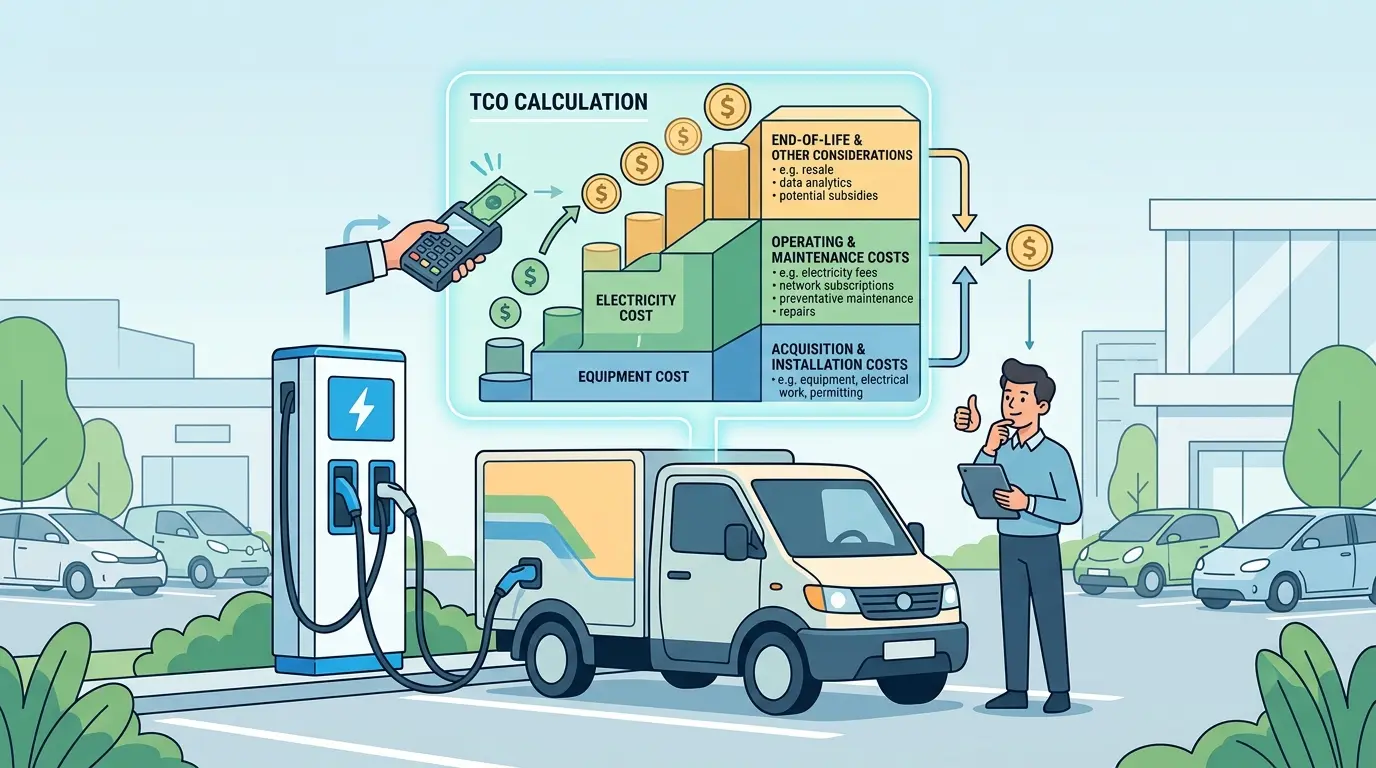
The cheapest charger on an RFQ sheet can become the most expensive asset on the site.
That happens when procurement teams compare cabinet price, connector count, or nameplate power first, while the real economics are being shaped somewhere else: trenching, switchgear, transformer lead times, software subscriptions, demand charges, maintenance dispatch, and the cost of downtime once vehicles start depending on the system.
For commercial EV charging, total cost of ownership is not a finance-only metric. It is an infrastructure design question. The strongest procurement decisions come from matching charger type, site load, service model, and expansion path to the operational role the site actually needs to play.
Why Purchase Price Is Only the Opening Number
Commercial charging projects rarely fail because the charger itself was too expensive. They usually underperform because the ownership model was too narrow.
If procurement compares vendors only by equipment price, it can miss the cost drivers that sit outside the cabinet: civil works, utility coordination, communications, software, preventive service, warranty response, and the business impact of unreliable uptime. A low initial quote may still produce higher five-year cost if it creates more site work, higher peak demand, weaker diagnostics, or earlier replacement pressure.
That is why TCO should be measured at the site level, not only at the unit level. Procurement is not buying a charger in isolation. It is buying a charging outcome: reliable daily charging, high-turnaround energy delivery, fleet readiness, or scalable multi-site visibility.
The Main Cost Layers in Charger Ownership
The most practical way to evaluate TCO is to break it into cost layers that can be priced, challenged, and stress-tested before award.
| Cost Layer | What It Includes | Why It Moves TCO |
|---|---|---|
| Hardware | Charger cabinet, connectors, cable management, mounting format, payment hardware | Visible upfront cost, but often not the dominant lifetime cost |
| Electrical and Civil Works | Trenching, foundations, conduit, panels, protection devices, wiring, signage | Can exceed hardware cost, especially when retrofitting existing sites |
| Utility and Grid Upgrades | Service upgrades, transformers, metering changes, interconnection work | Often determines whether higher-power charging is viable at all |
| Software and Connectivity | Network platform, billing, roaming, monitoring, SIM/data, firmware tools | Recurring cost that affects visibility, interoperability, and future flexibility |
| Operations and Maintenance | Preventive inspections, spare parts, field service, cleaning, cable replacement | Directly affects uptime and long-term operating stability |
| Energy and Demand Charges | Electricity consumption, tariff structure, site peak-demand exposure | Can materially change the economics of moderate or high-power deployments |
| Downtime and Service Failure | Lost charging sessions, fleet disruption, manual support burden, SLA exposure | Low-reliability hardware can create hidden cost far beyond repair invoices |
| Expansion and End-of-Life | Future bay additions, software migration, replacement cycles, decommissioning | A poor first-phase design can make later growth much more expensive |
Which layer matters most depends on the use case. At a workplace or hotel, civil work and software terms may drive the economics more than charger power. At a fleet depot or rapid-turn site, utility readiness, peak load, and uptime risk often matter more than the cabinet price delta between vendors.
AC, Moderate DC, and High-Power DC Create Different TCO Profiles
Not every commercial charging project should be optimized around speed. The right procurement choice depends on dwell time, throughput requirements, and how much electrical complexity the site can support without creating unnecessary cost.
| Charger Approach | Best Fit | Typical Upfront Cost Profile | Main Operational Advantage | Main TCO Risk |
|---|---|---|---|---|
| Smart AC charging | Workplaces, hotels, multifamily, corporate parking, overnight fleet return | Lower hardware and lower installation burden in many cases | Reliable daily charging across more bays | Slow turnaround if vehicles need rapid recovery |
| Moderate DC charging | Mixed-use commercial sites, smaller depots, selective fast-turn needs | Higher than AC, but often below large fast-charge builds | Better throughput without moving straight to ultra-high-power infrastructure | Demand charges and service upgrades can erode the business case |
| High-power DC fast charging | Public fast charging, route-critical fleets, high-turnover commercial sites | Highest hardware, utility, and site-preparation exposure | Fast recovery and more vehicles served per bay | High grid impact, more demanding uptime requirements, and more expensive service response |
In long-dwell environments, AC charging often produces the most manageable TCO because it spreads energy delivery across parked time instead of compressing load into short, expensive peaks. That usually means lower installation intensity, lower concurrency stress, and a better cost-per-bay model when vehicles sit for hours rather than minutes.
Moderate DC can be the right middle ground when the site needs more throughput than AC can provide, but does not need the full complexity of a high-power public fast-charging architecture. In practice, this is often where procurement teams can protect service quality without overbuilding the site on day one.
For short-dwell public sites, route-sensitive fleets, or operations where turnaround speed is directly tied to revenue or vehicle availability, DC charging may still deliver the lowest real operating cost per vehicle served. The mistake is not choosing DC fast charging. The mistake is choosing it where parked duration is already long enough for a simpler, lower-cost charging model to do the job.
The Hidden Costs That Reshape Procurement After Award
Many ownership surprises appear after the purchase order has already been signed. The most common example is utility-side complexity. Service capacity, transformer availability, interconnection approvals, and tariff design can change the economics before the charger is even energized. Procurement teams should model grid capacity, interconnection, and demand charges early rather than treating them as post-award engineering details.
The second hidden cost bucket is software and data control. Platform fees, transaction charges, roaming arrangements, firmware access, API restrictions, and data ownership terms all affect lifetime cost. A charger that looks inexpensive in hardware terms can become costly if the software contract locks the operator into rigid pricing, limits interoperability, or makes future network migration difficult.
Annual maintenance costs for EV charging stations should also be budgeted explicitly rather than buried inside a generic service allowance. Commercial operators should price preventive inspections, replacement components, remote monitoring, cable wear, payment-terminal support, and expected field response times based on actual usage conditions, not optimistic assumptions.
Then there is downtime. Procurement teams sometimes treat uptime as a technical quality issue rather than a cost issue. In reality, downtime can be one of the most expensive line items in the ownership model. It can reduce charging revenue, disrupt fleets, trigger manual support effort, undermine tenant or driver trust, and make future site expansion harder to justify.
How to Compare Vendor Proposals on a Like-for-Like TCO Basis
Good TCO comparison requires normalization. If one vendor includes civil work, commissioning, software, and service, while another quotes hardware only, the comparison is not real.
Procurement teams should normalize proposals around the metrics that matter operationally:
| Comparison Lens | What to Ask | Why It Matters |
|---|---|---|
| Cost per energized bay | What is the total installed cost for each usable charging position? | Prevents low cabinet price from hiding high site-work cost |
| Cost per delivered kWh at target utilization | What does the charger cost when modeled against realistic usage? | Links CapEx and OpEx to actual site performance |
| Cost per vehicle served per day | How many vehicles can the site reliably support? | More useful than connector count alone for commercial operations |
| Warranty and spare-parts scope | What is covered, for how long, and with what response time? | Clarifies lifetime service exposure |
| Platform and billing terms | What are the recurring software, transaction, and communication costs? | Prevents recurring fees from being underestimated |
| Load management capability | Can power be shared, scheduled, or prioritized? | Directly affects demand charges and expansion efficiency |
| Data and interoperability | Does the system support open protocols and exportable operating data? | Protects long-term flexibility and migration options |
| Expansion path | Can future bays or higher utilization be supported without redesign? | Avoids stranded first-phase infrastructure |
This is also where vendor maturity matters. Procurement teams should look beyond brochure claims and ask whether the supplier can support commissioning, firmware lifecycle management, spares planning, and project-specific configuration at scale. For distributors, infrastructure partners, and private-label programs, OEM or ODM readiness may also affect long-term TCO because it shapes branding flexibility, market fit, and replacement consistency across future phases.
One practical rule helps here: compare five-year or seven-year ownership cost under the same utilization, tariff, maintenance, and expansion assumptions. If a vendor cannot support that level of clarity, the risk usually sits with the buyer.
A Procurement Checklist Before You Issue the PO
Before award, procurement teams should be able to answer the following questions clearly:
- What is the actual charging job of the site: long-dwell replenishment, public fast turnover, fleet continuity, or mixed use?
- What level of uptime is operationally required, and what is the cost if the site falls below it?
- How much of the project budget sits in site work and utility readiness rather than hardware?
- What tariff structure applies to the site, and how sensitive is the project to peak demand?
- Are software, payment, connectivity, and network-management fees fully visible across the contract term?
- What maintenance model, spare-parts approach, and field response commitments are included?
- Who owns the operating data, and how difficult would future platform migration be?
- Can the site expand without repeating major civil work or replacing first-phase equipment?
Teams that work through a structured commercial EV charging project checklist usually catch these issues earlier, especially when multiple stakeholders are involved across procurement, facilities, energy, operations, and finance.
Practical Summary
For commercial EV chargers, the right procurement decision is rarely the one with the lowest purchase price. It is the one that produces the lowest defensible cost for the charging outcome the site actually needs.
That means evaluating the full ownership model: hardware, site work, grid upgrades, software, maintenance, tariff exposure, downtime risk, and the cost of future expansion. It also means being honest about fit. AC is not always the cheapest choice, and DC is not always the smartest upgrade. The best option depends on dwell time, vehicle turnover, electrical constraints, and how the operation creates value from charging.
Procurement teams that use TCO as a design tool rather than a finance exercise tend to make better charger decisions, avoid avoidable retrofit costs, and build charging infrastructure that can scale without becoming a budget problem later.