
 Deutsch
  Español
  Français
  Italiano
  Português
  Svenska
  Suomi
Suomi  Dansk
Dansk  Norsk bokmål
  Nederlands
  العربية
  עברית
עברית  Polski
  Türkçe
  Русский
  Uzbek
Uzbek  Azərbaycan
  Tiếng Việt
  ไทย
ไทย  한국어
한국어  日本語
日本語  简体中文
简体中文 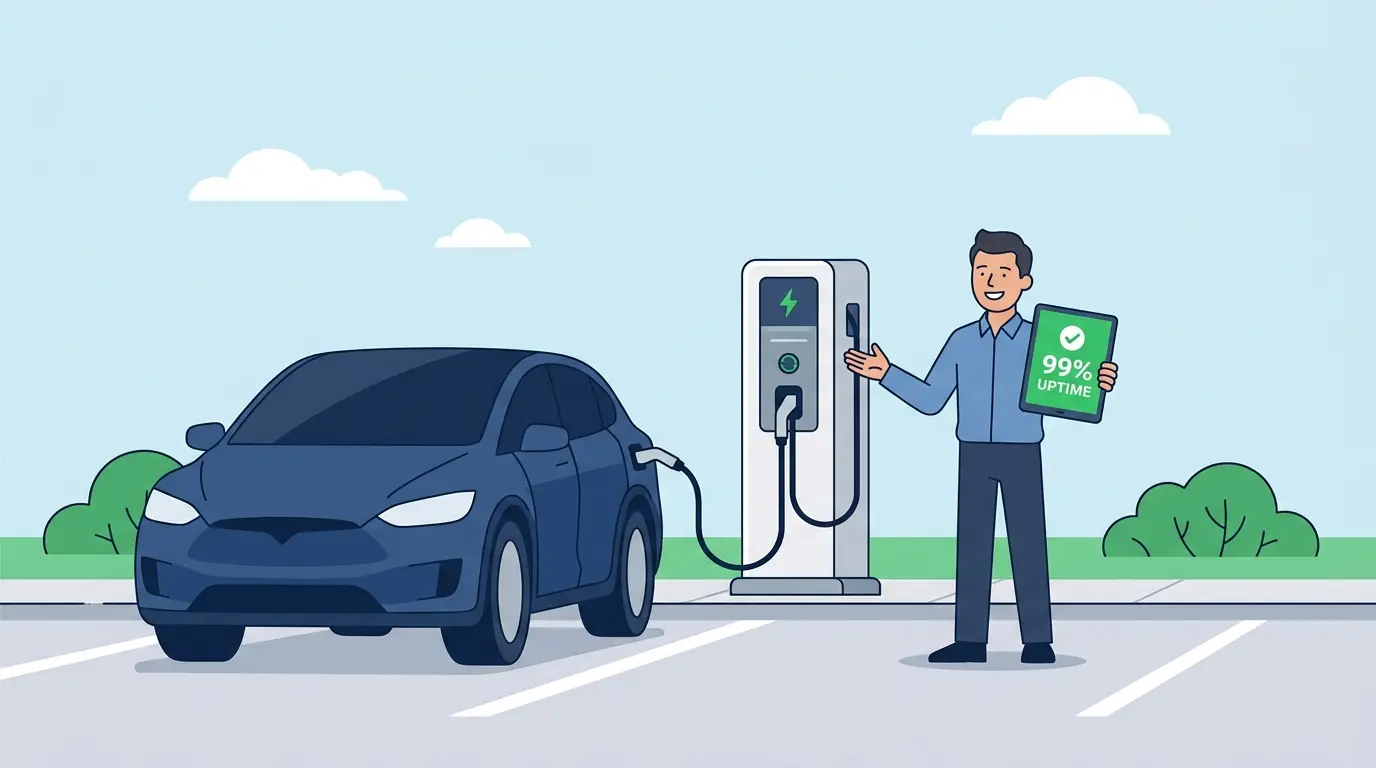
A charger can appear online in a dashboard and still fail the real-world test that matters: can a driver start a session, receive expected power, and leave on schedule? That gap is why uptime SLAs deserve closer scrutiny before procurement teams commit to a vendor.
For infrastructure buyers, fleet operators, site hosts, and channel partners, an uptime promise is only useful when it reflects operational reality. A contract that looks strong on paper can still leave the site exposed if the vendor measures uptime loosely, excludes the most common failure modes, or responds too slowly when high-priority chargers go down.
Why A Headline SLA Can Mislead Buyers
Many buyers compare vendors by looking at one visible number: the promised uptime percentage. That is understandable, but it is rarely enough.
An SLA can look competitive while still allowing too much operational disruption. The problem is not only the percentage itself. It is how the vendor defines availability, which assets are covered, which outages are excluded, and how performance is measured across hardware, software, and communications.
This matters even more when sites serve different charging roles. A workplace AC charging project can usually tolerate longer recovery windows than a depot or commercial location where DC fast charging protects vehicle turnaround and revenue continuity. Buyers should match the SLA to the business consequence of failure, not just the vendor’s marketing language.
Define What “Uptime” Means Before You Compare Vendors
The first question is simple: what exactly counts as uptime in this contract?
Some vendors define uptime as basic network connectivity. Others define it as charger availability for session initiation. The stronger definition is the one that tracks whether the charger can actually perform its job, not merely whether it is sending a heartbeat.
Before signing, buyers should ask whether uptime is measured at the charger level, connector level, site level, or network level. On multi-port equipment, one failed connector should not disappear inside a broader device-level number. On mixed portfolios, an underperforming high-priority charger should not be masked by less critical units elsewhere.
It is also worth asking whether power derating, failed authorization, payment errors, cooling faults, or repeated session drop-offs count as downtime. If a charger is technically online but cannot deliver a usable charging experience, many operators would treat that as operational unavailability.
Ask How Performance Is Measured And Reported
Even a reasonable definition of uptime becomes weak if the reporting method is vague.
Buyers should request a sample uptime report before procurement approval. That report should show how the vendor classifies incidents, timestamps outage start and end, handles partial failure, and distinguishes between planned and unplanned events. A good report should also make it easy to reconcile service tickets with performance claims.
This is where buyers should look beyond the charger itself and into the operating model. Vendors with disciplined monitoring, remote support, and escalation workflows are usually better positioned to prove SLA performance because they already track how failures are detected, triaged, and resolved.
If the vendor cannot explain how uptime is measured month by month, by charger role, and by failure type, the SLA may be more decorative than operational.
Review The Exclusions Before You Trust The Promise
Most SLA risk hides in the exclusions section, not in the headline commitment.
Exclusions are not inherently unreasonable. Utility outages, force majeure events, customer-side misuse, vandalism, and third-party telecom failures may fall outside the vendor’s direct control. The real issue is whether the excluded list is so broad that the buyer keeps most of the operational risk while the vendor still advertises a strong uptime target.
Look carefully at these common carve-outs:
- Planned maintenance windows
- Firmware and software update periods
- Payment gateway or authorization service failures
- Telecom or SIM connectivity issues
- Customer-side LAN, router, or firewall problems
- Utility-side power loss or upstream electrical constraints
- Environmental conditions outside stated operating assumptions
The contract should say which party owns each category, how incidents are documented, and what evidence is needed before an outage is excluded. Otherwise, the buyer may end up arguing after every major incident instead of relying on a shared service standard.
Separate Hardware Responsibility From Platform Responsibility
Many EV charging problems sit between hardware and software. A cable fault, a controller issue, a payment failure, and an OCPP communication breakdown can all stop charging, but they do not belong to the same response team.
That is why buyers should insist on a clear responsibility matrix. Who owns charger hardware? Who owns backend software? Who handles cloud services, roaming, payment flows, firmware validation, and interoperability with third-party systems? Who leads incident resolution when the root cause is unclear at first?
This question becomes especially important in open ecosystems. Buyers often prefer open charging networks and interoperability models because they reduce lock-in and give more flexibility over the life of the site. But openness only helps if the vendor is explicit about where its SLA starts and stops when multiple systems interact.
If the platform is provided by one party and the charger by another, the buyer should not accept a contract structure that allows each side to blame the other while the site remains partially down.
Match Response Times To Site Criticality
An uptime SLA is incomplete without response and restoration commitments.
For a fleet depot, transport hub, highway corridor, or any site where charging downtime can interrupt schedules, buyers should ask for severity-based response windows. A minor display fault and a failed high-priority DC charger should not enter the same service queue.
The practical questions are:
- How quickly will the vendor acknowledge a critical incident?
- How quickly will remote diagnostics begin?
- When does on-site dispatch happen?
- What is the target for temporary workaround versus full repair?
- Are spare parts stocked locally, regionally, or only at the factory?
- Is there a replacement-unit strategy for high-value failures?
This is where buyer context matters. AC charging in long-dwell environments often supports more flexible restoration windows. DC fast charging used for short-turnaround operations usually requires tighter service commitments because every lost hour affects throughput and site economics.
Ask How Updates Affect Availability
Software and firmware are part of the uptime discussion, not separate from it.
Updates can improve reliability, security, and compatibility, but they can also create planned downtime, failed rollouts, or new faults if they are not staged properly. Buyers should ask whether maintenance windows count against the SLA, how updates are approved, how rollback is handled, and whether the vendor validates new releases on a limited subset before wider deployment.
The strongest vendors treat firmware update strategy as an uptime protection process rather than a background technical task. That usually means change control, phased deployment, alarm monitoring after release, and clear customer communication when risk is elevated.
If the contract gives the vendor broad freedom to take chargers offline for updates without meaningful notice or service accountability, the buyer should tighten that language before signing.
Clarify Which KPIs Matter Beyond Uptime
A charger can satisfy a narrow uptime metric and still deliver a poor operating outcome. That is why buyers should ask for supporting performance indicators alongside the SLA.
Useful questions include whether the vendor tracks:
- Successful session start rate
- Successful session completion rate
- Mean time to acknowledge critical incidents
- Mean time to restore service
- Repeat fault frequency by charger or connector
- Power derating events and duration
- Offline duration by failure cause
These metrics create a more complete picture of service quality. In many cases, buyers should care as much about incident recovery discipline and session success as they do about the headline uptime percentage.
Secure Data Access Before Renewal Or Exit Becomes A Problem
An uptime SLA should also support long-term operational control. If the buyer cannot access incident history, logs, firmware records, or charger performance data, it becomes harder to validate the vendor’s claims and harder to transition later if the relationship changes.
Before signing, buyers should confirm ownership and access rights for operational data, event logs, configuration records, and service history. The contract should also describe export format, retention period, and handover obligations if the buyer changes network providers or service partners.
This is one reason a structured data handover checklist matters before any platform commitment becomes deeply embedded. A buyer who cannot retrieve operational history often discovers too late that the SLA was difficult to audit in the first place.
Make Remedies Proportional To Business Risk
Service credits are common in SLA design, but buyers should ask whether the proposed remedy actually matches the operational consequence of failure.
For noncritical sites, a modest credit structure may be acceptable. For high-utilization commercial or fleet deployments, credits alone may not offset lost throughput, dispatch disruption, customer dissatisfaction, or contractual penalties with downstream users.
In those cases, buyers may want stronger commercial protections, such as:
- Escalating remedies for repeated missed targets
- Mandatory root-cause reports after severe outages
- Defined spare-parts stocking obligations
- Priority replacement for failed high-value units
- Termination rights after repeated material breaches
The right remedy structure depends on the site’s business model, but the principle is simple: the contract should reflect how costly charger failure is in practice.
Buyer Questions To Put On The Table Before Signing
| What To Ask | Why It Matters | What A Stronger Answer Looks Like |
|---|---|---|
| How do you define uptime? | Prevents heartbeat-only definitions from masking real charging failures | Availability tied to usable charging, not just connectivity |
| Is uptime measured by charger, connector, or site? | Avoids averaging that hides partial outages | Granular reporting by asset and role |
| Which events are excluded from the SLA? | Reveals how much risk stays with the buyer | Narrow exclusions with clear evidence rules |
| What are your severity-based response and restoration targets? | Connects the SLA to business-critical recovery | Separate workflows for critical and noncritical failures |
| Who owns hardware, backend, firmware, and third-party integrations? | Reduces blame gaps during complex incidents | Clear responsibility matrix and escalation path |
| How are updates staged and rolled back? | Protects against self-inflicted downtime | Controlled release process with rollback discipline |
| What operational KPIs support the uptime claim? | Adds session-level visibility beyond one percentage | Session success, MTTR, repeat faults, and outage cause tracking |
| What data can the buyer export during renewal or migration? | Preserves auditability and future control | Defined access, retention, and handover obligations |
| What remedy applies if the target is missed repeatedly? | Aligns contract terms with operational risk | Meaningful credits plus escalation, reporting, or exit rights |
Practical Summary
Charger uptime SLAs are worth far more than a headline percentage. For buyers, the real question is whether the vendor’s promise reflects charger usability, incident response discipline, software accountability, and the operational consequences of failure at the site level.
The best contracts define uptime clearly, measure it transparently, limit exclusions carefully, and tie service commitments to charger criticality. They also treat updates, interoperability, data access, and escalation workflows as part of service performance rather than side topics.
Before signing with any vendor, buyers should push the conversation past the top-line SLA number and into the mechanics of how reliability is delivered. That is where procurement risk becomes operational clarity.