
 Deutsch
  Español
  Français
  Italiano
  Português
  Svenska
  Suomi
Suomi  Dansk
Dansk  Norsk bokmål
  Nederlands
  العربية
  עברית
עברית  Polski
  Türkçe
  Русский
  Uzbek
Uzbek  Azərbaycan
  Tiếng Việt
  ไทย
ไทย  한국어
한국어  日本語
日本語  简体中文
简体中文 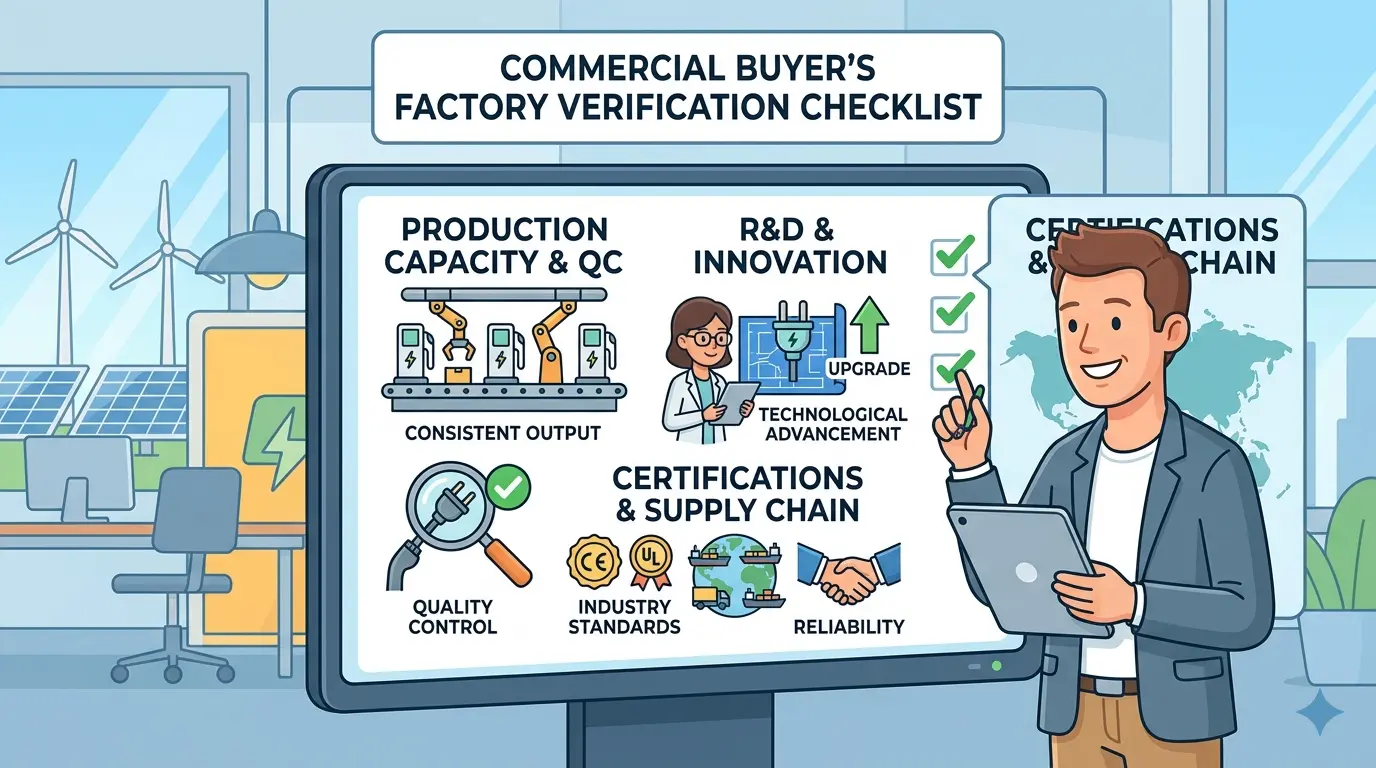
A charger sample can pass a demo and still become a procurement problem six months later. Commercial buyers usually discover the gap only after rollout begins: the pilot firmware does not match the production batch, spare-parts coverage is unclear, certification paperwork does not fit the destination market, or the supplier can build 20 units well but struggles to maintain quality at 500.
That is why factory approval should be treated as an operational risk review, not a box-checking visit. For distributors, fleet infrastructure teams, project developers, site hosts, and private-label programs, the real question is whether the factory can repeatedly deliver the right charger configuration, documentation, interoperability, and post-sale support at commercial scale.
Factory Approval Is Really A Repeatability Test
Commercial buyers are not only approving a building, an assembly line, or a product brochure. They are approving a manufacturing system that will affect site fit, charging uptime, software compatibility, replacement cycles, and procurement risk for years.
The level of scrutiny should match the project. A buyer qualifying AC chargers for a small workplace pilot does not need the same audit depth as a network operator approving high-power DC chargers for public sites. But in both cases, factory approval still comes down to the same issue: can this supplier build the same product, to the same standard, with the same support discipline, every time?
| Verification Area | What Buyers Should Verify | Why It Matters |
|---|---|---|
| Charger fit | Whether the factory truly builds the AC or DC class the project requires | Better site fit and lower risk of buying the wrong architecture |
| Compliance control | Certification scope, test records, and market-specific documentation | Lower approval delays and procurement risk |
| Power and thermal design | Component selection, derating logic, cooling, and protection design | Better reliability, safety, and charger throughput |
| Software and firmware governance | OCPP support, release control, remote diagnostics, and rollback discipline | Stronger network visibility and fewer field issues |
| Production control | Traceability, line consistency, change control, and capacity planning | Easier scaling from pilot to rollout |
| Service readiness | Spare parts, escalation workflow, RMA process, and field support | Lower downtime and faster issue resolution |
Verify The Factory Builds The Charger Category Your Project Actually Needs
Many factory visits go wrong because the buyer audits manufacturing before locking the deployment logic. Factory approval should happen after the buyer has already defined dwell time, power expectations, connector strategy, operating model, and expansion plan. A disciplined commercial EV charging project checklist helps keep the audit tied to the real project instead of turning it into a generic supplier tour.
That matters because a factory can appear impressive while still being the wrong manufacturing partner for the actual use case. A site portfolio built around daily workplace charging, multifamily parking, or overnight fleet replenishment requires a very different production strength than a rollout centered on public fast charging, corridor traffic, or route-critical commercial vehicles. Buyers should confirm not just that the supplier offers chargers, but that it repeatedly builds the charger type, mounting format, connector mix, and software behavior the project depends on.
In practical terms, buyers should ask to see the production and test flow for the exact charger class under consideration. If the program depends on DC fast charging, inspect the line that handles higher-power assemblies, protection systems, cable management, and thermal control. If the core need is smart AC deployment, verify metering, access control, enclosure options, and load-sharing behavior. The goal is not portfolio breadth on paper. It is evidence that the factory is strongest where the project will actually make money or protect operations.
Check Compliance, Test Discipline, And Traceability
Certifications matter, but commercial buyers should not approve a factory on logos alone. The stronger question is whether the factory can show controlled, repeatable compliance discipline across the markets it wants to serve. That includes market-relevant declarations, test reports, version alignment between certified units and shipping units, and a documented process for handling revisions. Buyers who need a sharper framework for this review should start with the core questions in PandaExo’s guide to CE and TUV certification for EV chargers.
Beyond paperwork, ask how the factory tracks serial numbers, component lots, test outcomes, rework, and final inspection results. Can it trace a failed charger back to a production batch? Can it identify when a supplier substitution occurred? Can it show whether software and hardware revisions were aligned at the time of shipment? Without that level of traceability, field failures become harder to diagnose, warranty costs rise, and cross-border procurement becomes riskier.
Useful questions include:
- What final acceptance tests does every unit pass before shipment?
- What environmental, load, or protection tests are done by sample and by batch?
- How are failed units quarantined, repaired, and released back into stock?
- When a design revision happens, how is certification impact assessed before shipment resumes?
Review Power Electronics And Thermal Design Competence
For commercial infrastructure buyers, factory approval should include a serious review of power-conversion competence. That does not mean turning the audit into a semiconductor lecture. It means confirming that the supplier can explain its own electrical architecture clearly enough to prove engineering control.
Ask how the charger handles thermal stress, load variation, surge conditions, grounding faults, contactor wear, and power derating. Review enclosure protection strategy, cable durability, connector life assumptions, and cooling design at the power levels you plan to deploy. A supplier that can only recite rated power without explaining how performance is protected under real operating conditions is asking the buyer to absorb reliability risk later.
This is where technical depth translates directly into business outcomes. Better thermal management supports higher charger availability at busy sites. Stronger power-electronics design helps reduce nuisance trips, unplanned service visits, and throughput loss. More disciplined component selection lowers the chance that a pilot unit performs well while the scaled rollout suffers from substitutions or inconsistent builds.
Verify Software, Firmware, And Interoperability Governance
If the chargers will operate across multiple sites, software discipline becomes part of factory approval. Buyers should ask which versions of OCPP are supported, which profiles are active, how logs are exported, how remote diagnostics work, and how the charger behaves when the network is unstable. Interoperability is not a marketing add-on. It affects commissioning speed, platform visibility, roaming readiness, and the long-term ability to avoid vendor lock-in.
Commercial teams should also separate cloud features from embedded charger logic. The distinction between charger software and firmware matters during factory approval because failures in these layers create different operational problems. Firmware discipline affects charger behavior, protection logic, and hardware compatibility. Software discipline affects dashboards, permissions, reporting, billing flows, and fleet visibility. Buyers should ask how releases are controlled, how bugs are escalated, how rollback is handled, and whether custom branding or customer-specific settings are isolated cleanly from the core code base.
At minimum, buyers should verify:
- Release notes and version-control discipline
- Remote update process and rollback method
- Interoperability test evidence with the target platform stack
- Event log availability for service teams and network operators
- Responsibility boundaries between the factory, software team, and local support partner
Audit Production Capacity And Change-Control Before You Scale
A successful pilot does not prove a factory is ready for a large commercial rollout. Buyers should inspect how production is scheduled, where bottlenecks sit, which processes are subcontracted, and what happens when key components become constrained. The right question is not only “How many units can you produce per month?” It is “How many units of this exact charger configuration can you produce while holding the same quality standard, lead time, and documentation discipline?”
Change control is just as important as raw output. Commercial buyers should require clarity on engineering change notices, approved vendor substitutions, end-of-life component handling, BOM freeze rules, and notification timing. A factory that changes meters, contactors, cables, communications modules, or enclosures without a formal approval path can create hidden compatibility problems across a site portfolio.
This is especially important for buyers planning phased expansion. If the second and third shipment waves are not materially consistent with the first, operators can end up managing mixed firmware behavior, uneven spare-parts inventories, and inconsistent maintenance procedures across supposedly identical sites.
Evaluate OEM And ODM Governance If Private Label Is In Scope
Commercial buyers using private-label, regional adaptation, or channel-specific branding should treat OEM and ODM governance as a separate approval workstream. Too many programs approve the factory on the base charger, then discover later that branded labels, UI localization, packaging, manuals, app branding, and connector variations are handled informally.
That is a problem because customization changes more than appearance. It can affect compliance scope, documentation accuracy, after-sales responsibility, firmware branches, and spare-parts mapping. Buyers should ask which changes are cosmetic, which changes trigger engineering review, and which changes require new validation before shipment.
Practical controls include:
- A golden sample signed off before mass production
- Clear ownership of labels, manuals, cartons, and serial conventions
- Documented approval flow for interface, enclosure, or connector changes
- A defined rule for when a custom request triggers retesting or recertification
- Warranty terms that stay aligned with the customized configuration, not only the base model
Confirm Post-Shipment Support, Spares, And Escalation Before Approval
Factory approval is incomplete if it stops at shipment. Commercial buyers should verify what happens after installation when a charger fails, a communications module misbehaves, or a site needs replacement parts quickly.
Ask whether the factory provides commissioning support, remote troubleshooting, spare-parts kits, structured fault reporting, and root-cause analysis for repeated failures. Confirm who owns first response, who decides whether a unit is replaced or repaired, and how long escalation takes when a site outage affects driver experience or fleet readiness. A low unit price can be wiped out quickly by slow service loops, unclear warranty routing, or missing spares.
This is also where buyers should test the supplier’s documentation discipline. Installation instructions, commissioning steps, fault-code definitions, wiring guidance, and service manuals should be readable, revision-controlled, and aligned with the exact hardware being shipped. If the factory cannot support the field team cleanly, post-sale friction will move from the supplier to the buyer’s operations budget.
A Practical Factory Approval Sequence
For most commercial procurement teams, factory approval is strongest when it follows a staged sequence instead of a one-day impression.
- Define the deployment model first: charger type, power range, site pattern, software stack, and expansion plan.
- Review documentation before the visit: certifications, test records, drawings, firmware notes, and service materials.
- Audit the exact production line and test flow for the target charger configuration.
- Verify traceability, change control, and supplier-substitution rules.
- Test interoperability, remote diagnostics, and post-sale escalation processes.
- Use a pilot order to confirm that shipping units match the approved sample and documentation set.
That sequence helps buyers avoid the most common mistake in charger procurement: approving the supplier relationship before proving delivery discipline under real project conditions.
Practical Summary
The strongest EV charger factory partners are not the ones with the lowest quoted price or the smoothest tour. They are the ones that can repeatedly build the right charger architecture, control quality and revisions, support open interoperability, and keep documentation, spare parts, and service aligned as volumes grow.
Before approving any EV charger manufacturing partner, commercial buyers should verify six things clearly: charger-category fit, compliance discipline, power-electronics competence, software and firmware governance, production change control, and post-shipment support readiness. When those checks are done well, buyers reduce procurement risk, improve site fit, and give themselves a stronger foundation for scaling commercial charging infrastructure without avoidable operational drag.