
 Deutsch
  Español
  Français
  Italiano
  Português
  Svenska
  Suomi
Suomi  Dansk
Dansk  Norsk bokmål
  Nederlands
  العربية
  עברית
עברית  Polski
  Türkçe
  Русский
  Uzbek
Uzbek  Azərbaycan
  Tiếng Việt
  ไทย
ไทย  한국어
한국어  日本語
日本語  简体中文
简体中文 
In EV charging procurement, software and firmware are often discussed together and sometimes treated as if they are interchangeable. They are not. That confusion can lead to the wrong technical questions during vendor evaluation, poor update governance after deployment, and avoidable support friction when chargers misbehave in the field.
For CPOs, site hosts, distributors, project developers, and OEM partners, the distinction matters because it affects how you evaluate flexibility, interoperability, serviceability, and long-term operating risk across a portfolio of EV chargers.
The Simple Difference Between Software and Firmware
Firmware is the embedded code that runs inside the charger hardware. It governs how the charger behaves as a device: power-stage logic, connector handling, protection states, communications timing, sensor response, and internal control routines.
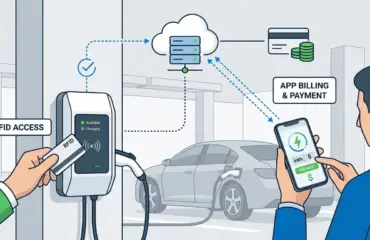
Software usually refers to the higher-level systems around the charger: backend platforms, dashboards, billing layers, mobile apps, access control, reporting tools, and fleet or site management interfaces. That is the layer operators and administrators interact with most directly.
The clearest way to think about it is this: firmware controls the charger as a machine, while software controls the charger as part of a networked business system.
| Layer | Primary Role | Typical Examples | Main Business Impact |
|---|---|---|---|
| Firmware | Controls charger behavior at device level | Relay logic, safety checks, communication timing, thermal response, session handling | Reliability, safety, compatibility, and device stability |
| Software | Manages charger behavior at network or business level | Portals, billing, access control, apps, reporting, fleet rules, alerts | Visibility, monetization, user experience, and portfolio operations |
Why the Distinction Matters in Real Operations
When a charger is online but performing incorrectly, the problem may exist in either layer. A tariff mismatch, user-permission problem, or reporting issue usually points toward software. A handshake problem, unstable connector behavior, protective-state failure, or irregular session control often points closer to firmware.
This matters because the fix path changes. Some issues can be resolved by configuration updates or backend changes. Others require a firmware patch, a supervised field update, or in some cases direct hardware inspection. Operators who do not separate those possibilities often lose time escalating the problem to the wrong team.
If your team is diagnosing charger behavior from alarms and field reports, it also helps to understand how those symptoms surface in practical troubleshooting workflows such as PandaExo’s guide to charger fault codes.
| Common Field Issue | More Likely Layer | Why |
|---|---|---|
| User cannot start session despite valid account | Software | Usually tied to authentication, permissions, or platform rules |
| Charger display shows wrong pricing or tariff | Software | Commercial logic usually lives in backend or management systems |
| Charger boots but fails to complete charging handshake reliably | Firmware | Device-level protocol timing and control behavior are often involved |
| Charger trips protective state unexpectedly under load | Firmware | Thermal logic, sensing, and low-level protection routines are likely relevant |
| Charging data appears late or incomplete in portal | Software | Reporting, communication routing, or cloud-side processing is often the cause |
| Device behaves differently after an update | Either | Could be firmware behavior change or a software-side compatibility issue |
What Software Usually Controls in a Commercial Charging Network
In most commercial deployments, software owns the operational and commercial layer. That includes:
- User authentication and access rules
- Payment workflows and tariff structures
- Fleet policies and charging schedules
- Monitoring dashboards and alert routing
- Session history, reporting, and analytics
- Support workflows and service visibility
Software is also where interoperability becomes visible to the operator. Even when the physical charger is capable, a poor software layer can still create weak roaming support, limited visibility, and unnecessary operational overhead. That is why buyers should understand not only the hardware but also the communication standards and management stack behind it, including OCPP-driven interoperability.
What Firmware Usually Controls Inside the Charger
Firmware sits closer to charging performance, safety, and device resilience. It governs how the charger boots, how it responds to command sequences, how it supervises internal states, and how it reacts when real-world conditions drift away from ideal test conditions.
Typical firmware responsibilities include:
- Session initiation and control flow
- Connector and locking behavior
- Sensor reading and thermal supervision
- Relay or contactor sequencing
- Protection-state enforcement
- Communication timing with the vehicle and other internal boards
- Recovery behavior after interruptions or abnormal events
This is why a charger can look strong in a sales demo but still disappoint in the field if device-level behavior is not mature. In smart connected products, the real operating experience depends on how well firmware and software work together, especially in feature-rich product families such as smart AC wallbox solutions.
Questions Buyers Should Ask Before Procurement
Many charger evaluations stay too focused on power rating, connector type, and headline features. Those matter, but they do not tell you how governable the product will be after rollout.
The better questions are the ones that separate firmware capability from software promise.
| Buyer Question | Why It Matters |
|---|---|
| Which features are controlled in firmware and which depend on the backend? | Clarifies where flexibility actually lives and which changes require deeper intervention |
| How are firmware updates delivered, approved, and rolled back? | Reduces update risk across multi-site or revenue-sensitive deployments |
| What happens if network connectivity fails during an update? | Exposes recovery maturity and field resilience |
| Which logs are visible to operators, installers, and factory support? | Determines how quickly faults can be isolated and escalated |
| Can commercial workflows change without reflashing charger firmware? | Helps separate configurable platform features from hard-coded behavior |
| Are firmware release notes and compatibility dependencies documented clearly? | Protects long-term maintainability and change control |
These are lifecycle questions, not launch questions. A charger that is easy to approve during procurement but hard to govern over three to five years can become expensive very quickly.
Why OEM and ODM Partners Should Care Even More
For OEM and ODM programs, the software-versus-firmware boundary affects more than troubleshooting. It shapes branding scope, support ownership, regional adaptation, compliance coordination, and release management.
Some partners want branded apps, dashboards, and user-facing workflows while keeping device behavior largely standard. Others want specialized charging logic, market-specific functionality, or tighter integration with an existing platform stack. Those goals touch different layers, and confusing them creates avoidable project risk.
| OEM or ODM Goal | More Likely Layer | What Partners Should Clarify Early |
|---|---|---|
| Branded app and portal experience | Software | UI ownership, access rules, billing model, and data visibility |
| Region-specific charging behavior or custom operating sequence | Firmware | Validation scope, testing burden, and release-control process |
| Fleet or enterprise reporting workflows | Software | API structure, dashboards, permissions, and export logic |
| Specialized device behavior tied to hardware options | Firmware | Board-level compatibility, certification impact, and update governance |
Clear responsibility boundaries are what keep a custom charging program maintainable. Mature manufacturing partners define where customization lives, who owns each update stream, and how the two layers are tested together before release.
How PandaExo Approaches the Full Product Stack
PandaExo’s value here is not just that it supplies charging hardware. It is that hardware, device behavior, and energy-management capability are approached as part of a single commercial system rather than as disconnected layers.
That matters for buyers who need more than a power rating on a datasheet. It matters for CPOs that need network visibility, for distributors that need dependable support logic, and for OEM and ODM partners that need a realistic path to customization without creating an unmanageable service burden.
Because PandaExo supports both AC and DC charging scenarios alongside OEM and ODM capability, buyers can evaluate not just charger class or output level, but also how adaptable and maintainable the broader product stack will be over time.
Final Takeaway
Software and firmware are closely linked in EV charging, but they solve different problems. Software usually shapes operations, monetization, visibility, and user experience. Firmware usually governs device behavior, protective logic, and low-level charging performance.
Buyers who understand that distinction make better vendor comparisons, ask better technical questions, and reduce long-term support risk. If you are sourcing charging products for commercial deployment or custom-branded programs, PandaExo can help you evaluate the hardware, platform, and lifecycle implications together. Contact the PandaExo team to discuss AC, DC, and OEM-ready charging solutions.