
 Deutsch
  Español
  Français
  Italiano
  Português
  Svenska
  Suomi
Suomi  Dansk
Dansk  Norsk bokmål
  Nederlands
  العربية
  עברית
עברית  Polski
  Türkçe
  Русский
  Uzbek
Uzbek  Azərbaycan
  Tiếng Việt
  ไทย
ไทย  한국어
한국어  日本語
日本語  简体中文
简体中文 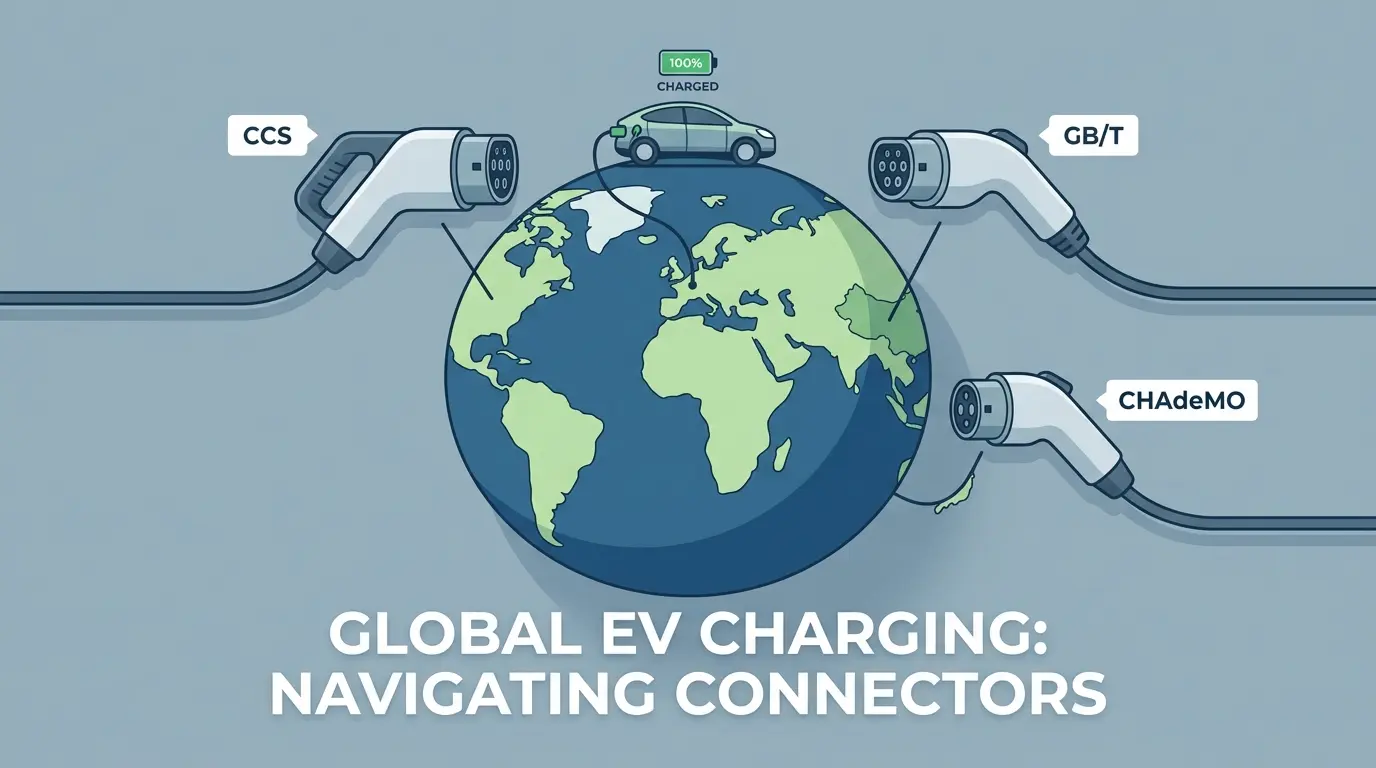
Many EV charging projects fail to localize at the connector layer long before they fail at the power layer. A charger platform may have the right output range, enclosure design, and software stack, yet still create procurement friction if the connector strategy does not match the vehicles, regulations, and operating model in the target market.
For distributors, site developers, fleet operators, and OEM or ODM partners, connector strategy is not just a question of which plug to offer. It affects certification scope, inventory planning, site usability, adapter policy, cable management, service training, and future expansion. The right answer is rarely “support everything everywhere.” The better approach is to match connector architecture to market reality.
Connector Strategy Is Really a Market-Entry Strategy
In global EV charging, the connector decision sits at the intersection of technical compatibility and commercial execution. It determines whether a charger can serve the expected vehicle base without creating avoidable friction for installers, operators, or end users.
That is why connector planning should be treated as a market-entry decision, not a late-stage hardware detail. The questions are broader than plug format alone:
- Which AC and DC standards dominate in the target region today?
- Is the project serving public charging, private fleets, mixed-use commercial sites, or channel resale?
- Does the business need one market-specific SKU, a modular family, or a multi-connector cabinet?
- How much transition risk exists because of changing standards, imported vehicles, or mixed regional fleets?
When those questions are answered early, buyers reduce the risk of stranded inventory, awkward site experiences, and retrofits that could have been avoided.
The Connector Landscape by Region
No global connector strategy works unless it starts with regional reality. The table below is a practical planning view rather than a regulatory checklist.
| Market | Common AC Interface | Common DC Interface | Planning Implication |
|---|---|---|---|
| North America | J1772 remains common, with NACS increasingly important in some vehicle and site segments | CCS1 and NACS both matter in many deployments | Transition planning is critical because installed base and future demand may not follow the same path |
| Europe | Type 2 | CCS2 | Public and commercial projects usually benefit from a cleaner standards environment, but certification and interoperability discipline still matter |
| China | GB/T | GB/T | Connector choice is tied closely to local compliance, domestic vehicle compatibility, and market-specific hardware planning |
| Japan and certain legacy deployments | Varies by vehicle mix and project type | CHAdeMO may still matter in legacy or niche environments | Support only where the business case justifies it, rather than assuming it belongs in every global rollout |
The main lesson is simple: charger power class does not define market fit by itself. A 120kW charger with the wrong connector mix is still the wrong product for the market.
Why One Global Connector Plan Usually Fails
Global buyers often try to simplify expansion by forcing one connector configuration across multiple regions. That can look efficient in procurement, but it usually shifts complexity downstream.
First, vehicle compatibility changes by market. The same commercial property owner may need one connector strategy in Germany, another in the United States, and a different one again for a China-focused channel program. Second, user expectations change. In one region, a public site may need broad walk-up compatibility. In another, the real need may be fleet standardization and controlled access.
Third, the connector decision changes the hardware and service burden. Cable assemblies, locking mechanisms, temperature sensing, replacement parts, and installer familiarity do not remain identical across standards. Even the AC-side choice between Type 1 and Type 2 changes the practical deployment discussion, which is why PandaExo’s guide to IEC 62196 Type 2 vs. SAE J1772 remains relevant for buyers planning across regions.
The result is that one global SKU often looks simpler on a spreadsheet than it does in the field.
When Standardization Still Makes Sense
That does not mean global standardization is a mistake. It means the right layer must be standardized.
For many manufacturers, distributors, and multi-market buyers, the most practical model is to standardize the core platform while localizing the interface layer. In other words, keep the underlying power architecture, control logic, HMI philosophy, remote diagnostics, and manufacturing framework as consistent as possible, then adapt connector outputs, cable sets, and compliance details for each market.
This approach often works well for OEM and ODM programs because it protects engineering reuse without forcing a poor local fit. It can also reduce procurement risk by keeping more of the system common across product families. A supplier with a broader EV charger portfolio is often better positioned to support that balance than a vendor built around a single charger format.
From an operations perspective, standardized core platforms also make it easier to manage firmware governance, service documentation, parts planning, and network visibility across regions.
Choosing Between Single-Standard and Multi-Connector Hardware
The next decision is not just which connector to support, but how many connectors should be supported on the same asset.
| Strategy | Best Fit | Operational Strength | Main Tradeoff |
|---|---|---|---|
| Single-standard hardware | Mature markets with a clear vehicle standard and predictable user base | Simpler maintenance, training, and user experience | Less flexible if the market mix shifts |
| Market-specific regional SKUs | Global programs entering several distinct regions | Strong local fit without overcomplicating each site | More SKU management across the portfolio |
| Dual-standard planning | Transitional markets or mixed commercial environments | Better compatibility during standard shifts | Higher inventory and service complexity |
| Multi-connector shared-power systems | Large depots, charging hubs, ports, or sites serving mixed fleets | Better asset utilization and flexible power distribution | More planning discipline required around traffic flow, cable layout, and service support |
Single-standard hardware usually makes the most sense when the local vehicle mix is stable and the site economics reward simplicity. Public or fleet charging projects in well-defined markets often benefit from that approach.
Multi-connector architecture becomes more attractive when the site cannot afford to guess wrong. That often includes logistics hubs, mixed-brand fleets, cross-border corridors, importer-driven markets, and high-value commercial sites that need broader compatibility without duplicating full power cabinets. In those cases, a system such as PandaExo’s 240-1080kW multi-connector group charging system can be relevant because it separates connector access from a one-cabinet-per-vehicle model and supports more flexible power allocation.
Do Not Treat Adapters as the Core Strategy
Adapters can solve a tactical problem, but they rarely solve a market strategy problem.
They are useful when handling imported vehicles, temporary compatibility gaps, pilot deployments, or transitional cross-market demand. They are much less effective as the long-term foundation of a commercial charging program. Overreliance on adapters can complicate support, training, warranty expectations, and user confidence, especially in unattended public or semi-public environments.
For buyers navigating cross-market compatibility, PandaExo’s article on CCS1 to CCS2 charging adapters for European importers is a good reminder that adapters are best treated as controlled exceptions, not as a substitute for proper connector localization.
Connector Strategy Also Shapes Compliance and After-Sales Execution
Connector selection affects far more than the charger faceplate. It also influences test scope, certification documentation, cable and plug sourcing, installation practice, spare-parts stocking, field-service training, and end-user instructions.
That is especially important for global channel programs. A charger that is technically compatible with a market still needs the right compliance path and documentation package for that region. PandaExo’s overview of CE and TUV certification for EV chargers illustrates why approval planning should stay tied to the target market from the beginning rather than being treated as an afterthought.
For distributors and OEM partners, this is where connector strategy becomes a service strategy. If the business cannot support the connector family with trained installers, replacement parts, and clear operating guidance, the commercial risk rises even if the electrical design is sound.
A Practical Connector Selection Framework for Global Buyers
The most reliable connector strategy usually follows a sequence rather than a guess.
- Define the market cluster first.
Start with the target region, not the existing product catalog. North America, Europe, China, and mixed importer markets should not be treated as interchangeable. - Map the real vehicle mix.
Public passenger charging, depot charging, commercial parking, and heavy-duty fleet environments often require different connector priorities even within the same country. - Separate platform commonality from connector localization.
Standardize the control layer and core power platform where possible, then decide which connector components should change by market. - Decide whether the site needs simplicity or optionality.
If throughput, uptime, and service simplicity matter most, single-standard hardware may be the better choice. If the site serves uncertain or mixed vehicle demand, multi-connector planning may protect future fit better. - Lock the compliance and support path before launch.
Connector choice should be approved alongside certification, documentation, spare parts, and installer readiness, not after the first shipment. - Review the next three years, not just today’s demand.
The best connector strategy is rarely the one that only matches the current fleet. It is the one that can support expected market movement without forcing an expensive redesign too soon.
Practical Summary
The right connector strategy for global EV charger markets is not the broadest menu of plugs. It is the configuration that gives each target market the compatibility it actually needs without creating unnecessary complexity in certification, inventory, support, or site operations.
In practice, that usually means standardizing the charger platform where it protects scale, then localizing the connector layer where the market demands it. Single-standard hardware works best when local conditions are clear and stable. Multi-connector systems make more sense when vehicle mix, market transition, or site economics make flexibility valuable. Adapters can bridge gaps, but they should not carry the full strategy.
For global buyers, distributors, and OEM or ODM partners, the strongest connector decision is the one that improves market fit, reduces procurement risk, and keeps expansion options open without turning the charging portfolio into a service burden.