
 Deutsch
  Español
  Français
  Italiano
  Português
  Svenska
  Suomi
Suomi  Dansk
Dansk  Norsk bokmål
  Nederlands
  العربية
  עברית
עברית  Polski
  Türkçe
  Русский
  Uzbek
Uzbek  Azərbaycan
  Tiếng Việt
  ไทย
ไทย  한국어
한국어  日本語
日本語  简体中文
简体中文 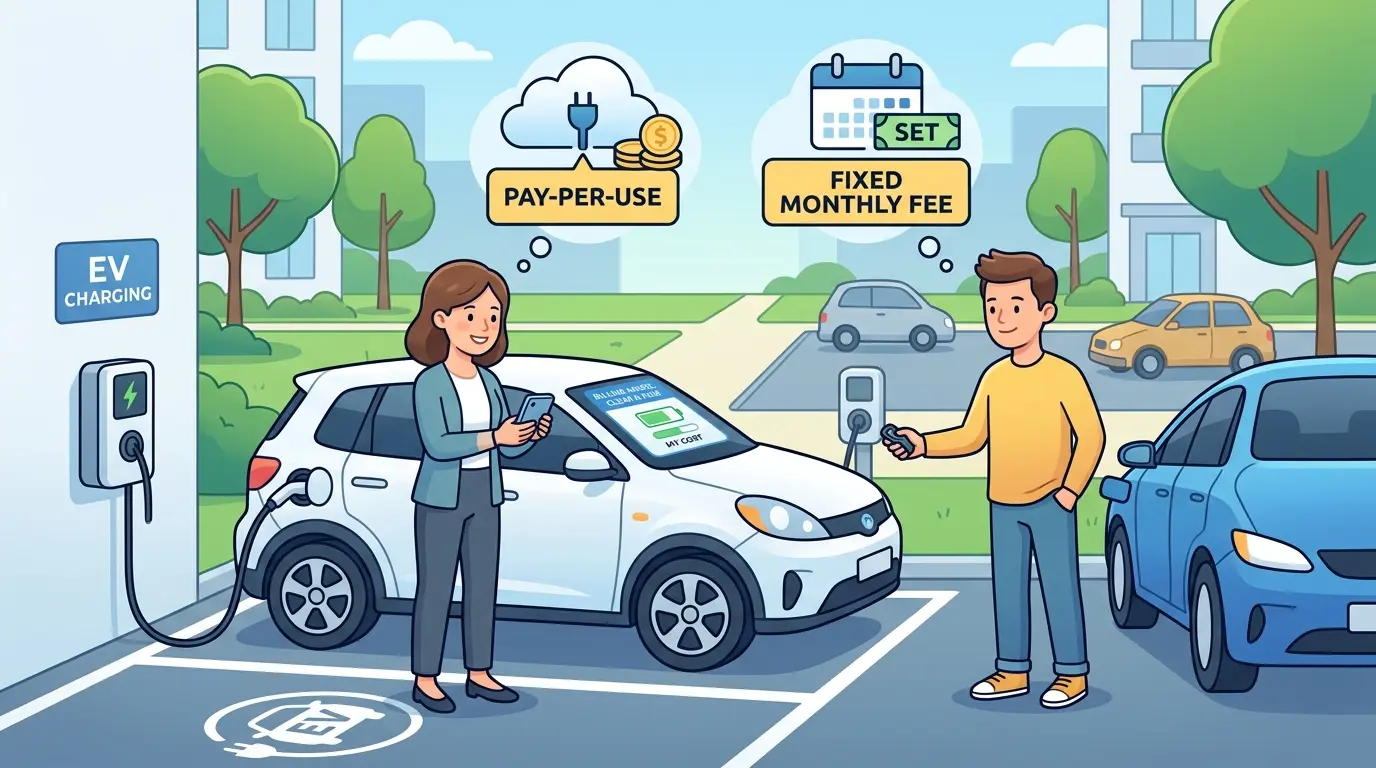
The biggest argument in apartment EV charging is usually not charger location. It is who pays, how they pay, and whether residents believe the bill is fair.
In multifamily properties, billing design affects adoption as much as hardware selection. A model that feels opaque will trigger complaints from EV drivers, resistance from non-EV residents, and extra work for property teams. A model that feels clear and proportional is far more likely to win approval from residents, condo boards, developers, and asset managers.
For most apartment projects, the right answer is not the cheapest-looking billing structure on paper. It is the one that balances fairness, predictability, operational simplicity, and room to scale.
Why Billing Models Shape Adoption
Apartment residents judge charging bills differently from public charging users. They are not making one-off transactions on a highway corridor. They are comparing their monthly charging cost with their parking fee, their utility bill, their neighbors’ experience, and the convenience they expected when they moved into the building.
That changes the acceptance threshold. Residents usually want five things from a billing model:
- A clear reason for what they are being charged
- A visible link between usage and cost
- Confidence that non-EV residents are not subsidizing EV drivers
- Predictable monthly expenses
- A payment process that does not require manual reimbursements or building staff intervention
If those conditions are missing, the project may still function technically, but it will not feel fair operationally.
The Main Billing Models at a Glance
| Billing model | Why residents may accept it | Why residents may push back | Best fit |
|---|---|---|---|
| Charging included in rent or parking | Very simple, no transaction friction | Feels unfair when some users charge heavily and others do not use it at all | Premium amenity positioning, low initial EV adoption, assigned spaces |
| Flat monthly subscription | Predictable monthly cost | Low-mileage drivers may feel they subsidize heavier users | Assigned chargers, fairly similar driving patterns |
| Per-kWh billing | Feels closest to actual energy use | Needs accurate metering, clear rules, and local regulatory compliance | Shared or assigned charging where fairness is a top priority |
| Time-based or session-based billing | Easy to administer in some markets | Can feel unfair when charging speed varies by vehicle or site load | Shared chargers, turnover-focused areas, markets where kWh resale is restricted |
| Hybrid model | Balances access, fairness, and turnover | Requires more thoughtful setup and communication | Most shared multifamily charging programs |
Charging Included in Rent or Parking Fees
This is the easiest model to explain because it removes the transaction layer. Residents see charging as part of the amenity package, much like access to a gym or a secure parcel room.
It can work in early-stage deployments where EV adoption is still low and the property wants to market charging as a premium feature. It can also make sense when each charger is tied to an assigned parking space and the landlord has already priced the premium into the parking arrangement.
The problem is that this model becomes harder to defend as utilization grows. Once several residents begin charging regularly, non-EV residents may see the arrangement as a hidden subsidy. Even EV residents can become frustrated if a neighbor with the same flat amenity benefit consumes far more electricity.
Included charging is usually accepted only when the property is deliberately positioning charging as a high-end amenity, or when adoption is still small enough that the cost difference does not create visible tension.
Flat Monthly Subscriptions
A flat monthly charging fee feels reasonable to many residents because it is simple and predictable. They know what to budget, and property teams know what to bill.
This approach works best when usage patterns are fairly consistent. For example, if most residents commute similar distances and charge overnight on assigned chargers, a subscription model can feel stable and low-friction.
But acceptance drops when usage differences become obvious. A resident who drives occasionally may not want to pay the same monthly fee as someone using the charger heavily every week. The property owner also takes on energy price risk, because the flat fee may stop matching actual electricity costs over time.
Subscription billing is usually more acceptable when it buys something more than electricity alone, such as guaranteed access to a reserved charger, priority scheduling, or a bundled premium parking package.
Per-kWh Billing
For most apartment communities, per-kWh billing is the most defensible model because it is the easiest to explain: the resident pays for the energy they use.
That does not automatically make it the easiest model to implement. It requires accurate session tracking, user authentication, and attention to local rules on energy resale or sub-metering. But where the framework is allowed, it tends to win on fairness because residents can see a direct relationship between charging behavior and cost.
This is also where networked access matters. If residents are expected to authenticate with RFID, an app, or account-based access, the billing experience needs to feel consistent and low-effort. The operational logic is similar to the workflows outlined in How RFID & App Billing Work in Semi-Public AC Charging Stations, even though apartment charging has its own resident and parking-policy layer.
Per-kWh billing is especially effective when the property wants to avoid resident complaints about hidden cross-subsidy. In condo and HOA environments, that transparency can be more important than any short-term simplicity gained from a flat-rate system.
Time-Based or Session-Based Billing
Time-based billing is common when a site wants to encourage turnover or when metered electricity resale is not the preferred structure. It can be simple from an administrative perspective, but resident acceptance depends heavily on context.
Where apartment residents are charging overnight, time-based pricing can feel unfair because not all vehicles charge at the same rate. A resident with a slower onboard charger may pay more for the same amount of energy. The same issue appears when site power is shared and charging output changes during peak building demand.
Time-based pricing is usually better accepted when it is framed as an access-management tool rather than the main electricity charge. For example, a site may allow a generous charging window and only apply time-based fees after a grace period or when a fully charged vehicle remains connected.
That distinction matters. Residents are far more likely to accept a time-based idle fee than a full time-based energy model.
Why Hybrid Models Usually Win
In shared multifamily environments, hybrid billing models often create the best balance between resident acceptance and site operations.
The most common hybrid structures include:
- A small monthly access fee plus per-kWh billing
- A reserved-space fee plus metered energy use
- Per-kWh billing plus idle fees after charging is complete
- A resident rate for regular use and a guest or visitor rate for temporary access
Residents tend to accept hybrid models when each charge component has a clear purpose. If the monthly fee pays for guaranteed access, software access, or reserved infrastructure, that is easier to understand. If the variable charge reflects actual electricity use, that also feels fair. Problems begin when fixed and variable fees overlap without a clear explanation.
For owners and operators, hybrid models are attractive because they can recover infrastructure costs without turning the electricity portion into a political issue. For residents, they preserve a sense of proportionality.
What Residents Mean by Fair
Property teams often focus on the arithmetic of billing, but residents focus on whether the system feels reasonable in daily life.
In practice, residents are more likely to accept apartment charging charges when:
- The pricing method is visible before they sign up
- Their session history is easy to review
- The building explains charger access rules clearly
- Idle fees are predictable and not punitive by surprise
- Slower charging caused by site limits is communicated in advance
That last point is important in multifamily projects. Shared capacity is normal, especially as adoption increases. But if a site uses dynamic power sharing and residents do not understand why their charging speed changes, they may assume the billing system is unfair. The right operational explanation is often as important as the tariff itself, especially in projects using dynamic load management in apartment building EV charging.
Matching the Model to the Property
The best billing model depends on the parking structure, resident profile, and operating goals.
| Property scenario | Billing model residents are most likely to accept | Why it fits |
|---|---|---|
| Assigned parking with private charger use | Flat fee or reserved-space fee plus per-kWh | Residents see a direct connection between their space and their charger |
| Shared parking with limited chargers | Hybrid model with per-kWh plus idle fee | Balances fairness with turnover control |
| Condo or HOA governance | Per-kWh or reserved-space fee plus metered billing | Easiest to defend in board discussions and resident reviews |
| Luxury apartment amenity launch | Charging included in parking premium at first, then transition later | Reduces early friction while adoption is still low |
| Cost-sensitive rental community | Low fixed fee or no fixed fee, mostly per-kWh | Keeps entry cost low and avoids penalizing light users |
One useful rule is this: the more shared the infrastructure is, the more the billing model should reflect actual use. The more private or assigned the infrastructure is, the more room there is for fixed-fee logic.
Hardware, Load Management, and Billing Need to Work Together
Billing acceptance is not just a finance question. It is also a site-design question.
Most apartment properties do not need public-style DC fast charging as the core resident offer. Overnight dwell times usually favor smart AC charging, because the business goal is dependable daily replenishment rather than ultra-fast turnover. That is why many multifamily planners compare equipment choices and installation strategy carefully before scaling, especially when reviewing questions like those covered in 7kW vs. 22kW AC commercial chargers.
DC fast charging can still have a role in mixed-use developments, premium convenience zones, or commercial-residential sites with high turnover. But it is not automatically the billing model answer for resident charging. Higher capital cost usually pushes pricing toward a public fast-charging mindset, which is not always what apartment residents want.
For multifamily deployments, the better fit is often a networked EV charging infrastructure setup that combines access control, session visibility, and scalable power management. In PandaExo terms, the value is not only the charger hardware itself. It is the ability to align hardware, load-sharing logic, and billing structure so the resident experience remains understandable as the site grows.
A Practical Rollout Checklist
Before locking in a billing model, apartment owners and operators should pressure-test the resident experience with a short checklist:
- Identify whether chargers are assigned, shared, or mixed-use.
- Confirm whether local rules allow direct per-kWh billing or require another structure.
- Decide what residents are really paying for: energy, access, parking privilege, or all three.
- Set idle-fee rules before launch, not after complaints start.
- Make session history visible through the platform or resident portal.
- Publish a one-page resident FAQ with example monthly bills.
- Review how the billing model behaves if EV adoption doubles in the next two to three years.
If a model looks good only at 10 chargers and becomes contentious at 40, it is probably the wrong model.
Final Takeaway
Apartment residents usually accept billing models that feel transparent, proportional, and easy to understand. That is why per-kWh billing and well-designed hybrid models tend to outperform flat-rate or all-inclusive approaches once EV adoption begins to scale.
Charging included in rent can work as a launch amenity. Flat subscriptions can work with assigned spaces and similar usage profiles. Time-based billing can help manage turnover. But for most multifamily properties, the strongest long-term answer is a model that separates infrastructure access from actual energy use and explains both clearly.
In other words, residents do not just want charging. They want a charging bill that makes sense. The apartment projects that win adoption are the ones that treat billing as part of infrastructure design, not as an afterthought.