
 Deutsch
  Español
  Français
  Italiano
  Português
  Svenska
  Suomi
Suomi  Dansk
Dansk  Norsk bokmål
  Nederlands
  العربية
  עברית
עברית  Polski
  Türkçe
  Русский
  Uzbek
Uzbek  Azərbaycan
  Tiếng Việt
  ไทย
ไทย  한국어
한국어  日本語
日本語  简体中文
简体中文 
As the transition to electric mobility accelerates, property managers and developers face a significant engineering bottleneck: how to integrate multiple EV chargers into existing apartment buildings without triggering catastrophic grid overloads or requiring exorbitant electrical infrastructure upgrades.
The solution to this multifamily charging puzzle isn’t simply adding more copper—it is deploying smarter power distribution. Dynamic Load Management (DLM) has emerged as the critical technology for scaling EV infrastructure in high-density residential properties.
In this guide, we will break down the mechanics of DLM, explore its commercial benefits, and explain how PandaExo’s factory-direct solutions provide the intelligent energy management required for modern apartment complexes.
The Challenge: Power Constraints in Apartment Buildings
Most multi-tenant residential buildings constructed even a decade ago were not designed to handle the simultaneous power draw of dozens of electric vehicles. When residents plug in their vehicles after work, the building experiences a massive spike in energy demand.
Without intelligent intervention, each charger draws its maximum rated power. This leads to three severe issues for property owners:
- Circuit Overloads: Risk of tripping main breakers, causing building-wide power outages.
- Exorbitant Upgrade Costs: Forced upgrades to transformers, electrical panels, and switchgear—often costing tens or hundreds of thousands of dollars.
- Peak Demand Penalties: Utility companies levy heavy fines for exceeding maximum peak power thresholds.
What is Dynamic Load Management (DLM)?
Dynamic Load Management (DLM) is an intelligent software and hardware control system that continuously monitors a building’s real-time energy consumption and automatically adjusts the power distributed to connected EV chargers.
Instead of a static allocation where each charger reserves a fixed amount of power (whether a car is plugged in or not), DLM pools the available electrical capacity and dynamically shifts it to where it is needed most.
How DLM Works in Practice
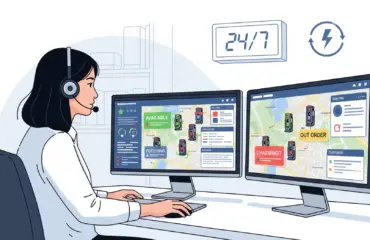
- Real-Time Monitoring: A measurement device (often utilizing current transformers) is installed at the main electrical switchboard to monitor the building’s total base load (HVAC, lighting, elevators, appliances) in real-time.
- Capacity Calculation: The DLM controller calculates the remaining safe electrical capacity available for EV charging at any given second.
- Active Distribution: The system communicates directly with the network of EV chargers, dynamically throttling the amperage up or down. If building demand is high (e.g., at 6:00 PM when everyone is cooking), the chargers deliver a slower trickle charge.
- Off-Peak Optimization: In the middle of the night, when the building’s base load drops, the DLM system ramps up the power to the chargers, ensuring all vehicles are fully charged by morning.
Key Business Benefits for Property Managers
Implementing DLM shifts EV charging from an operational headache to a scalable, value-add amenity.
1. Avoid Costly Infrastructure Upgrades
The primary ROI of DLM comes from capital expenditure (CapEx) avoidance. By intelligently balancing the load, property managers can install up to four times as many chargers on an existing electrical panel without needing a costly utility service upgrade.
2. Maximize Charging Points
DLM allows you to safely install chargers in every parking bay rather than limiting installations to a handful of dedicated spots. For overnight residential charging, deploying networked AC chargers linked via a DLM system is the most cost-effective way to scale property-wide access.
3. Lower Operational Costs (OpEx)
By capping the total simultaneous power draw, DLM prevents peak demand charges from the utility company, keeping monthly electricity bills predictable and low.
Why PandaExo’s Infrastructure Leads the Market
Delivering reliable DLM requires a seamless integration of intelligent software and rugged, high-performance hardware. As a global leader in smart energy management, PandaExo designs solutions specifically tailored for commercial and multifamily environments.
- Vertical Integration & Precision: Operating out of a 28,000-square-meter advanced manufacturing base, PandaExo maintains total quality control over our OEM/ODM operations.
- Semiconductor Heritage: Unlike software-only companies, we have a deep heritage in power semiconductors. This means the core internal components driving our energy conversion—down to the exact bridge rectifier—are engineered for industrial longevity and precise thermal management.
- Flexible Deployment Options: Whether your property requires dozens of smart wallboxes or you are planning a mixed-use complex that incorporates high-speed DC chargers for rapid turnaround, our integrated platforms communicate flawlessly to protect your grid.
By choosing PandaExo, developers benefit from factory-direct scale, ensuring you get premium, smart-grid-ready hardware without the middleman markup.
Ready to Future-Proof Your Property?
Upgrading your apartment building’s charging infrastructure doesn’t have to mean overhauling your entire electrical grid. With PandaExo’s smart DLM technology, you can maximize your existing power capacity safely and efficiently.
To explore our complete lineup of scalable, factory-direct hardware, shop our full range of solutions today or reach out to our engineering team for a customized deployment strategy.