
 Deutsch
  Español
  Français
  Italiano
  Português
  Svenska
  Suomi
Suomi  Dansk
Dansk  Norsk bokmål
  Nederlands
  العربية
  עברית
עברית  Polski
  Türkçe
  Русский
  Uzbek
Uzbek  Azərbaycan
  Tiếng Việt
  ไทย
ไทย  한국어
한국어  日本語
日本語  简体中文
简体中文 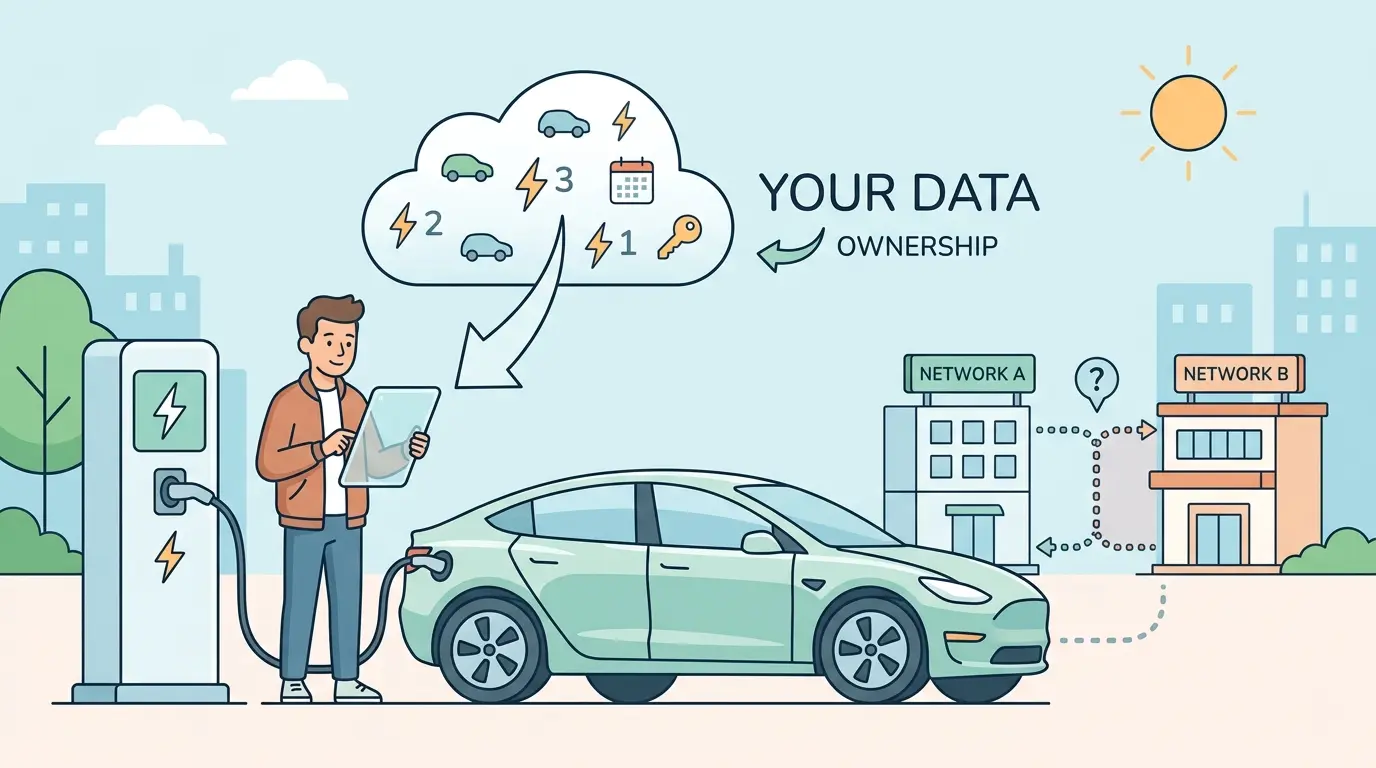
A charging network provider can usually be replaced faster than a charger asset can be depreciated. That is why data ownership matters more than many buyers realize during procurement.
The visible hardware may stay in the ground, on the wall, or in the depot, but the operating value of the site often lives inside the software layer: charger inventory, session records, pricing rules, user credentials, fault history, load-management settings, and reporting workflows. If those records are trapped inside a closed platform, switching providers can mean more than a contract change. It can trigger downtime, reconfiguration work, billing gaps, and lost operational visibility.
For infrastructure buyers, fleet operators, and multi-site charging planners, the real question is not whether a provider switch is possible. It is whether the chargers, the data, and the business workflows can move together.
Why Data Ownership Becomes a Strategic Issue
Most EV charging contracts are signed around near-term deployment needs: go-live speed, payment features, remote monitoring, or tariff setup. But network relationships often change before the chargers do.
An operator may want to switch providers because support quality slips, software costs rise, a portfolio expands into new regions, a fleet program needs different billing logic, or the business wants more control over integrations. In each case, the charger hardware may still be fit for purpose. The risk sits in the software and data dependency.
That risk grows as a site evolves from a pilot installation into a broader charging estate. What starts as a few connected chargers can become a business-critical operating system for access control, uptime management, reimbursement, energy coordination, and customer reporting.
Which Data Sets Matter Most During a Provider Switch
Not all EV charger data has the same migration value. Some records are useful for reporting. Others are essential to keeping the site operational after cutover.
| Data Set | Why It Matters During Migration | What Happens If It Is Missing |
|---|---|---|
| Charger inventory, serial numbers, and device IDs | Lets the new provider map each asset correctly | Chargers may need manual rediscovery or on-site reconfiguration |
| Site hierarchy, naming, and location metadata | Preserves reporting structure across portfolios | Dashboards become inconsistent and cross-site reporting breaks |
| Firmware versions and configuration settings | Helps validate compatibility and reproduce charger behavior | Settings drift, remote control issues, and avoidable troubleshooting increase |
| Transaction and session history | Supports utilization analysis, customer disputes, and financial reporting | Historical performance baselines disappear |
| Tariffs, tax rules, and billing logic | Prevents pricing errors after cutover | Revenue leakage, invoicing mistakes, or customer complaints can follow |
| Driver, fleet, RFID, and access-control records | Keeps users and vehicles authorized without full re-enrollment | Friction rises at go-live and support tickets spike |
| Alarm logs, ticket history, and diagnostics | Gives the new team operational context | Known faults get rediscovered from scratch |
| Load-management and site-energy settings | Protects site capacity and charging behavior | Demand peaks, queueing issues, or power conflicts may return |
| API and webhook integrations | Maintains data flow to ERP, fleet, or property systems | Reporting and automation workflows stop working |
For commercial sites, the most expensive losses are usually not raw data-loss events. They are workflow losses. When a new provider cannot inherit the operating logic of the site, the charger network may keep running physically while the business layer around it starts failing.
What Usually Happens When an Operator Switches Providers
A provider switch typically falls into one of three patterns.
| Migration Scenario | What the Transition Looks Like | Likely Business Impact |
|---|---|---|
| Open and well-documented environment | Device mapping, configuration review, data export, and remote reprovisioning are handled in a structured process | Lowest downtime and better continuity |
| Partially portable environment | Basic exports are available, but billing logic, credentials, or site rules need manual rebuilding | Moderate disruption and temporary reporting gaps |
| Closed or proprietary environment | Data export is limited, credentials are controlled by the incumbent, or chargers depend on custom integrations | Highest migration cost, greater downtime risk, and possible hardware replacement pressure |
The operational difference between these scenarios is substantial. In the best case, the switch feels like a controlled software migration. In the worst case, it becomes a hybrid IT, field-service, and commercial recovery project.
Ownership Is Not the Same as Access
Many buyers assume that if the contract says customer data belongs to the customer, the problem is solved. In practice, ownership without practical access is weak protection.
A site host or operator needs more than a general ownership clause. It needs the right to export data in usable formats, the right to do so on demand, the right to preserve historical records after termination, and the right to migrate those records into another platform without technical obstruction.
The contract language worth checking usually includes:
- Who owns raw charger data, processed analytics, and derived reports
- What export formats are available and how often exports can be requested
- Whether API access continues through the transition period
- How long historical data remains accessible after contract termination
- Whether migration assistance is included, billed separately, or subject to delay
- Who controls SIMs, certificates, user authentication, payment tokens, and third-party integrations
- Whether there are fees tied to data extraction or early termination support
If these terms are vague, the operator may legally own the data but still have no fast, clean way to retrieve it in time for a migration.
Open Standards Reduce Risk, but They Do Not Eliminate It
Interoperability standards help, which is why many operators now pay closer attention to open charging network interoperability trends before committing to a software stack.
Even so, standards are not a complete portability guarantee. OCPP can make charger-to-platform communication more flexible, but it does not automatically preserve billing models, dashboard structures, user entitlements, maintenance history, or internal reporting workflows. Buyers still need to understand what OCPP actually covers in commercial charging environments.
The practical takeaway is simple: open protocols reduce lock-in risk, but operators still need explicit data-governance terms, migration procedures, and documented export paths.
Why Migration Complexity Changes by Charging Use Case
Data portability does not look the same across every charger portfolio.
In AC smart-charging environments such as workplaces, apartment buildings, and destination sites, the biggest migration risks often sit in user management, access permissions, tariff logic, and reimbursement workflows. There may be many endpoints, relatively modest power levels, and a high need for dependable day-to-day authorization and usage reporting.
In DC fast-charging environments, the stakes often shift toward throughput, uptime, queue management, remote fault response, fleet scheduling, and integration with site-energy strategy. A provider switch that disrupts diagnostics or remote control at a busy commercial site can have a direct effect on utilization and service quality.
Mixed portfolios are harder still. Operators running both AC and DC assets across multiple sites need a data structure that can survive growth, ownership changes, and platform changes without forcing each location into a separate reporting model.
This is one reason buyers increasingly evaluate charging infrastructure not only by power class and enclosure type, but by how well the hardware and software stack support long-term operational flexibility.
What Buyers Should Secure Before a Provider Change
Before starting the transition, operators should work through a formal EV charger data handover checklist rather than treating export and access rights as a last-minute request.
The cutover itself also needs disciplined execution. Good network migration planning practices help reduce downtime, avoid charger misassignment, and protect revenue continuity.
At minimum, the outgoing provider and incoming provider should be aligned on these questions:
- Can the full charger inventory be exported with unique device identifiers and site mapping?
- Can all tariffs, pricing schedules, and tax rules be recreated accurately in the new system?
- Are driver, fleet, RFID, and whitelist records portable?
- Can historical transactions be exported in a machine-readable format rather than static reports only?
- Are alarm logs, maintenance tickets, and fault codes included in the handover?
- Who controls device certificates, communication credentials, and remote configuration rights?
- Will API connections to finance, fleet, or property systems remain active during the transition?
- Is there a defined validation process to confirm data completeness after migration?
- What happens to payment-processing and roaming relationships during cutover?
- What level of downtime, if any, is operationally acceptable by site type?
These are not administrative details. They determine whether a migration is controlled or chaotic.
How to Protect Data Ownership Before the First Deployment
The best time to protect portability is before the first charger is commissioned, not when a provider relationship has already deteriorated.
A more resilient procurement approach usually includes these safeguards:
- Separate charger asset strategy from platform dependency. Hardware should not become unusable because a software contract changes.
- Require export rights in the master agreement, including raw records and derived reporting data.
- Ask for sample exports before signing. A sample file reveals more than a marketing promise.
- Verify protocol support, API availability, and administrative control boundaries in writing.
- Keep an independent asset register outside the network platform.
- Preserve periodic backups of key commercial and operational reports.
- For OEM or ODM programs, define who controls branding assets, certificates, cloud tenancy, and future software migration rights.
For large portfolios, these protections are part of infrastructure design, not only legal review. They shape how easily the network can scale, change vendors, or adapt to new business models later.
Practical Summary
Switching network providers does not automatically mean losing control of an EV charging site, but it can expose weak assumptions about data ownership very quickly.
If charger data, billing logic, user records, and operational history are portable, a provider switch is usually a manageable transition project. If they are not, the same switch can disrupt uptime, reporting, customer experience, and site economics.
For buyers planning long-life EV charging assets, the smarter question is not only whether a network platform works today. It is whether the platform allows the business to keep control of its chargers, its data, and its operating model when change inevitably comes.