
 Deutsch
  Español
  Français
  Italiano
  Português
  Svenska
  Suomi
Suomi  Dansk
Dansk  Norsk bokmål
  Nederlands
  العربية
  עברית
עברית  Polski
  Türkçe
  Русский
  Uzbek
Uzbek  Azərbaycan
  Tiếng Việt
  ไทย
ไทย  한국어
한국어  日本語
日本語  简体中文
简体中文 
When a charging network changes backend providers, the most expensive problems usually do not come from the charger cabinet. They come from the business data attached to it. User accounts, RFID permissions, tariff rules, charger IDs, session history, and support records all influence whether the new platform can go live without disruption.
That is why data handover should be treated as a formal transition workstream, not as an afterthought once the commercial agreement is signed. A charger can reconnect successfully and still fail operationally if the surrounding data has been exported poorly, mapped incorrectly, or validated too late.
Why Data Handover Needs Its Own Transition Plan
Operators often assume that once chargers are pointed to a new network, the migration is largely complete. In practice, the charging estate may depend on information spread across platform dashboards, billing environments, CRM records, support systems, finance reporting, and site-level documentation.
The physical assets may remain in place, but the business logic behind them often changes hands. If that data is incomplete or inconsistent, the new provider may inherit chargers that are technically online but commercially and operationally misconfigured.
The table below shows why this handover should be managed as its own project.
| Transition Area | What Must Be Preserved | What Goes Wrong If It Is Missed |
|---|---|---|
| Asset records | Charger IDs, serial numbers, site relationships, firmware references | Devices may be imported incorrectly or assigned to the wrong site |
| Commercial setup | Tariffs, taxes, access rules, reimbursement logic | Charging sessions may run with wrong pricing or user permissions |
| Historical records | Session logs, revenue data, alarms, ticket history | Operators lose visibility needed for finance, SLA review, and maintenance |
| Integrations | API keys, roaming links, payment dependencies, reporting feeds | Downstream systems may break after cutover |
The Core Data Sets to Secure Before Cutover
Before switching providers, operators should identify every data set required to keep the new platform commercially usable on day one. At minimum, the handover scope should include the following.
| Data Category | Typical Contents | Why It Matters at Go-Live |
|---|---|---|
| Charger inventory | Charger model, serial number, asset ID, connector count, site assignment | Ensures the new platform recognizes the correct installed estate |
| Site and ownership records | Site address, host contact, commercial owner, maintenance contact | Prevents confusion during support escalation and asset assignment |
| Configuration records | Firmware versions, charger settings, communication notes, commissioning details | Helps the incoming provider distinguish platform issues from device-specific constraints |
| Tariffs and billing logic | Pricing rules, tax settings, fee structures, time-of-use schedules | Protects revenue integrity and customer trust |
| User access data | RFID credentials, user groups, app entitlements, fleet permissions | Keeps access control and driver experience consistent |
| Operational history | Charging sessions, utilization reports, revenue exports, downtime history | Preserves trend analysis and commercial reporting continuity |
| Service records | Alarm history, trouble tickets, maintenance notes, replacement history | Supports faster troubleshooting after migration |
| Integration dependencies | API tokens, webhook references, roaming settings, payment processor links | Prevents hidden failures outside the charger platform itself |
The objective is not just to archive data. It is to preserve operating continuity across finance, support, access control, and charger management.
Tariffs and User Access Are the Most Common Quiet Failure Points
Many migrations fail quietly in the commercial logic layer. The chargers come online, the dashboard works, and the transition is declared successful, but tariffs are wrong, access groups are incomplete, or reimbursement rules do not match the previous setup.
This risk is even higher in semi-public, mixed-access, or fleet environments where different users follow different payment and authorization paths. PandaExo’s article on RFID and app billing in semi-public charging environments is a useful reference if your team needs to review how that logic is typically structured.
Before cutover, confirm:
- Which user groups must be migrated exactly as-is
- Whether RFID identifiers need reformatting or remapping
- How guest charging, hosted charging, and employee charging are separated
- Whether pricing logic depends on site, user type, time window, or external billing rules
Export Historical Data Before It Becomes Harder to Recover
Historical data is often treated as optional until the old platform becomes inaccessible. That is usually too late. Operators rely on past session data, revenue records, and fault history for more than simple reporting. Those records inform maintenance planning, SLA disputes, utilization benchmarking, and future investment decisions.
Before the provider transition is finalized, determine:
- Which historical records will remain accessible after contract end
- Which data must be exported manually before cutoff
- Which export formats the incoming provider can actually use
- Which records are needed only for archive purposes and which must support live operations
If the new provider cannot ingest historical data directly, that does not mean the export is unnecessary. It may still be essential for finance, warranty, and service governance.
Validate the New Provider’s Import Requirements Early
Data handover is not complete when the outgoing provider sends files. It is complete when the incoming provider confirms that the files are usable, the mappings are correct, and the imported records support the planned go-live model.
Operators should require the new platform team to validate:
- Charger identifiers and site hierarchy
- Tariff structure and tax treatment
- User-account mapping and RFID formatting
- Historical import limitations
- Required field names, date formats, and data-cleaning rules
This reduces the risk of discovering preventable mapping errors during the actual transition window.
Treat Protocol Readiness and Data Readiness as One Decision
Provider switching is not just about files. It also involves understanding which functions live at device level and which live in the backend. That distinction affects what must be rebuilt in the new environment.
Key questions include:
- Which chargers are using open protocol connections and which rely on provider-specific workflows?
- Which settings are stored in the charger versus the cloud platform?
- Which alerts, remote actions, and access controls depend on the current backend structure?
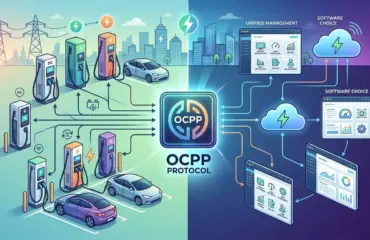
That is why PandaExo’s explanation of OCPP in commercial EV charging matters in migration planning. Open standards help with interoperability, but they do not eliminate the need for disciplined data transfer and configuration review.
A Practical Handover Checklist Before Switching Providers
The most reliable cutovers happen when operators separate archive tasks from go-live-critical tasks and confirm both with the incoming provider.
| Checklist Item | Minimum Verification Standard |
|---|---|
| Charger inventory is complete | All live chargers, connectors, asset IDs, serial numbers, and site assignments are confirmed |
| Site records are current | Ownership, billing, support, and local contact information is updated |
| Tariff logic is documented | Pricing rules, tax handling, and reimbursement logic are exported and reviewed |
| Access data is mapped | RFID, app access, user groups, and permissions are validated in the target environment |
| Historical records are secured | Session, revenue, and alarm history is exported before source access changes |
| Configuration details are retained | Firmware levels and charger-specific notes are documented for future troubleshooting |
| Integration dependencies are identified | APIs, roaming links, reporting tools, and payment systems are cataloged |
| Import format is approved | The incoming provider confirms files are usable and correctly mapped |
| Rollback planning exists | A contingency path is defined if cutover behavior is incorrect |
What Stronger Infrastructure Planning Looks Like
Network transitions are easier when the underlying charging strategy was built with long-term flexibility in mind. Operators do not just need chargers that can be installed. They need charging assets and management structures that remain commercially supportable as providers, ownership structures, and reporting requirements evolve.
That is where PandaExo becomes relevant beyond the hardware layer. With a broad EV charger portfolio, smart energy management capability, and OEM and ODM flexibility, PandaExo supports organizations that need infrastructure designed for growth, migration, and long-term operational control.
Final Takeaway
Switching network providers is not only a software migration. It is a data-governance exercise that affects revenue, access control, reporting, support quality, and operational continuity. Operators that secure charger records, pricing logic, user access, service history, and import validation before cutover are far less likely to lose value during the transition.
If your organization is planning a network change and wants charging infrastructure designed for cleaner migration, scalable control, and long-term flexibility, contact the PandaExo team to discuss a solution that supports evolving network operations.