
 Deutsch
  Español
  Français
  Italiano
  Português
  Svenska
  Suomi
Suomi  Dansk
Dansk  Norsk bokmål
  Nederlands
  العربية
  עברית
עברית  Polski
  Türkçe
  Русский
  Uzbek
Uzbek  Azərbaycan
  Tiếng Việt
  ไทย
ไทย  한국어
한국어  日本語
日本語  简体中文
简体中文 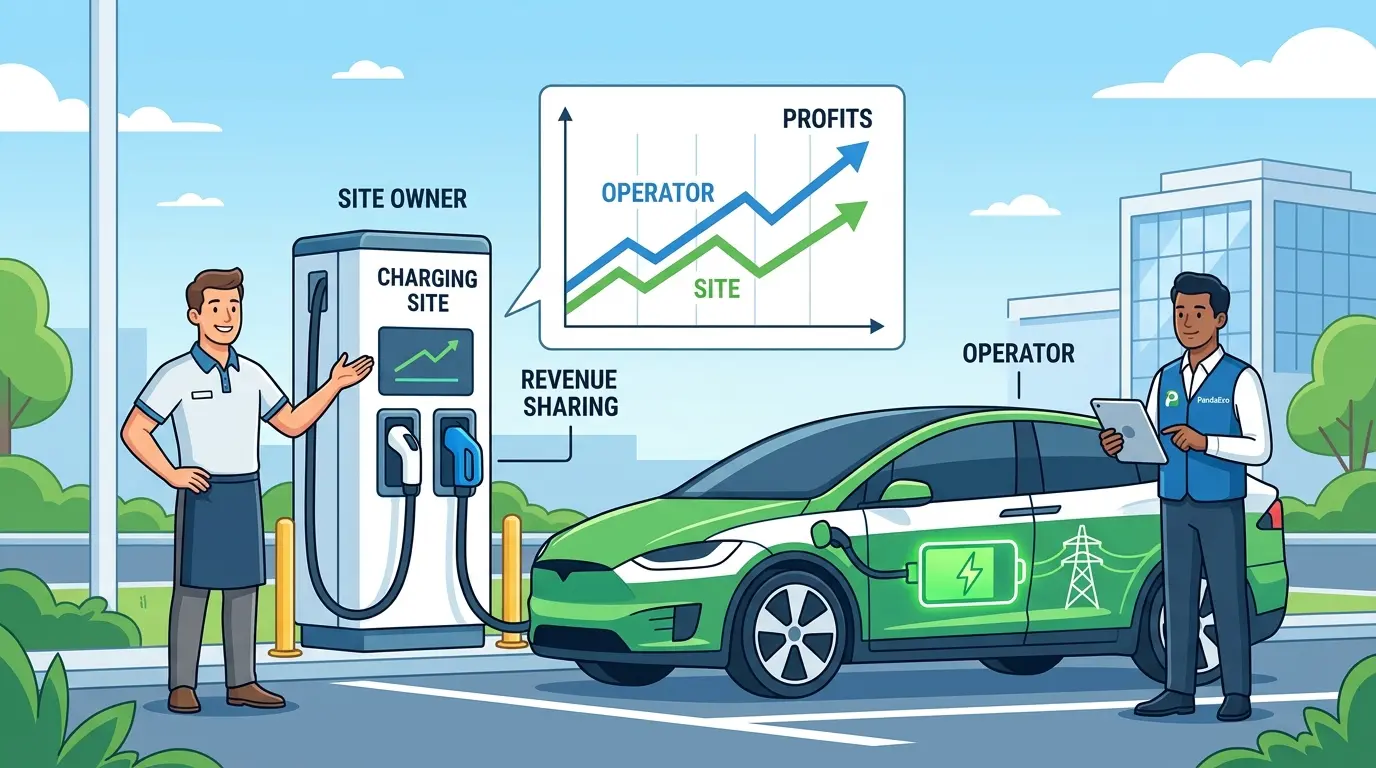
When a hotel, retail park, office campus, or fleet-adjacent parking site wants EV charging, the first commercial question is often not charger power. It is who invests, who operates, and how the charging revenue will be shared once drivers start using the site.
That question matters because commercial EV charging rarely works as a simple landlord-tenant arrangement. Electricity costs move. Utilization changes by season. Some sites use charging to generate direct income, while others use it to increase dwell time, attract tenants, or support fleet readiness. A revenue-sharing model has to reflect those operational realities, not just a percentage on a contract page.
Why Revenue Sharing Starts With the Site Business Model
A workplace that wants employee charging has a different objective from a roadside site chasing fast-turnover public sessions. A hotel may view EV charging as part of the guest experience. A retail site may treat it as a traffic and dwell-time tool. A logistics operator may care less about public charging revenue and more about protecting vehicle availability.
That is why the best commercial structure starts with the site’s real monetization goal. For some properties, the aim is direct charging income. For others, it is indirect value such as longer customer stays, higher tenant retention, or better parking-lot utilization. PandaExo’s own guidance on monetizing parking lots with commercial EV charging stations shows why revenue planning should sit alongside site strategy, not after it.
Before negotiating percentages, both sides should be clear on:
- whether charging is a profit center, an amenity, or an operational asset
- who controls driver pricing
- whether the site expects mostly public, private, or mixed usage
- how much utilization risk the host is willing to absorb
The Most Common Revenue Sharing Models
No single structure fits every commercial site. In practice, most agreements fall into a small set of repeatable models.
| Model | Who Usually Funds Infrastructure | How Revenue Is Shared | Where It Fits Best | Main Tradeoff |
|---|---|---|---|---|
| Pure third-party operator model | Operator or CPO | Host receives a fixed percentage of charging revenue | Low-risk site hosts that want minimal operational burden | Host gets limited upside and often less pricing control |
| Minimum guarantee plus revenue share | Operator funds most assets, sometimes with host make-ready support | Host receives a base payment plus upside above agreed thresholds | Strong-traffic sites that want downside protection | Contract complexity is higher |
| Host-funded, operator-managed model | Host funds chargers or electrical works | Operator takes service, software, or management fee while host keeps most charging revenue | Owners who want long-term control of the asset | Host carries more utilization and maintenance risk |
| Fixed lease or site-rent model | Operator funds assets | Host receives fixed rent instead of usage-based share | High-traffic sites where predictable income matters more than upside | Host gives up growth if utilization rises sharply |
| Hybrid private/public model | Host funds part of the site, operator or partner funds public-facing layer | Revenue split depends on fleet use, public sessions, and cost allocation | Fleets, mixed-use parking, depots, and commercial campuses | Settlement rules can become complex |
These are not just legal formats. They are risk allocation models. The more one party funds, maintains, and operates, the more revenue that party will expect to retain.
Who Pays for What Usually Decides the Percentage
Many revenue-share discussions stall because both sides focus on gross charging revenue instead of the full delivery stack behind that revenue.
A commercial EV charging site may involve:
- utility upgrades or transformer coordination
- trenching, civil works, and make-ready costs
- charger hardware
- software platform and remote monitoring
- maintenance and field service
- payment processing and roaming fees
- driver support and fault escalation
- electricity procurement and demand charges
If the operator covers almost all of those items, a high operator share is commercially logical. If the host is paying for make-ready, reserving prime parking, upgrading service capacity, or even buying the hardware, the host has stronger grounds for a higher share or greater pricing control.
This is why percentage-only negotiations can be misleading. A 20 percent share to the site host might be weak in one deal and reasonable in another, depending on who absorbed the capital and operational burden.
AC and DC Charging Change the Revenue Logic
Revenue sharing for AC charging tends to work best where dwell time is long and the commercial goal is steady utilization rather than rapid turnover. That often includes workplaces, hotels, multifamily parking, and destination retail. In these environments, charging may support the broader property offering as much as it creates direct charging income, which can make amenity-led or host-funded models more attractive.
Revenue sharing for DC charging usually sits under more pressure because the hardware, grid connection, and operating costs are higher. DC fast charging can improve throughput and make a site more competitive for public charging demand, but it also brings bigger exposure to utilization volatility, power cost swings, and demand-charge risk. That is why many DC-focused agreements include stricter pricing rights, minimum performance clauses, or more detailed cost-recovery language.
The key tradeoff is not that AC is “better” or DC is “better.” It is that each charging type supports a different economic model.
| Charging Strategy | Typical Revenue Logic | Best-Fit Commercial Objective |
|---|---|---|
| AC destination charging | Lower ticket size, steadier dwell-based usage | Amenity value, tenant support, workplace or hospitality charging |
| DC fast charging | Higher per-session value with higher capex and energy risk | Turnover, public access, corridor traffic, fleet turnaround |
| Mixed AC/DC site | Split economics by user type and dwell window | Balance daily usage, public access, and operational flexibility |
A site host that picks the wrong charging format can end up with a revenue-sharing model that looks reasonable on paper but performs poorly in practice.
Pricing Control, Data Access, and Roaming Rights Matter More Than Many Hosts Expect
A revenue share is only meaningful if both parties agree on what counts as revenue and who controls the levers behind it.
For example:
- Can the operator change driver pricing without host approval?
- Are idle fees or reservation fees included in the revenue pool?
- Are roaming sessions treated differently from app-direct sessions?
- Are promotional discounts deducted before or after revenue is split?
- Does the host receive access to session-level data and settlement detail?
These questions become more important when networks connect across multiple platforms or roaming ecosystems. PandaExo’s educational material on open charging networks, OCPP, OCPI, and roaming trends helps explain why interoperability is commercially useful but can also complicate settlement if the contract does not define data ownership and pricing logic clearly.
A weak contract can leave the site host technically “sharing revenue” while having little visibility into how that revenue was created.
Gross Revenue Share and Net Revenue Share Are Not the Same Thing
One of the most important contract distinctions is whether the share applies to gross charging revenue or net revenue after specific deductions.
Gross revenue share is simpler to understand and easier to audit. The host receives a percentage of all collected charging income before most downstream cost adjustments. This can work well where electricity costs are relatively stable or where the operator is comfortable carrying more margin risk.
Net revenue share can make sense when power costs, payment processing, roaming expenses, and operational service costs fluctuate meaningfully. But it needs tighter definitions. If “net revenue” is loosely drafted, the site host may discover too late that the chargeable base has been reduced by a long list of operator-side deductions.
That issue becomes even sharper on high-power sites, where utility structure can materially affect margin. PandaExo’s guidance on grid capacity, interconnection, and demand charges is relevant here because a site that looks attractive on gross session revenue can still underperform if peak demand charges are not modeled correctly.
In commercial negotiations, it is usually better to ask:
- what is included in revenue
- what costs can be deducted
- when settlement reports are delivered
- what audit rights the host has
- whether electricity cost risk is capped or passed through
A Practical Decision Framework for Choosing the Right Model
The right revenue-sharing structure usually follows the site’s role in the overall charging business.
| Site Type | Common Goal | Often-Suitable Model | Why It Tends to Work |
|---|---|---|---|
| Hotel or resort | Guest amenity with some direct income | Host-funded or minimum-guarantee hybrid | Brand and guest experience matter as much as charging margin |
| Workplace campus | Employee support and future readiness | Host-funded, operator-managed | Asset control and predictable policy management matter |
| Retail parking | Increased dwell time plus public charging revenue | Revenue share or minimum guarantee plus upside | Traffic varies, so upside and downside protection both matter |
| Fleet-adjacent depot | Protect operations first, monetize spare capacity second | Hybrid private/public model | Fleet access rules and public-session rules need separate logic |
| Highway or fast-turn site | Maximize charging turnover | Operator-led DC model with detailed performance terms | Specialized operations and utilization risk are higher |
If a site wants low involvement and minimal capital exposure, a third-party operator model may be the right choice even if the headline share is smaller. If a property owner wants long-term asset value, pricing influence, and data access, funding more of the infrastructure may be worth the additional risk.
Where PandaExo’s Broader Role Becomes Relevant
Revenue-sharing models often look simple at launch and become more complex as the site scales. A property that starts with a few AC chargers may later want DC fast charging, software-based load control, branded network experience, or multi-site reporting. That is where a supplier with both charging hardware and platform awareness becomes more relevant than a single-product vendor.
In PandaExo’s positioning, the practical advantage is not that every site needs the same charger mix. It is that commercial hosts, distributors, and network planners often need room to evolve from one operating model to another. A site may begin as amenity charging, move toward revenue-focused public access, and later require stronger network visibility or white-label flexibility through OEM or ODM collaboration. The commercial agreement should leave room for that operational growth.
Practical Summary
Revenue sharing in commercial EV charging is really a question of who carries risk, who controls the customer relationship, and who owns the long-term value of the site.
- The best model depends on whether charging is an amenity, a direct revenue stream, or an operational necessity.
- The percentage split only makes sense once capital costs, software, maintenance, and power risk are defined.
- AC and DC charging support different economic models and should not be treated as interchangeable.
- Gross and net revenue share create very different outcomes if deductions are not clearly defined.
- Pricing control, data visibility, and roaming rules can matter as much as the headline split.
- The right agreement should work for today’s site economics and still hold up if the charging strategy expands later.
A commercial EV charging contract does not need to chase the highest theoretical revenue share. It needs to align infrastructure cost, operational responsibility, and growth potential in a way both the site host and the charging partner can actually sustain.