
 Deutsch
  Español
  Français
  Italiano
  Português
  Svenska
  Suomi
Suomi  Dansk
Dansk  Norsk bokmål
  Nederlands
  العربية
  עברית
עברית  Polski
  Türkçe
  Русский
  Uzbek
Uzbek  Azərbaycan
  Tiếng Việt
  ไทย
ไทย  한국어
한국어  日本語
日本語  简体中文
简体中文 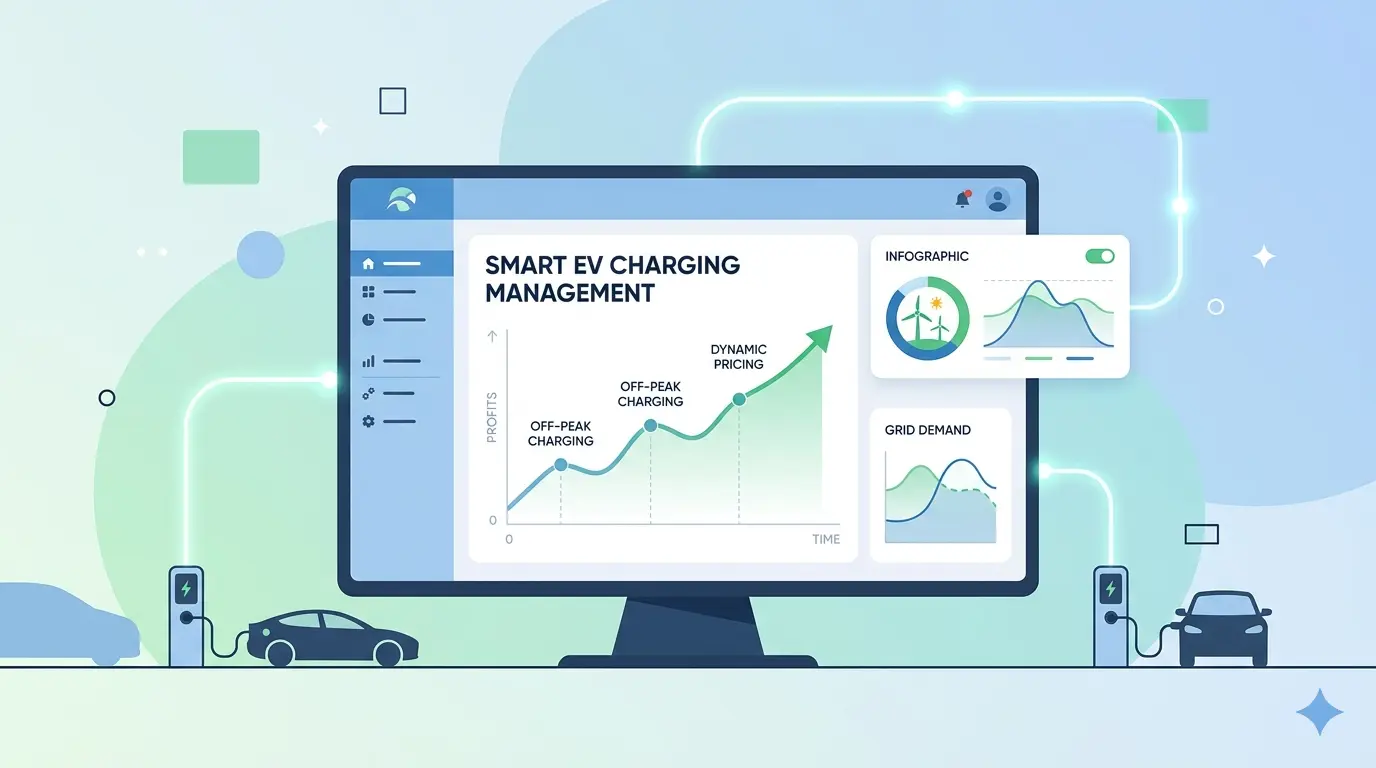
An EV charging site can look busy and still underperform financially. Chargers may be occupied, sessions may be flowing, and new hardware may be installed on schedule, yet margins stay thin because power is delivered at the wrong times, demand charges spike unexpectedly, downtime goes unnoticed too long, or low-value sessions crowd out higher-value use.
That is why profitability in EV charging is no longer only a hardware question. For charge point operators, fleet planners, commercial site hosts, and infrastructure buyers, the more important issue is how well the site turns limited grid capacity and installed chargers into reliable, billable, and scalable service. Energy management platforms help close that gap.
Profitability Problems Usually Start in Operations, Not in the Charger Cabinet
Many charging projects lose margin in predictable ways:
- too much simultaneous charging during expensive tariff windows
- poor visibility into which chargers are profitable and which are underused
- unnecessary service upgrades caused by unmanaged peak demand
- avoidable downtime because faults are found too late
- flat pricing that ignores dwell behavior, fleet urgency, or local energy cost
These issues are operational, not purely electrical. A site may have the right mix of AC and DC chargers on paper, but if charging sessions are unmanaged, the business still absorbs higher operating cost and lower asset productivity.
This is where an energy management platform matters. It gives operators a control layer that can shape charging behavior instead of passively recording it.
What an Energy Management Platform Actually Controls
At a practical level, an energy management platform connects charger activity, site power limits, user access, and operational data into one decision system. That system can be simple for a small workplace installation or much more sophisticated for a multi-site commercial network.
The strongest platforms typically focus on five commercial functions.
| Platform Function | What It Does Operationally | Why It Matters for Profitability |
|---|---|---|
| Dynamic load management | Allocates available site power across chargers in real time | Helps reduce demand-charge exposure and delay costly electrical upgrades |
| Session prioritization | Pushes power first to the most time-sensitive vehicles or users | Improves charger throughput and protects higher-value sessions |
| Remote monitoring and alerts | Detects faults, communication issues, or abnormal charger behavior early | Reduces downtime, truck rolls, and lost revenue hours |
| Pricing and access control | Applies tariffs, user classes, fleet rules, and payment policies | Improves revenue quality instead of only increasing session count |
| Reporting and portfolio analytics | Shows utilization, energy cost, uptime, and site-level performance | Supports better pricing, expansion timing, and capital allocation |
Not every site needs every feature immediately. But without some form of centralized control, operators often end up oversizing hardware to solve problems that smarter scheduling and power allocation could have handled more efficiently.
Lower Peak Demand Without Stranding Charger Capacity
One of the fastest ways an energy management platform improves profitability is by reducing the mismatch between charger nameplate power and actual site power availability.
Most commercial sites cannot let every connector run at maximum output at the same time without triggering major infrastructure costs. If they try, the result may be transformer upgrades, utility delays, or higher recurring tariff penalties. If they avoid expansion entirely, they may under-serve drivers and cap revenue.
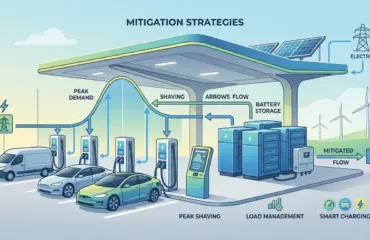
An energy management platform creates a middle path. It can cap total site draw, distribute power dynamically, and shift flexible sessions into lower-cost periods. That helps operators serve more vehicles inside a fixed electrical envelope.
For example, a mixed site might use AC chargers for long-dwell users and reserve faster DC charging for urgent sessions. With managed power allocation, the operator does not need to build every bay for worst-case simultaneous demand. This is especially important when evaluating grid limits, interconnection timing, and tariff exposure. PandaExo’s guidance on grid capacity, interconnection, and demand charges reflects the same commercial reality: profitability is often protected by controlling peaks, not by chasing maximum installed output.
The tradeoff is that managed charging requires clear business rules. If the site serves many users who all expect immediate high-power charging, aggressive power sharing can frustrate customers. The platform improves economics, but only when the service promise matches the site model.
Improve Charger Utilization and Site Throughput
Utilization is often treated as a single KPI, but profitable utilization is more specific. A charger is not valuable simply because it is occupied. It is valuable when it delivers energy to the right user at the right time and turns over fast enough to support additional sessions.
Energy management platforms improve this by making session priority visible and enforceable. Instead of letting charging run on a first-plugged, first-served basis, operators can prioritize by:
- fleet departure time
- driver type or membership class
- parking duration
- state-of-charge target
- time-of-day pricing window
That changes the economics of the site. High-value fleet vehicles can leave on schedule. Retail or hospitality drivers can be encouraged to move after useful charging is complete. Lower-priority sessions can be throttled when the site approaches a power cap. In practice, this means more billable sessions from the same installed hardware.
For sites built around customer dwell time, smarter throughput is often more profitable than simply adding another charger. Operators exploring revenue models for semi-public and commercial parking can see the same logic in PandaExo’s article on monetizing parking lots with commercial EV charging stations: profitability depends on session quality, turnover, and site fit, not just on charger count.
Turn Data Into Better Pricing Decisions
Many operators underprice charging because they treat electricity as the only input cost. In reality, profitability also depends on idle bay occupancy, payment friction, support overhead, uptime risk, and the value of the parking space itself.
An energy management platform helps by showing how these variables behave over time. Instead of asking only, “How much energy did we sell?” operators can ask sharper questions:
- Which hours produce the strongest margin after energy cost?
- Which user groups create the longest dwell with the lowest revenue?
- Which sites have strong traffic but weak conversion?
- Which locations justify more DC capacity, and which only need better control rules?
That visibility supports better pricing design. Some sites benefit from time-based fees after charging is largely complete. Others need differentiated pricing for fleet accounts, employees, residents, or public users. Some networks benefit from off-peak incentives that shift load without reducing total demand.
The important point is that pricing becomes operationally informed rather than guess-based. A platform does not guarantee higher pricing power, but it helps operators stop subsidizing inefficient behavior.
Reduce Downtime and Protect Revenue Hours
Profitability also improves when chargers stay available. A busy site with frequent outages can destroy margin quickly because the operator still carries infrastructure cost, service overhead, and customer acquisition effort while losing revenue during fault periods.
Energy management platforms help reduce this risk through centralized alarms, remote diagnostics, charger status visibility, and better incident response workflows. Instead of learning about failures from frustrated drivers, operators can detect communication loss, connector faults, abnormal temperature behavior, or payment issues earlier.
This matters even more across growing networks. Once a business manages multiple sites, uptime becomes a portfolio problem rather than a single-location maintenance issue. PandaExo’s article on EV charging network uptime strategy highlights the same point: monitoring and escalation discipline are not back-office details; they directly affect charger revenue and network trust.
There is a tradeoff here as well. More software visibility can create more operational complexity if alerts are poorly configured or if support teams do not have clear escalation rules. Good platforms reduce noise as well as downtime.
Better Profitability by Site Type
Not every charging business earns margin the same way. The most valuable platform features change with the operating model.
| Site Type | Main Profit Driver | Platform Features That Matter Most |
|---|---|---|
| Fleet depot | Departure readiness and controlled peak demand | Scheduling, load balancing, vehicle priority rules, energy caps |
| Retail or hospitality | Session turnover and dwell monetization | Time-based pricing, customer access rules, occupancy visibility |
| Workplace or multifamily | Fair access and scalable infrastructure sharing | User authentication, load sharing, billing separation, reporting |
| Highway or high-power public site | Uptime and queue flow under heavy demand | Real-time monitoring, remote support, power allocation, fault alerts |
This is why a platform should be selected around business model fit, not feature count alone. A fleet operator may value depot scheduling far more than public roaming tools. A hotel or retail property may care more about guest experience, dwell time control, and pricing flexibility than about maximum power output.
Strong Platforms Also Improve Expansion Decisions
One of the less obvious profitability benefits is better capital discipline. Without good site-level data, operators often expand based on complaints, anecdotal usage, or headline session counts. That can lead to overbuilding in one location while under-serving another.
Energy management platforms help identify where the bottleneck actually sits:
- lack of total site power
- too few connectors
- poor charger mix
- weak uptime
- poor pricing design
- demand that is highly concentrated into short windows
That distinction matters for future spend. Sometimes the right answer is another charger. Sometimes it is a software policy change. Sometimes it is a small amount of DC capacity added to an AC-heavy site. Sometimes it is simply better balancing across existing assets.
PandaExo positions smart energy management as part of a broader infrastructure stack rather than as an isolated software layer. That is commercially sensible. Platform value is strongest when it works with the charger mix, site constraints, and scaling plan instead of being added after those decisions are already locked in.
What Buyers Should Evaluate Before Choosing a Platform
For buyers, the key question is not whether a platform has a dashboard. Nearly every platform does. The real question is whether it can support profitable operations under the site’s actual constraints.
Before selection, evaluate:
- Whether the platform can enforce site-level power limits and charging priorities.
- Whether pricing rules reflect the operator’s real business model.
- Whether the system supports charger interoperability and future network flexibility.
- Whether data ownership, reporting access, and export capability are clear.
- Whether alerting and remote diagnostics reduce support cost in practice.
- Whether the platform can scale from one site to a portfolio without forcing a full migration.
Interoperability is especially important. A platform that traps the operator inside one hardware or software path can create future procurement risk even if the initial deployment looks simple. That is why standards and network compatibility matter. PandaExo’s overview of the OCPP protocol and why commercial EV stations need it is useful here because open communication standards often support better long-term bargaining power, easier integration, and lower migration friction.
Practical Summary
Energy management platforms improve EV charging profitability by making the site more controllable, not just more visible.
They help operators reduce peak-demand costs, improve charger throughput, protect uptime, support smarter pricing, and expand with better capital discipline. In many cases, they also help avoid unnecessary overbuilding by extracting more value from the electrical capacity and hardware already in place.
That does not mean every site needs a highly complex platform. Small, predictable installations may only need light-touch controls. But once a charging business faces shared site power, multiple user groups, portfolio growth, or tighter uptime expectations, platform capability becomes much more than a convenience layer.
For commercial EV charging, profitability rarely comes from selling more kilowatt-hours alone. It comes from controlling when power is delivered, to whom, at what margin, and with how little avoidable downtime. That is the role an energy management platform is designed to play.