
 Deutsch
  Español
  Français
  Italiano
  Português
  Svenska
  Suomi
Suomi  Dansk
Dansk  Norsk bokmål
  Nederlands
  العربية
  עברית
עברית  Polski
  Türkçe
  Русский
  Uzbek
Uzbek  Azərbaycan
  Tiếng Việt
  ไทย
ไทย  한국어
한국어  日本語
日本語  简体中文
简体中文 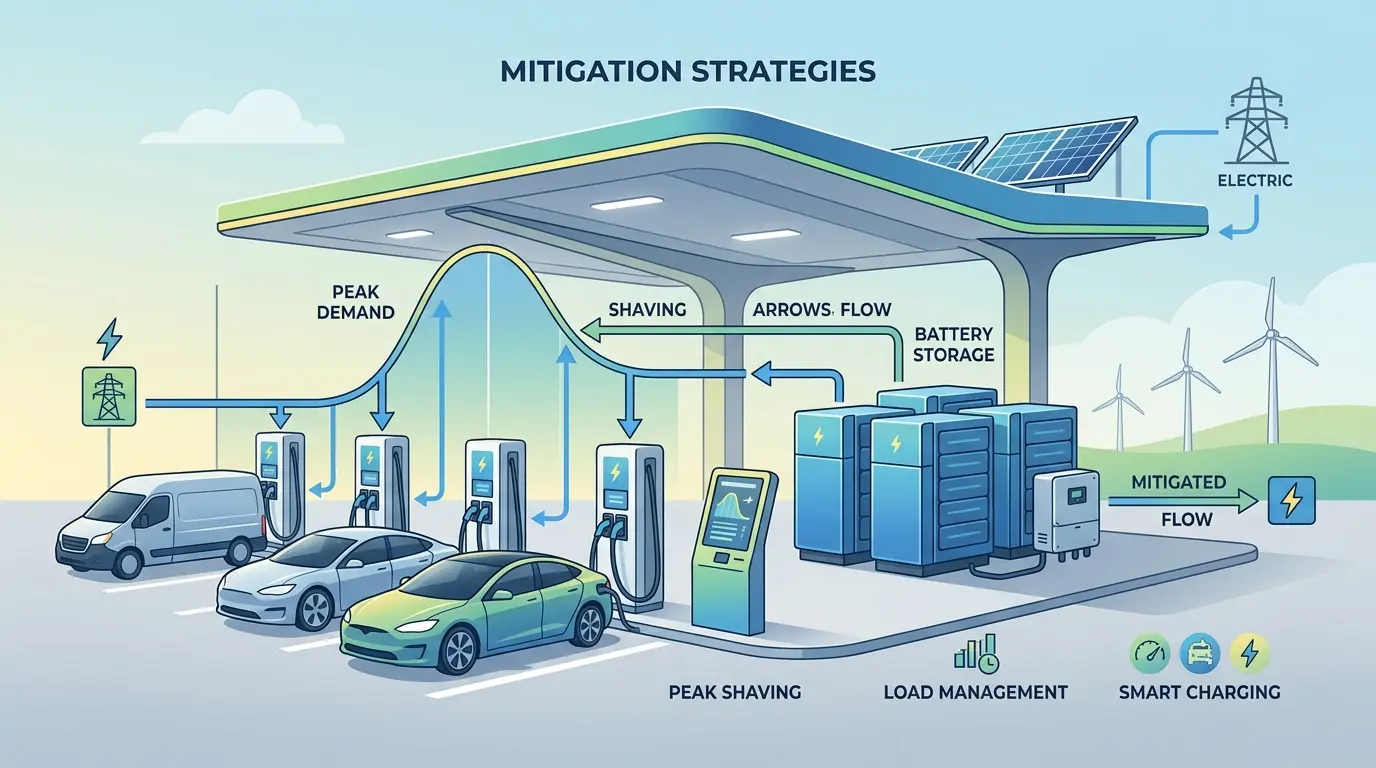
A site can attract strong charger utilization and still underperform financially if monthly peaks are left unmanaged. That problem usually appears after launch: a few high-power charging sessions overlap for one billing interval, the utility records a new demand peak, and the site pays for that spike long after the queue clears.
At high-power EV charging sites, the economic risk is not only how many kilowatt-hours are sold. It is how much power the site pulls at one time, how often that peak recurs, and whether the charging design gives operators any control over it.
The practical goal is not to slow every vehicle down. It is to protect site economics while still delivering the charging experience the location actually needs.
Why Demand Charges Hit High-Power Sites Hard
Demand charges are typically based on the highest short-interval power draw a site reaches during the billing period, often over 15-minute or 30-minute windows. For a high-power charging location, that means the most expensive moment on the site can matter more than the average day.
This is why high-power DC charging sites need a different operating model from slower, dwell-based charging environments. A location with moderate average utilization can still create an expensive monthly peak if several vehicles plug in at once and begin charging near maximum output before their power curves taper.
The result is a common mismatch: operators optimize for speed and turnover, but the utility tariff penalizes unmanaged coincidence. In many markets, demand charges become the line item that decides whether a fast-charging site scales cleanly or becomes margin-constrained.
Start With a Load Model, Not a Charger Shopping List
The first mitigation step is not choosing a charger model. It is understanding the site’s real load profile.
That model should include:
- The utility billing interval and any demand-ratchet rules
- Existing building or depot base load by time of day
- Available service capacity and transformer headroom
- Expected arrival clustering and charging concurrency
- Typical charge-curve behavior instead of nameplate power assumptions
- Seasonal patterns, fleet exceptions, and special event peaks
This is where site planning and tariff planning have to meet. PandaExo’s broader guidance on grid capacity, interconnection, and demand charges is relevant because many costly charging decisions are actually utility-interface decisions in disguise.
Without that model, operators tend to overreact in one of two ways: they either oversize infrastructure around worst-case simultaneous output, or they underbuild flexibility and discover too late that one busy interval can reset the monthly cost structure.
Compare the Main Mitigation Levers Before You Spend
No single tactic solves every demand-charge problem. The right mix depends on dwell time, traffic volatility, utility structure, expansion plans, and how much queue risk the site can tolerate.
| Mitigation Lever | Best Fit | Primary Benefit | Main Tradeoff |
|---|---|---|---|
| Site power caps and dynamic load balancing | Sites with variable demand and flexible charging windows | Limits monthly peak without changing physical layout | Can extend session times during busy periods |
| Shared power cabinets or grouped charging architecture | Multi-dispenser sites where not every vehicle needs full output at once | Reduces coincident peak while preserving connector availability | Less effective if many vehicles need maximum power simultaneously |
| Mixed AC and DC topology | Depots, workplaces, hotels, retail, and mixed dwell environments | Pushes slower loads off expensive high-power infrastructure | Requires more deliberate user and vehicle segmentation |
| Battery energy storage | Sites facing repeated peak penalties or delayed utility upgrades | Shaves short-duration peaks and can defer grid upgrades | Adds capital cost, controls complexity, and operating constraints |
| Managed scheduling, reservations, and priority rules | Fleets and semi-controlled public sites | Aligns power delivery with operational need instead of arrival randomness | Works best when user behavior can be influenced |
| Phased energization and staged expansion | New builds and portfolio rollouts | Avoids paying for unused peak capability too early | Requires disciplined expansion planning |
The strongest demand-charge strategies usually combine several of these levers. High-power charging becomes more economical when operators treat speed as a managed resource rather than a permanently available maximum at every connector.
Shared Power Usually Beats Static Nameplate Planning
Many high-power sites are designed as if every dispenser must be ready to deliver full output at the same moment. In practice, that assumption is often too expensive. Real charging behavior is staggered, charge curves taper, and not every session is operationally critical.
For larger installations, architectures such as PandaExo’s 240-1080kW multi-connector group charging system matter because they let operators distribute a common power pool across multiple dispensers instead of reserving full nameplate output at every bay. That approach can preserve site throughput while avoiding unnecessary utility peaks.
The tradeoff should be understood honestly. Shared power is not magic. If a site regularly has several vehicles that all require maximum-rate charging at the same time, the power pool still needs to be large enough to protect queue times and service levels. But where utilization is uneven, grouped power allocation is often one of the fastest ways to control peak exposure without shrinking connector count.
Right-Size Power Levels to Real Dwell Time
One of the most expensive mistakes in high-power site planning is choosing charger output as a branding statement rather than an operating decision. Not every site needs the highest available power level, and not every vehicle benefits materially from it.
If the average dwell window is longer than the planning team assumed, mid-power DC can sometimes deliver the required energy with less tariff pressure and lower infrastructure burden. PandaExo’s own comparison of 60kW vs. 120kW DC EV chargers is useful here because right-sizing power often does more for demand-cost control than any after-the-fact software setting.
As a practical rule:
- Highway and route-critical fleet locations justify higher power when short dwell is non-negotiable.
- Retail, hospitality, municipal, and urban commercial sites often perform better with a balanced mix of moderate DC and managed dwell time.
- Fleet depots with overnight parking often reduce cost most effectively by reserving high-power charging for only the vehicles that truly need fast recovery.
This is also why a supplier with both AC and DC options plus smart energy management is often easier to scale with. Demand mitigation is usually a system-design problem, not a single-charger problem.
Use Software Controls to Protect the Monthly Peak
Hardware alone does not solve demand-charge exposure if the site has no operating rules. Once chargers are commissioned, site software should decide who gets priority, how much power the site can release at one time, and what happens when demand spikes unexpectedly.
The most effective controls usually include a site demand cap, session prioritization by departure time or route criticality, taper-aware power allocation, and alerts when building load plus charger load approaches a threshold. For public or semi-public sites, price signals, reservations, and queue logic can also help shift charging behavior away from the most expensive intervals.
That is where smart energy management platforms become commercially important rather than merely technical. Operators need visibility across chargers, site load, and peak events so they can manage the monthly maximum intentionally instead of discovering it on the utility bill.
Battery Storage Helps in Specific Cases, Not All Cases
Battery energy storage is one of the most discussed demand-charge tools, but it is not automatically the right answer. It works best when the site suffers from short, sharp peak events, when utility upgrades are delayed or expensive, or when the operator needs flexibility during ramp-up.
In those cases, storage can shave the grid peak while still letting chargers deliver high short-duration power. It can also support resilience goals and, in some markets, improve the broader business case through tariff arbitrage or backup value.
But storage becomes less compelling when the site’s demand problem is long-duration, repeated, and close to sustained charger output. In that scenario, the battery may need to be large and frequently cycled, which changes the economics quickly. Solar can help reduce energy purchases, but by itself it usually does not guarantee peak shaving at the exact hour when fast charging demand is highest.
Phase the Build Instead of Energizing Everything at Once
One of the simplest demand-charge mitigation strategies is sequencing. Civil works, conduit runs, switchgear planning, and space reservation can be designed around the full long-term buildout while only part of the high-power capacity is energized on day one.
That approach helps in two ways. First, it limits early-stage demand exposure when utilization is still ramping. Second, it gives operators time to observe real traffic patterns before committing to the next utility and equipment step.
For portfolio owners, this is especially important. A design standard that supports phased expansion can reduce procurement risk across multiple sites, because not every property will justify the same power mix or activation schedule at the same moment.
Procurement Questions That Prevent Expensive Mistakes
Before committing to hardware, site hosts, fleets, and charging-network planners should ask a set of questions that goes beyond charger output.
- What billing interval sets the demand charge, and does the tariff include ratchets or seasonal variations?
- How much building load already occupies site headroom during the hours chargers will be busiest?
- How many sessions truly require maximum-rate charging, and how often do they overlap?
- Can the chosen architecture share power dynamically across multiple connectors?
- What rules will software use when the site demand cap is reached?
- Would a mixed AC and DC layout reduce peak cost without harming user experience?
- Is battery storage solving a short-interval peak problem or masking an underplanned grid strategy?
- Can the supplier support phased expansion, monitoring, and future site standardization?
If these questions are asked early, demand-charge mitigation becomes part of site design instead of an emergency workaround after launch.
Practical Summary
High-power EV charging sites do not control cost by avoiding power. They control cost by deciding where high power is necessary, where it can be shared, and when it should be limited.
The most durable strategy usually combines five disciplines: model the real site load, right-size charger power to actual dwell time, use software to cap and prioritize demand, add storage only when the economics are specific and defensible, and phase capacity activation instead of energizing the full future build too early.
Demand charges are not just a utility problem. They are a planning, controls, and procurement problem. Sites that treat them that way are in a much stronger position to expand high-power charging without sacrificing throughput or site economics.