
 Deutsch
  Español
  Français
  Italiano
  Português
  Svenska
  Suomi
Suomi  Dansk
Dansk  Norsk bokmål
  Nederlands
  العربية
  עברית
עברית  Polski
  Türkçe
  Русский
  Uzbek
Uzbek  Azərbaycan
  Tiếng Việt
  ไทย
ไทย  한국어
한국어  日本語
日本語  简体中文
简体中文 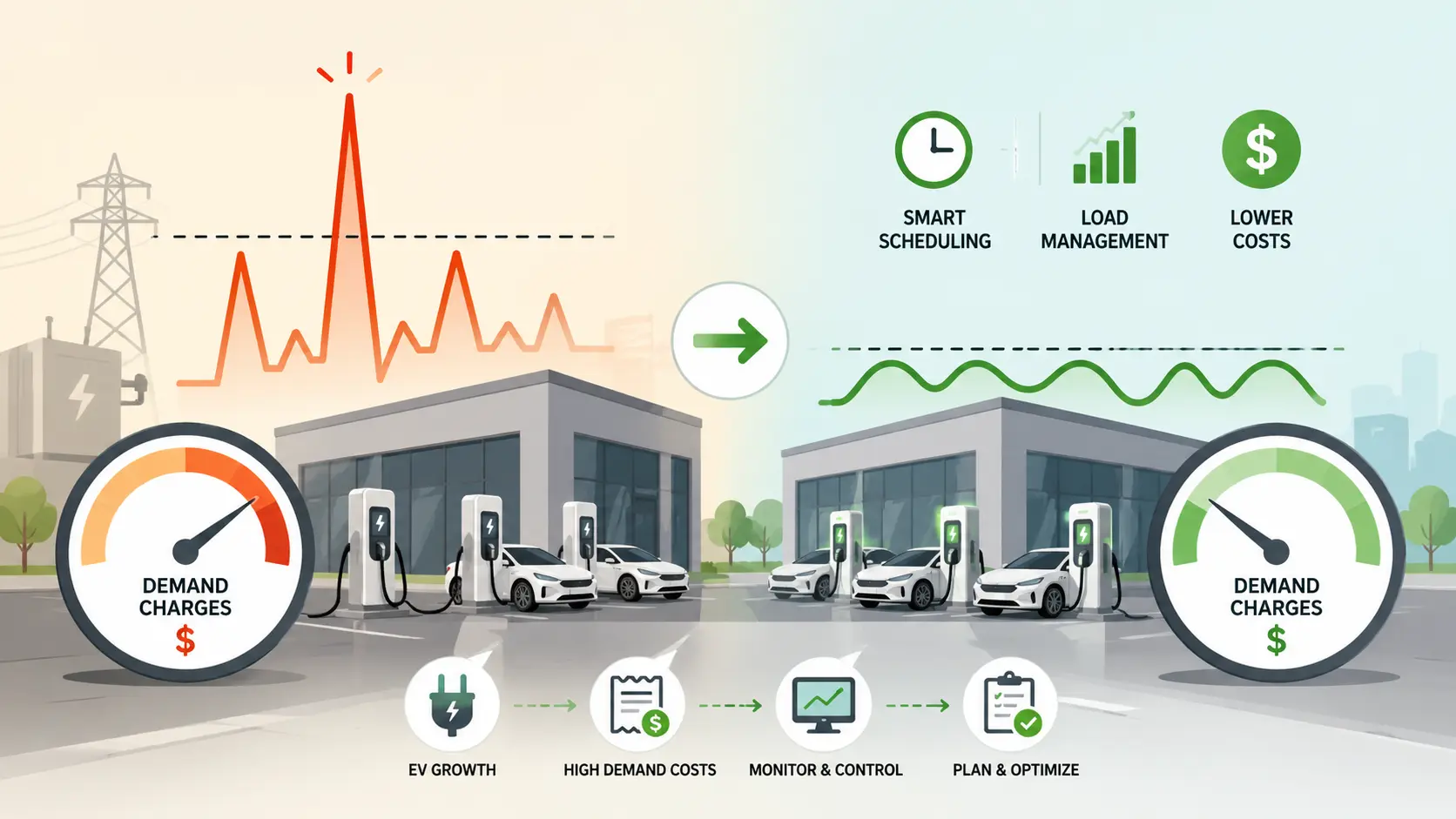
An EV charging project can look attractive in a procurement spreadsheet and still underperform once the first full utility bill arrives. For many commercial site hosts, the surprise is not total energy consumption. It is the monthly peak created when several vehicles charge at once, when fast charging overlaps with building demand, or when charger power is selected without enough attention to tariff structure.
That is why demand charges matter so much in EV charging economics. A site may use a reasonable amount of electricity across the month and still face a cost profile that feels harder to control than expected. For workplaces, hotels, retail centers, parking operators, multifamily properties, and depot hosts, the economics are shaped by both energy delivered and the highest load the site creates.
The practical takeaway is simple: charger selection is only one part of the decision. The stronger business case usually comes from matching charger power, session timing, site load, and expansion plans to the way the utility actually bills the property.
What Demand Charges Actually Measure
Many commercial electricity tariffs do not bill only on energy consumed. They also include a demand component tied to the highest level of power the site draws during a billing period. That means the bill is influenced not just by how much electricity is used, but by how sharply the site peaks.
For site hosts, this creates a different planning problem from ordinary energy management. A charger that runs at the wrong time, or several chargers that ramp together, can affect the month’s economics even if overall charging volume is still modest.
| Cost Element | What It Measures | What Often Drives It | Why It Matters for EV Charging |
|---|---|---|---|
| Energy charge | Total electricity used over time | kWh consumed across the month | Reflects how much charging energy was actually delivered |
| Demand charge | Highest level of site power draw during the billing cycle | Simultaneous building load plus charging load | Can turn a short peak into a lasting monthly cost issue |
| Fixed or service charges | Ongoing access and infrastructure-related fees | Tariff design and service class | Usually less sensitive to daily charging behavior |
Not every utility structures tariffs the same way. Some sites are more exposed to peak-demand pricing than others. That is exactly why site hosts should review their actual tariff instead of assuming EV charging economics will look the same across regions, portfolios, or property types.
Why EV Charging Can Trigger Expensive Peaks
EV charging is power-dense by nature. Even when a site’s monthly charging volume is not especially high, the charging sessions themselves can be highly concentrated.
Common peak-creation patterns include:
- Several drivers plugging in soon after arriving at the same time
- Fast charging sessions overlapping with HVAC, refrigeration, kitchen, or industrial loads
- A site installing higher-power chargers before utilization patterns are well understood
- Fleet vehicles returning in waves and demanding immediate energy recovery
- Charging software operating without enough power-sharing or scheduling logic
This is why first-time hosts sometimes misread the risk. The site may be thinking in terms of annual EV adoption and average monthly energy demand, while the tariff is reacting to a much shorter peak window.
The economic question is not only how much charging the site expects to sell or provide. It is whether charging sessions will coincide with the building’s busiest electrical moments.
Not Every Charger Creates the Same Economic Profile
Site hosts often compare chargers by speed first. That is understandable, but it can hide the more important question: what kind of power profile does the site actually need?
For many commercial parking environments, workplace locations, and longer-dwell properties, a base layer built around AC charging may create a more manageable economic model than leading with higher-power hardware across every parking bay.
By contrast, sites serving short dwell times, route-critical vehicles, or rapid turnover may still need DC charging because the operational value of fast energy delivery outweighs the extra complexity. The point is not that one charging type is better in general. It is that each one produces a different relationship between dwell time, throughput, and tariff exposure.
| Charging Approach | Typical Business Fit | Demand-Charge Exposure | Main Tradeoff |
|---|---|---|---|
| Managed AC charging | Workplaces, hotels, multifamily, long-dwell parking | Often easier to shape and distribute | Slower energy delivery, less suited to urgent turnaround |
| Moderate-power DC charging | Mixed-use commercial sites, smaller fleet depots, selective fast-turn needs | Higher peak sensitivity, but more targeted | Better turnaround, but requires tighter load planning |
| High-power DC fast charging | Highway, public fast charging, high-utilization fleets, route-critical operations | Strongest peak-demand exposure if unmanaged | Highest throughput, but also the greatest site-power pressure |
The mistake is not choosing DC fast charging. The mistake is choosing it where the business case depends mostly on offering charging, rather than on protecting vehicle uptime or accelerating customer turnover. A site with long parked sessions may not gain much from concentrating load into a shorter, more expensive peak.
The Site’s Existing Load Matters As Much As the Charger
EV charging rarely arrives at an empty electrical site. It is usually added to a property that already has its own demand pattern.
That matters because the utility sees the total load, not the charger in isolation. A charger that looks reasonable on paper can become much more expensive when it overlaps with existing building peaks.
Site hosts should ask a few direct questions early:
- When does the building already hit its highest electrical demand?
- Do charging sessions tend to begin during those same hours?
- Are the busiest charging periods predictable or highly variable?
- Will new chargers serve long-dwell vehicles, short-dwell customers, or both?
- Can the site stagger charging without hurting the user experience?
In many projects, this is where the economics become clearer. A charger may not be financially problematic because of its nameplate rating alone. It becomes problematic when it is layered on top of a site’s busiest operational window.
How Site Hosts Can Reduce Demand-Charge Exposure
Demand charges are not always avoidable, but they are often more manageable than they first appear. The most effective approach is usually to control when and how power is delivered instead of assuming the only solution is to install less charging.
Practical mitigation strategies include:
- Phasing charger deployment instead of building to full future capacity on day one
- Sharing available power across multiple connectors instead of letting every charger run at maximum output simultaneously
- Prioritizing vehicles by departure time, state of charge, or operational importance
- Scheduling sessions to avoid overlap with the site’s own electrical peaks
- Using tariff-aware controls so charging behavior follows the economics of the site rather than a fixed default setting
In properties with recurring concurrency risk, dynamic load management can be especially valuable because it helps cap avoidable peaks while still keeping more vehicles connected. That does not eliminate the need for good utility planning, but it often improves how much charging capacity a site can support before a service upgrade becomes necessary.
Utility coordination also matters more than many hosts expect. Reviewing service capacity, interconnection requirements, transformer lead times, and tariff structure early is often what separates a scalable charging rollout from a project that becomes expensive to correct later. PandaExo’s broader guidance on grid capacity, interconnection, and demand charges is relevant here because site economics are often set by electrical constraints before hardware is even installed.
Some sites also evaluate battery storage, solar generation, or other behind-the-meter strategies. Those options can help in the right context, but they should not be treated as automatic fixes. Their value depends on tariff design, load shape, capital cost, operating goals, and how consistently the charging peak can be predicted.
When Higher Power Still Makes Financial Sense
Demand-charge risk does not mean faster charging is a bad investment. In some use cases, higher power is exactly what protects the economics.
That is especially true when the site earns value from one or more of the following:
- High customer turnover that depends on short dwell windows
- Fleet route continuity where downtime is operationally expensive
- Commercial sites where charger throughput matters more than total connector count
- Locations where a slower charging model would require too many bays or too much parking dwell
In those situations, the right answer may be to accept a sharper power profile because the business model is built around rapid energy recovery. The key is to make that choice deliberately, with full visibility into tariff effects and site load interactions, rather than assuming faster hardware is automatically more future-proof.
A site host should be wary of both extremes: installing too little power for the real use case, or installing too much power before demand patterns justify it.
A Practical Screening Framework for Site Hosts
Before procurement, most site hosts can improve decision quality by aligning four variables: dwell time, concurrency, building load, and growth plan.
| Site Type | Typical Dwell Pattern | Often Strongest Starting Point | Main Economic Concern |
|---|---|---|---|
| Workplace parking | Long and predictable | Managed AC charging | Avoiding unnecessary peak overlap during building business hours |
| Hotel or multifamily | Long but variable by occupancy | AC charging with power sharing | Supporting more users without overcommitting site capacity |
| Retail or destination commercial | Mixed dwell, often time-sensitive | Selective mix of AC and moderate DC | Matching charger speed to real customer stay length |
| Fleet depot | Structured but operationally sensitive | AC base layer with targeted DC support where needed | Balancing route continuity against site peak exposure |
| Public fast-charge site | Short dwell and high throughput expectations | DC fast charging | Making sure utilization and revenue justify the heavier power model |
This kind of screening helps prevent a common procurement error: choosing hardware first and discovering later that the tariff, load profile, or dwell pattern points toward a different architecture.
What Site Hosts Should Review Before They Buy
Before signing off on charger quantity or power level, site hosts should review:
- The utility tariff structure, including whether demand charges materially affect the bill.
- Existing building load patterns and the hours when the site already peaks.
- Expected charging concurrency rather than total charger count alone.
- Whether users truly need rapid turnaround or simply reliable access to charging.
- The control logic available for scheduling, prioritization, and power sharing.
- The expansion path if utilization grows faster than expected.
These questions are often more valuable than chasing a single headline speed figure. A charging project performs better when the site host understands not just how fast a charger can run, but how often it should run at that level and what happens to the full site bill when it does.
Practical Summary
Demand charges change EV charging economics because they shift attention from energy alone to peak behavior. For commercial site hosts, that means the strongest project is rarely the one with the most charger power on paper. It is the one that fits dwell time, building load, tariff structure, and growth plans without creating avoidable peak-cost pressure.
In many properties, manageable economics come from a measured rollout, smart power-sharing, and charger selection that matches how vehicles actually use the site. In others, higher-power charging still makes sense because throughput or route continuity is the real value driver.
The important thing is to treat demand charges as a planning input, not an afterthought. Site hosts that do that early tend to make better decisions about charger mix, site phasing, utility coordination, and long-term charging profitability.