

 Deutsch
  Español
  Français
  Italiano
  Português
  Svenska
  Suomi
Suomi  Dansk
Dansk  Norsk bokmål
  Nederlands
  العربية
  עברית
עברית  Polski
  Türkçe
  Русский
  Uzbek
Uzbek  Azərbaycan
  Tiếng Việt
  ไทย
ไทย  한국어
한국어  日本語
日本語  简体中文
简体中文 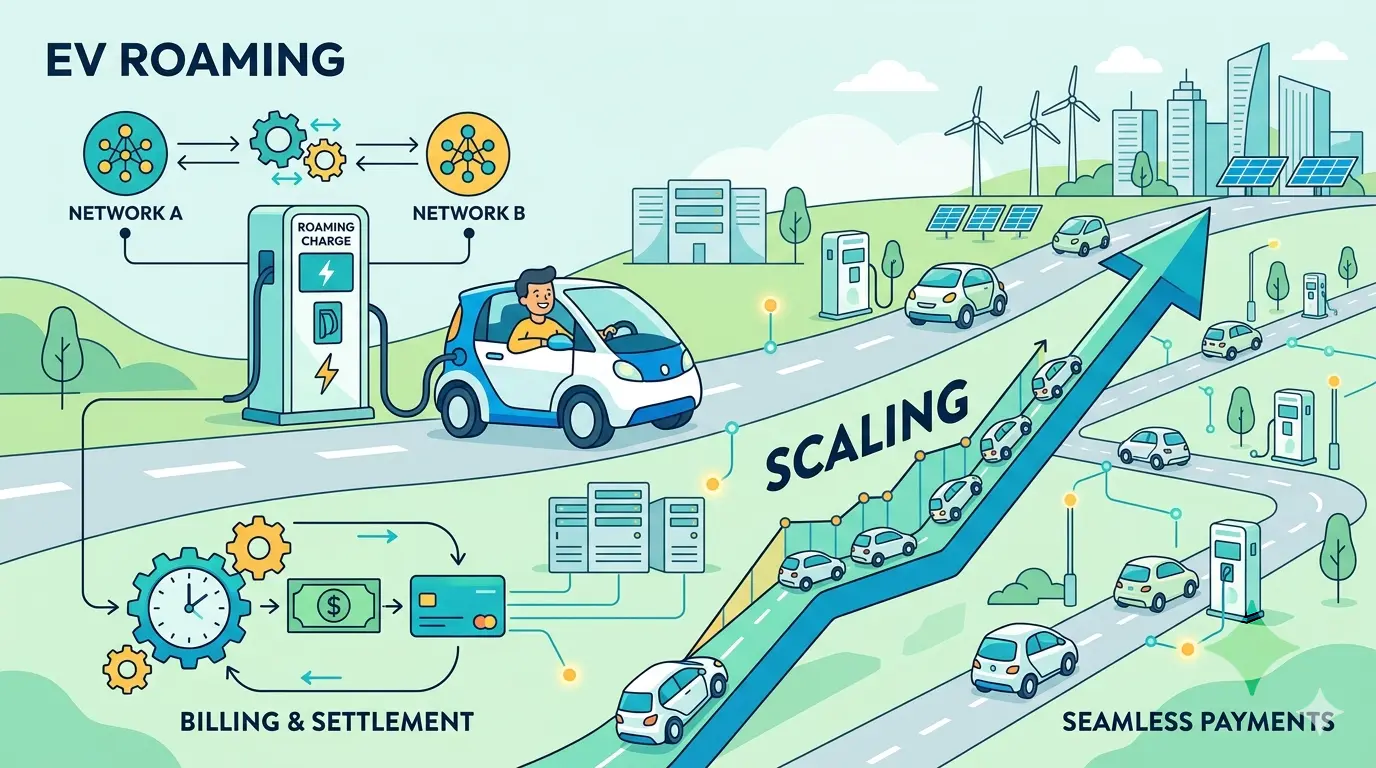
Most charging networks do not run into serious roaming and settlement pain on day one. The trouble starts later, when more drivers arrive through third-party apps, more partner agreements go live, and tariff logic becomes harder to explain across sites, regions, and user groups.
At that point, roaming is no longer just a commercial growth lever. It becomes a data-governance, finance-operations, and customer-trust issue. If session records are inconsistent, tariff versions are unclear, or settlement rules live in spreadsheets instead of controlled workflows, the network starts leaking time and margin long before leadership sees the problem in a monthly report.
That is why scaling operators should treat roaming, billing, and settlement as part of network architecture early, not as a back-office layer to clean up later.
Why This Becomes a Scaling Problem Faster Than Many Teams Expect
In the early phase, a network can often survive with partial manual review. A small number of partner sessions, simple tariffs, and a limited charger footprint make it possible to correct errors case by case.
That model breaks down once the network begins serving multiple roaming partners, different charger types, region-specific tax rules, or mixed pricing structures across public, semi-public, and fleet-oriented sites. A billing issue is no longer just an invoice issue. It can affect driver trust, partner relationships, revenue recognition, dispute volume, and the speed at which finance teams can close a settlement period.
This is especially important for operators growing across mixed EV charging infrastructure portfolios, where hardware standardization, platform behavior, and commercial logic need to stay aligned as the estate expands.
Roaming Grows Demand, But It Also Adds Operational Dependency
Roaming can help networks increase utilization by making chargers visible to more drivers through partner apps and e-mobility service providers. That reach matters. A well-placed charging site benefits when drivers do not need to download a new app or create a new account just to start a session.
But roaming also means the customer journey is no longer controlled by one system. Authorization, tariff display, session data transfer, invoicing, and settlement may now depend on multiple parties exchanging clean data at the right time. If those handoffs are weak, the network does not just create customer confusion. It creates operational ambiguity over who owes whom, why a session failed, or why a receipt does not match the driver’s expectation.
That is why operators should understand roaming not only as an interoperability topic, but also as a billing and settlement topic. The commercial benefit of openness only works when the underlying session and tariff data can support it reliably, which is also why many teams start by clarifying standards and interfaces through resources such as open charging networks, OCPP, OCPI, roaming, and interoperability trends.
Billing Logic Needs to Be Designed for Exceptions, Not Just Ideal Sessions
Many operators define pricing well enough for a normal session and still create avoidable billing problems because the exception logic is weak.
In practice, charging tariffs often combine several elements:
- Energy-based pricing
- Session fees
- Time-based charging components
- Idle or overstay fees
- Parking-related charges
- Membership or partner discounts
- Tax handling by jurisdiction
- Currency conversion or partner-specific settlement treatment
The billing challenge is not only calculating the intended tariff. It is proving which tariff version applied, which party displayed it, whether the session completed normally, and how adjustments should be handled when it did not.
This matters even more when networks run mixed commercial models across AC, DC, destination, workplace, retail, and corridor sites. Operators who already understand how tariff structure shapes driver behavior tend to manage this better, particularly when they view pricing as part of network operations rather than only a revenue setting.
Settlement Is Where Weak Data Discipline Turns Into Revenue Leakage
Billing tells the driver or partner what should be charged. Settlement determines what is actually reconciled and paid between parties.
That distinction matters because a network can appear commercially active while still building hidden financial friction underneath. If charge detail records arrive late, fail validation, contain mismatched connector identifiers, or reference outdated tariff rules, invoices slow down. Finance teams then spend more time chasing exceptions, while partner trust drops and aging balances become harder to interpret.
For scaling networks, settlement should be treated as a controlled operating process with defined calendars, validation rules, responsibility ownership, and dispute workflows. It should not depend on whether a few experienced employees happen to remember how a partner expects files to be cleaned before invoice generation.
The operators that handle this well usually design settlement around repeatable controls early, including:
- Standard partner onboarding fields and contract metadata
- Clear charge detail record validation rules
- Defined settlement periods and approval checkpoints
- Exception queues for incomplete or disputed sessions
- Audit trails for corrections, credits, and resubmissions
- Reconciliation views that connect session volume to invoice output
Without those controls, growth often creates the illusion of momentum while back-office complexity quietly compounds.
Charge Detail Record Quality Should Be Treated as a Core Asset
If roaming and settlement depend on one operational artifact more than any other, it is the charge detail record.
A network does not need a perfect theoretical data model. It does need a disciplined one. That means the session record should reliably identify the charger, connector, timestamps, authorization event, pricing context, metered energy, session outcome, applicable tax treatment, and the commercial parties involved.
If that sounds obvious, it is. The issue is that many networks treat CDR quality as a technical integration detail rather than as the core commercial record that supports billing, settlement, dispute resolution, and auditability.
The table below shows which elements tend to matter most early.
| CDR Element | Why It Matters | What Goes Wrong If It Is Weak |
|---|---|---|
| Stable charger and connector IDs | Links the session to the right asset and partner record | Sessions cannot be reconciled cleanly across systems |
| Accurate start and stop timestamps | Supports pricing, tax timing, and dispute review | Session duration and fee logic become unreliable |
| Metered energy values | Supports energy-based billing and settlement confidence | Partner invoices are challenged or adjusted manually |
| Tariff version reference | Proves which price logic applied at the moment of charging | Operators cannot explain receipt mismatches later |
| Authorization source and token context | Clarifies who initiated access and under which agreement | Roaming disputes become harder to isolate |
| Session outcome and error state | Distinguishes completed sessions from interrupted ones | Failed or partial sessions enter billing flows incorrectly |
| Tax and currency treatment | Supports compliant invoicing and cross-border reporting | Finance teams need manual correction before settlement |
Teams that control these fields early usually find it much easier to scale partner count, geographic coverage, and settlement volume without creating disproportionate finance overhead.
Reconciliation and Dispute Handling Need Structure Before Volume Arrives
Most settlement failures are not caused by one dramatic systems outage. They are caused by repeated small mismatches: missing values, inconsistent timestamps, unclear tariff application, duplicate sessions, or partner-side interpretation differences.
That is why reconciliation should not be reduced to invoice matching at the end of the month. It should be an ongoing workflow that identifies errors while the operational context is still fresh enough to investigate.
Strong early practice usually includes:
- Automated validation before a session enters billable status
- Tolerance rules for meter or timestamp mismatches
- Reason codes for rejected or corrected records
- Clear ownership between operations, platform, and finance teams
- A documented dispute window and resubmission path
- Version control for tariff updates and partner-specific commercial rules
Networks that delay this often discover that the real problem is not one wrong invoice. It is the absence of a common language for deciding whether a session is valid, adjusted, credited, or excluded.
Do Not Separate Network Operations From Finance Operations
Roaming and settlement quality are strongly affected by operational realities at the charger level.
If a charger goes offline during authorization, if a firmware change alters how a session ends, or if a network migration changes how connector identifiers are mapped, the finance effect shows up later through failed charges, disputed sessions, or broken settlement files. In other words, commercial accuracy depends on operational discipline.
That is one reason platform transition planning matters long before an operator actually changes providers. Teams that preserve structured records, configuration history, and extractable session data are in a better position to keep settlement continuity intact during change. That principle is reflected in both data handover planning before switching network providers and network migration best practices for EV charger platforms.
The practical lesson is simple: charger operations, platform operations, and finance operations should not be designed as isolated workstreams if the network expects to scale roaming volume with confidence.
What Scaling Networks Should Put in Place Early
The exact software stack can vary. The control points should not.
| Early Capability | Why It Matters at Scale | Risk If Delayed |
|---|---|---|
| Master data governance for sites, chargers, and connectors | Keeps assets identifiable across platforms and partner files | Reconciliation breaks as identifiers drift |
| Tariff versioning and approval control | Preserves billing explainability | Teams cannot prove which price logic applied |
| Automated CDR validation | Reduces invalid sessions entering settlement | Finance relies on manual cleanup |
| Partner-specific commercial templates | Standardizes roaming setup and settlement expectations | Every new partner creates custom overhead |
| Cross-functional dispute workflow | Clarifies who resolves operational vs commercial issues | Exceptions stay open too long |
| Settlement calendar with clear checkpoints | Improves close discipline and cash visibility | Invoicing becomes inconsistent or delayed |
| Exportable audit trail and migration-ready records | Protects long-term control over network history | Platform changes become risky and expensive |
None of these capabilities are glamorous. All of them become expensive if they are introduced only after the network is already carrying meaningful roaming volume.
Questions Operators Should Ask Before Complexity Arrives
Before a network signs more roaming agreements or expands into more complex billing territory, leadership should be able to answer a few basic questions clearly:
- Which system is the source of truth for tariff logic, and how is change approval controlled?
- Which system is the source of truth for billable session records?
- How are incomplete, duplicate, or disputed sessions identified before settlement?
- Who owns partner onboarding, exception handling, and invoice approval across operations and finance?
- Can the network explain any session receipt after the fact using stored tariff, meter, and authorization data?
- If the platform changed next year, could the operator export enough structured history to preserve settlement continuity?
If the answer to several of these questions is still informal, the network has probably reached the point where process maturity needs to catch up with commercial ambition.
Practical Summary
Roaming helps charging networks grow reach, but it also raises the standard for data quality, tariff governance, and financial control. Billing is not just about setting prices. Settlement is not just about sending invoices. Both depend on a network’s ability to produce clean, explainable session records and resolve exceptions without slowing the business down.
The networks that scale more smoothly usually get a few things right early: they control identifiers, version tariffs, validate charge detail records before they become billable, and treat reconciliation as an operating process rather than an afterthought.
For charging operators, CPOs, and infrastructure partners, the right early investment is not more administrative complexity for its own sake. It is building enough structure now that growth does not later turn into preventable revenue leakage, partner friction, and finance drag.