
 Deutsch
  Español
  Français
  Italiano
  Português
  Svenska
  Suomi
Suomi  Dansk
Dansk  Norsk bokmål
  Nederlands
  العربية
  עברית
עברית  Polski
  Türkçe
  Русский
  Uzbek
Uzbek  Azərbaycan
  Tiếng Việt
  ไทย
ไทย  한국어
한국어  日本語
日本語  简体中文
简体中文 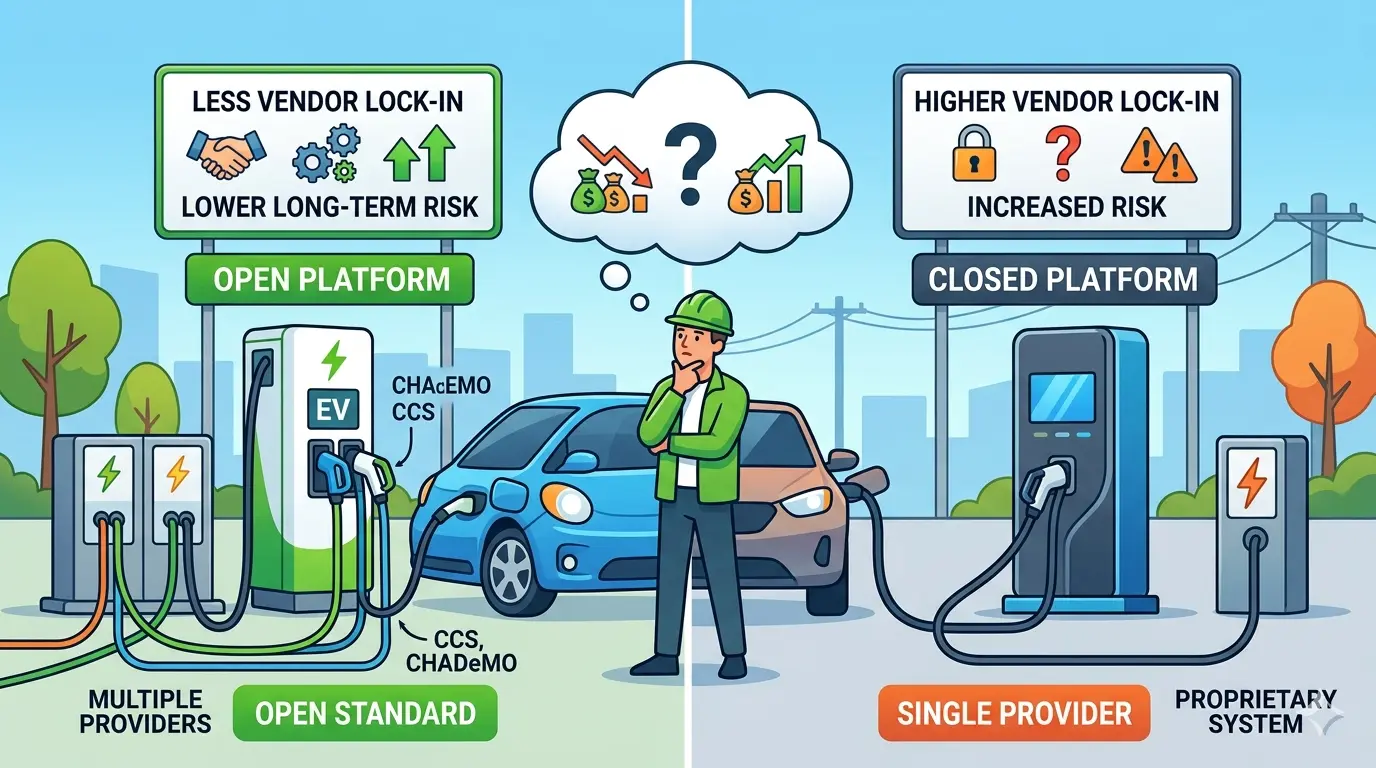
The platform decision rarely feels dangerous at the start of an EV charging rollout. A first site goes live, users can authenticate, sessions appear on a dashboard, and the deployment looks stable enough. The real risk usually shows up later, when a second hardware vendor enters the picture, when a property group wants portfolio-wide reporting, when a fleet operator needs tighter control logic, or when the original software relationship becomes commercially or operationally harder to justify.
That is why infrastructure buyers should not treat open and closed charging platforms as branding language. They are operating models. Each one shapes procurement flexibility, data ownership, migration exposure, integration options, and long-term support discipline in a different way.
For most buyers, the better question is not “Which model is better?” It is “Which model creates the least structural risk once the business changes?”
What Open and Closed Really Mean in EV Charging
An open charging platform usually refers to a system designed around interoperable communication standards, broader hardware compatibility, accessible data flows, and a lower dependency on one tightly controlled vendor stack. In practice, that often means protocol support, clearer API options, easier third-party integration, and a better chance of operating mixed hardware over time. PandaExo’s explanation of open charging networks is useful here because it shows that openness is not only about charger communication. It also affects roaming, network expansion, and future commercial flexibility.
A closed platform usually means the hardware, software, backend logic, firmware path, and support structure are controlled within a narrower ecosystem. That can be a fully vertically integrated vendor environment or a tightly approved set of compatible components and services.
Neither model is automatically good or bad.
An open platform can still create problems if integrations are weak, if firmware governance is loose, or if interoperability is promised but poorly tested. A closed platform can still work very well when the vendor has strong operational discipline, clear support boundaries, and a deployment that is unlikely to outgrow its original assumptions.
The difference is where the risk tends to sit.
Why Long-Term Risk Usually Appears After the First Successful Deployment
Single-site projects often hide structural weakness because the operating environment is still simple. There may be one owner, one site host, one charger class, one billing model, and one support team. Under those conditions, even a highly restrictive platform can feel efficient.
Risk tends to rise when one or more of these changes happen:
- the portfolio expands across multiple sites with different dwell patterns
- AC and DC charging need to coexist under one operating framework
- the organization wants competitive leverage across more than one hardware supplier
- a fleet, retail, hospitality, workplace, or multifamily use case is added later
- roaming, external payment, utility data, or building-system integrations become necessary
- ownership changes force data export, migration, or service-provider handover
This is why long-term platform risk is usually an expansion problem, not an installation problem. What looked like a clean decision at site one can become expensive friction at site ten.
Where Open Platforms Usually Reduce Long-Term Risk
Open platforms usually create less structural risk when the charging business expects to evolve.
The first advantage is procurement leverage. If the platform can support broader charger compatibility and standards-based communication, buyers have more room to negotiate on future hardware, service, and software decisions instead of remaining dependent on one ecosystem. That matters even more when a portfolio may eventually need a broader EV charger portfolio across different site types, power classes, and deployment formats.
The second advantage is integration flexibility. Once charging becomes part of a wider operating model, it often needs to connect to energy management logic, user access systems, payment workflows, fleet tools, or reporting layers. Standards support does not guarantee easy integration, but it usually lowers the barrier.
The third advantage is migration resilience. When a platform change becomes necessary, standards-based architecture and cleaner data portability usually reduce the cost, downtime, and confusion involved in switching environments. PandaExo’s guide to EV charger network migration best practices is relevant because it shows how avoidable migration friction turns into real operating risk once chargers are already live.
The fourth advantage is stronger data ownership and operational continuity. Open architectures do not automatically solve data-handling problems, but they usually make it easier to define export rights, reporting access, and offboarding expectations before the contract becomes a constraint.
The fifth advantage is better fit for mixed-hardware growth. This matters for organizations that may start with one charger class and later add different site models, different vehicle behaviors, or different regional requirements.
In short, open platforms often reduce long-term risk because they preserve options.
Where Closed Platforms Can Reduce Risk in the Near Term
Closed platforms are not irrational. In some cases, they reduce execution risk early on.
If the deployment is small, predictable, and unlikely to change materially, a closed system can simplify support. One vendor may own the charger behavior, backend environment, firmware process, and escalation path. That can reduce ambiguity when faults appear.
Closed platforms can also be easier to launch when the buyer has a lean internal team and wants one accountable party rather than multiple integration partners. Fewer hardware combinations may mean less interoperability testing, fewer edge cases, and a faster path to stable operations.
They can also work well in environments where the operator values consistency more than future vendor flexibility. A closed model may be commercially acceptable if the charging environment is intentionally narrow, such as a stable private fleet depot, a controlled employee site, or a limited owner-operated network with little expectation of external integration.
The key issue is that these benefits usually reduce short-term complexity, not long-term dependency.
That tradeoff is often acceptable, but it should be acknowledged directly.
The Risk Comparison Buyers Should Actually Use
The most useful comparison is not “open equals flexible, closed equals simple.” Buyers should compare where each model concentrates risk over time.
| Risk Category | Open Platform Tendency | Closed Platform Tendency | Lower-Risk Choice When… |
|---|---|---|---|
| Procurement leverage | Usually stronger because future hardware and service choices are less constrained | Usually weaker because replacement and expansion paths may depend on one ecosystem | Open, if the buyer expects competitive sourcing later |
| Operational simplicity at launch | Can require more testing and governance upfront | Often simpler at launch because the vendor stack is narrower | Closed, if the site is small and change is unlikely |
| Data portability | Usually easier to define and enforce when the architecture supports export and interoperability | Often more vulnerable if data access depends on one platform relationship | Open, if future migration or handover is plausible |
| Multi-vendor growth | Better suited to mixed hardware environments over time | Can become restrictive once site needs diversify | Open, if the portfolio will expand across use cases |
| Vendor accountability | Can be blurred if support boundaries are poorly defined | Can be clearer because one provider controls more of the stack | Closed, if the contract defines strong service accountability |
| Migration exposure | Usually lower if standards and data access are real, not just promised | Often higher because offboarding may require more rework | Open, if the organization wants strategic flexibility |
| Change control and QA discipline | Depends heavily on governance quality | Can be tighter if the vendor controls testing, firmware, and release logic well | Closed, if the vendor has proven operational maturity |
| Business model adaptability | Usually higher for roaming, mixed ownership, and evolving network structures | Usually lower if the original use case changes materially | Open, if future operating conditions are uncertain |
This table points to a simple pattern: open platforms usually reduce structural long-term risk, while closed platforms can reduce short-term delivery risk.
Why Standards Matter More Than Marketing Claims
Many platform pitches use the word “open” loosely. Buyers should not accept the claim without checking what is actually open.
For example, support for OCPP matters because it can materially improve charger-to-backend interoperability and future backend flexibility. But the real question is not whether the acronym appears on a brochure. It is whether the implementation is stable, well supported, and commercially usable. PandaExo’s article on what the OCPP protocol means for commercial EV stations is helpful because it frames standards in buyer terms rather than technical shorthand.
The same discipline applies to APIs, data export tools, roaming interfaces, and firmware governance. A platform is not genuinely lower risk just because it is described as open. It is lower risk when interoperability works in practice, support responsibility is clear, and contract terms preserve future operating options.
The Biggest Hidden Risk Is Usually Data Handover, Not Hardware Replacement
Buyers often focus on whether chargers can be swapped later. That matters, but the deeper risk is usually operational data lock-in.
If session history, configuration records, user permissions, pricing structures, alarm logs, firmware history, and performance data are hard to extract in a usable format, a platform change becomes much more disruptive. The organization does not just replace hardware or software. It loses continuity.
That continuity matters for finance teams, service teams, compliance processes, uptime analysis, and user support. It also matters when networks change ownership or when service providers are replaced.
This is why PandaExo’s data handover checklist before switching network providers is such a practical lens. It shifts the platform discussion away from abstract openness and toward operational control.
A Better Answer Than “Open” or “Closed”: Governed Openness
For many serious infrastructure buyers, the least risky model is not extreme openness or total closure. It is governed openness.
That means choosing a platform strategy with real standards support, practical interoperability, and contractual data rights, while still enforcing disciplined firmware control, support accountability, cybersecurity process, and tested integration boundaries.
In other words, the goal is not unlimited flexibility. The goal is controlled flexibility.
That model tends to work best because it avoids two common mistakes:
- overvaluing short-term simplicity and getting trapped in a restrictive ecosystem later
- overvaluing theoretical openness without building the governance needed to operate it reliably
The right platform should preserve future options without turning the operating model into a support burden.
Questions Buyers Should Put Into the RFP and Contract
Before choosing either model, buyers should force the long-term risk discussion into procurement documents.
Ask these questions clearly:
- Can charger data, pricing rules, user records, and site configuration be exported in a structured and usable format?
- Which communication standards are supported in practice, and on which hardware or firmware versions?
- Who is accountable when hardware, backend logic, payment tools, and network integrations conflict?
- What happens if the buyer changes software platforms, hardware suppliers, or service operators later?
- How are firmware updates approved, rolled back, and documented across the charger estate?
- Can the platform support mixed AC and DC environments without forcing separate operating silos?
- What offboarding obligations exist for credentials, keys, reports, and historical data?
If a vendor cannot answer those questions with operational clarity, the buyer is not evaluating platform risk properly.
Which Model Creates Less Long-Term Risk?
In most growth-oriented EV charging businesses, open platforms create less long-term risk.
That is especially true for buyers that expect one or more of the following:
- multi-site expansion
- mixed hardware environments
- future backend changes
- roaming or external integrations
- competitive procurement over time
- ownership, operator, or business-model changes
Closed platforms can still be the safer short-term choice when the environment is narrow, stable, and intentionally controlled. But once the charging business needs to adapt, their main advantage often turns into dependency.
The practical conclusion is straightforward. If the business expects change, open usually reduces long-term risk. If the business is genuinely stable and tightly bounded, closed may reduce launch friction but should still be chosen with explicit awareness of future lock-in exposure.
Practical Summary
Open and closed charging platforms do not create risk in the same way.
Closed models often reduce short-term complexity by narrowing the operating environment and simplifying vendor accountability. Open models usually reduce long-term exposure by preserving procurement flexibility, data portability, integration options, and migration resilience.
For most infrastructure buyers, the safest path is not ideological openness. It is a governed, standards-based platform strategy that protects future options while keeping operational control disciplined.
That is the real test to apply before signing: not whether the platform looks simple today, but whether it will still be commercially workable after the network grows, the use case changes, or the original vendor relationship is no longer the best fit.