
 Deutsch
  Español
  Français
  Italiano
  Português
  Svenska
  Suomi
Suomi  Dansk
Dansk  Norsk bokmål
  Nederlands
  العربية
  עברית
עברית  Polski
  Türkçe
  Русский
  Uzbek
Uzbek  Azərbaycan
  Tiếng Việt
  ไทย
ไทย  한국어
한국어  日本語
日本語  简体中文
简体中文 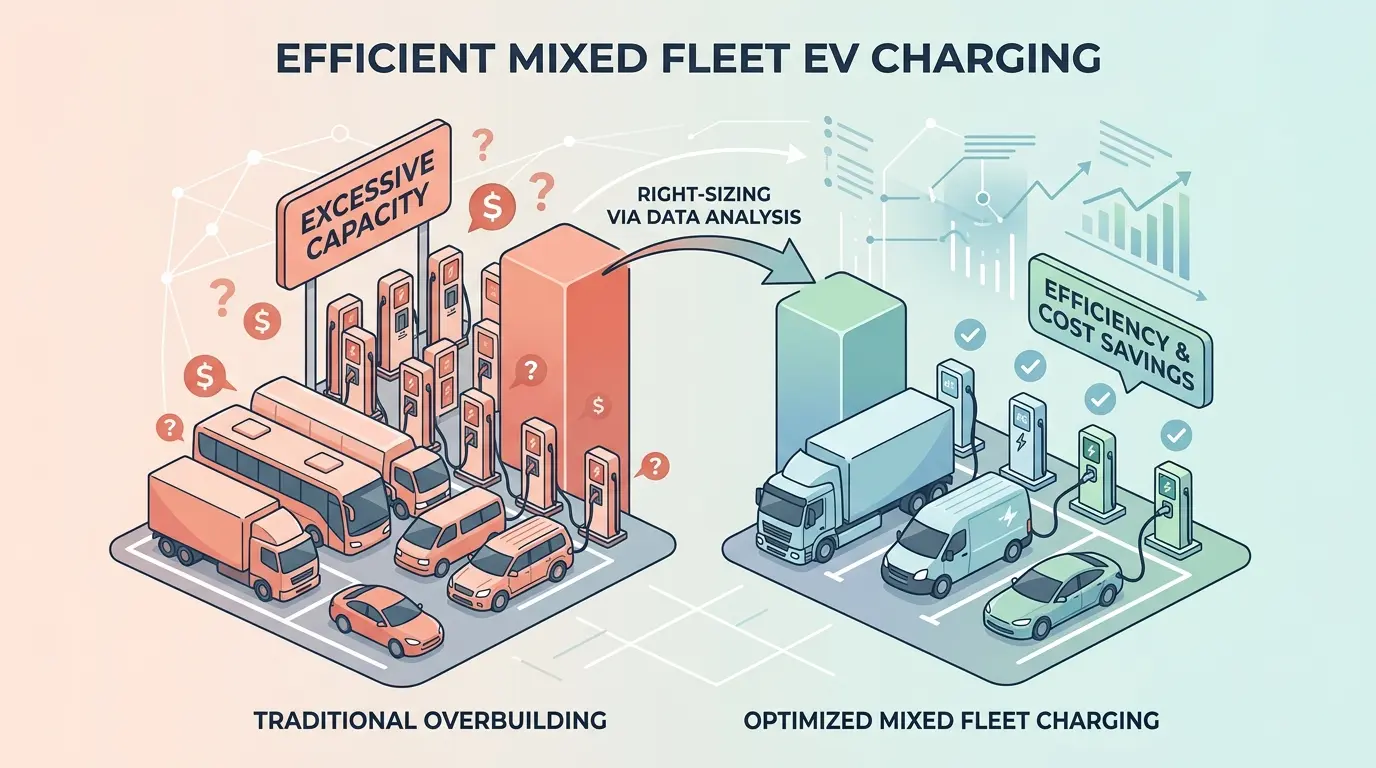
If you manage a mixed EV fleet, the biggest sizing mistake is usually not underestimating demand. It is assuming every vehicle needs the same charging behavior at the same time.
A depot with service vans, pool cars, supervisor vehicles, and a few high-utilization units does not behave like a single-use fleet. Some vehicles can sit overnight. Some only need a daily top-up. Some need fast recovery between jobs. If you size the site for full simultaneous peak across every bay, you can end up overspending on chargers, switchgear, trenching, and utility upgrades that deliver very little operational value.
The better approach is to size infrastructure around energy demand, dwell time, dispatch risk, and site constraints, then phase the build so the site can grow without being overbuilt on day one.
Why Mixed Fleets Break Simple Charger-to-Vehicle Ratios
Single-ratio planning sounds efficient, but mixed fleets rarely follow a single charging pattern. A light-duty sales vehicle parked at the office all day has a very different requirement from a delivery van that returns late and needs to leave again early the next morning.
That is why charger count alone is a poor planning metric. Infrastructure sizing should reflect charging jobs, not just parked assets.
| Fleet Group | Typical Parking Pattern | Charging Objective | Best-Fit Charging Approach |
|---|---|---|---|
| Pool cars and admin vehicles | Long office-hour or overnight dwell | Restore daily consumption efficiently | AC smart charging |
| Service vans | Overnight depot return, occasional urgent turnaround | Reliable replenishment with some recovery flexibility | Mostly AC, with limited DC contingency |
| Route-critical or high-utilization units | Short dwell between trips | Fast energy recovery to protect uptime | Targeted DC fast charging |
| Visitor or contractor EVs | Unpredictable access windows | Convenience without interfering with core fleet operations | Managed AC on separate rules |
When these use cases are mixed together, overbuilding usually happens for one of three reasons:
- The site is sized as if every vehicle must charge at full power simultaneously.
- DC fast charging is treated as the default answer rather than a tool for specific turnaround problems.
- Future growth is addressed by installing all final hardware immediately instead of preparing the site for phased expansion.
Start With Daily Energy, Not Equipment Count
The first calculation is not “How many chargers do we want?” It is “How much energy does each vehicle group need on a typical day, and when does that energy need to be delivered?”
For each vehicle class, define:
- Vehicle count
- Average daily energy needed per vehicle
- Minimum departure state of charge or route buffer
- Typical arrival and departure windows
- Peak-day exceptions such as overtime, second shifts, or seasonal routes
In practice, daily fleet energy need is the sum of all vehicle-group charging needs, not the sum of all battery capacities on site. A van with a large battery does not need a full recharge every day if its route only consumes part of that pack. Using battery size as the sizing baseline almost always inflates infrastructure requirements.
This step also reveals which loads are flexible and which are operationally critical. That distinction matters more than the average charger power on a product sheet.
Match AC and DC to Dwell Time, Not to Procurement Ambition
For most fleets, AC charging should be the default starting point wherever vehicles have dependable dwell windows. It is well suited to overnight depot parking, workplace charging, and fleets that can replenish energy gradually without affecting dispatch. AC infrastructure is typically easier to distribute across parking areas and can reduce unnecessary capital intensity when the operational need is daily replenishment rather than rapid turnaround.
By contrast, DC charging earns its place when a vehicle’s utilization pattern leaves little room for slower charging. That usually means route-critical vehicles, short between-shift dwell, or situations where one missed charging window creates service disruption. DC fast charging can reduce dwell time and protect throughput, but it also increases demands on utility capacity, thermal management, site design, and overall project economics.
The tradeoff is straightforward:
| Question | AC Smart Charging Usually Wins When | DC Fast Charging Usually Wins When |
|---|---|---|
| How long can vehicles stay parked? | Several hours or overnight | Short windows between trips |
| What is the charging goal? | Daily replenishment | Rapid operational recovery |
| How sensitive is the site to utility cost and complexity? | High sensitivity | Fast turnaround justifies higher infrastructure burden |
| How many vehicles need urgent charging at once? | Few or none | A defined subset regularly does |
The mistake is not choosing DC. The mistake is choosing it for vehicles that would be served perfectly well by managed AC.
Size for Managed Concurrency, Not Nameplate Peak
Most mixed-fleet sites do not need every connected charger delivering full power at the same moment. Vehicles arrive at different times, leave at different times, and do not all require the same energy before departure. That means the real sizing question is concurrent charging demand, not installed connector count.
Smart scheduling and load balancing can materially reduce overbuild risk by sequencing flexible loads behind urgent ones. The same logic behind dynamic load management in other EV charging environments applies to fleets: set a site demand cap, prioritize vehicles by departure time or route criticality, and let software distribute power where it creates the most operational value.
This is where smart energy management becomes more than a platform feature. It becomes a capital planning tool. If the site can intelligently manage concurrency, the electrical backbone often does not need to be sized around worst-case simultaneous output across every charger.
Build the Site Once, but Energize It in Phases
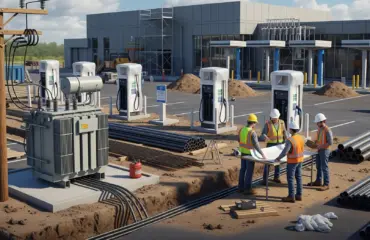
One of the most effective ways to avoid overbuilding is to separate site preparation from hardware activation. Civil works and utility coordination are disruptive and expensive to repeat. Charger hardware deployment is easier to phase.
For that reason, many operators prepare the site for the long-term fleet vision but energize only what near-term demand justifies. That often means:
- Installing conduit, trenching, and spare pathways for future chargers
- Reserving pad, cabinet, or switchgear space for later expansion
- Designing parking layout and cable reach around the final site plan
- Activating only the initial charger mix needed for the current fleet profile
That is also why buyers often prefer a supplier with a broader EV charger portfolio. In PandaExo’s positioning, the value is not that every site needs every charger class. It is that mixed fleets often need a scalable path across AC charging, selected DC fast charging, and platform-level visibility rather than a one-format deployment strategy.
Bring Utility and Site Constraints Into the Model Early
Fleet charging plans often look reasonable on paper until utility timelines, transformer availability, or parking flow realities are added back into the project. Oversizing can happen not only through too much hardware, but also through poor assumptions about service capacity and construction readiness.
Before finalizing the charger mix, pressure-test the plan against:
- Available service capacity and upgrade lead times
- Demand-charge exposure under high-power charging events
- Trenching distance and civil complexity
- Parking circulation, reversing patterns, and charger accessibility
- Future vehicle mix changes, including heavier-duty or larger-pack vehicles
If the utility process is not modeled early, fleets can commit to a theoretical build that is too expensive or too slow to deliver. A more grounded planning method is to align infrastructure design with real interconnection and demand-cost conditions from the start, which is why utility-side planning deserves as much attention as charger selection itself. PandaExo’s own educational guidance on grid capacity, interconnection, and demand charges reflects this reality.
Use a Simple Decision Framework Before You Procure
Mixed-fleet charging plans become easier to manage when decisions are made in a fixed order.
- Group vehicles by duty cycle, not by brand or battery size.
- Quantify average and peak-day energy demand for each group.
- Identify which vehicles truly need short-window turnaround.
- Default to AC for long dwell and add DC only where the operation clearly requires it.
- Set a site demand cap and evaluate whether software-managed concurrency can keep the fleet within it.
- Phase the rollout so future growth is prepared for, but not fully installed on day one.
This sequencing helps buyers avoid a common procurement trap: comparing charger models before they have defined the operational problem each charger is meant to solve.
Do Not Ignore Procurement and Platform Risk
Infrastructure that looks correctly sized can still become a poor investment if the platform, hardware roadmap, or supplier model does not fit how the fleet will expand. Mixed fleets often evolve. A site that serves passenger vehicles today may need to add commercial vans, external users, or multi-site visibility tomorrow.
That means the sizing conversation should include more than kilowatts and connector count. It should also include network visibility, load-control logic, firmware strategy, expansion compatibility, and whether OEM or ODM flexibility will matter for channel partners or specialized deployment requirements. These are not add-ons after the fact. They affect how well today’s infrastructure decision survives tomorrow’s fleet changes.
Practical Summary
The right way to size EV charging infrastructure for mixed fleets is to think like an operator, not like a catalog buyer.
- Start with daily energy need, not total battery capacity.
- Default to AC where dwell time makes it practical.
- Use DC selectively for true turnaround pressure, not as a universal upgrade.
- Manage concurrency with software before paying for unnecessary peak capacity.
- Prepare the site for future expansion, but activate hardware in phases.
- Bring utility, parking, and dispatch realities into the model early.
Mixed fleets do not need the biggest possible charging build. They need a charging system that matches how vehicles actually move through the day. When the infrastructure is sized around real duty cycles, operational priorities, and controlled growth, fleets can expand charging access without overbuilding the site that supports it.