
 Deutsch
  Español
  Français
  Italiano
  Português
  Svenska
  Suomi
Suomi  Dansk
Dansk  Norsk bokmål
  Nederlands
  العربية
  עברית
עברית  Polski
  Türkçe
  Русский
  Uzbek
Uzbek  Azərbaycan
  Tiếng Việt
  ไทย
ไทย  한국어
한국어  日本語
日本語  简体中文
简体中文 
Commercial EV charging projects often begin as site-level conversations about charger count, installation budget, and customer demand. Utilities evaluate the same project differently. From their perspective, the question is not simply whether a property wants charging. The question is whether the local grid can support the added load safely, economically, and on a timeline that fits available infrastructure.
That distinction matters. A project that looks straightforward from the site owner’s side can slow down once transformer capacity, feeder constraints, metering changes, or utility construction windows enter the picture. For developers, fleet operators, property owners, and CPOs, understanding how utilities review charging proposals is one of the most practical ways to reduce avoidable delays.
What Utilities Are Actually Reviewing
Utilities do not approve projects based on charger demand alone. They assess the electrical and operational consequences of the proposed load.
At a high level, most utility reviews focus on the areas below.
| Utility Review Area | What the Utility Is Asking | Why It Matters to the Project |
|---|---|---|
| Existing service capacity | Can the current service support the new EV charging load? | Determines whether the site can move quickly or needs infrastructure upgrades |
| Transformer impact | Can the serving transformer handle the added demand and charging pattern? | Often becomes a critical schedule and budget driver |
| Feeder and upstream constraints | Does the local distribution network have room for this new load? | May require utility-side construction beyond the property line |
| Protection and metering | Are protective devices, coordination, and metering arrangements still appropriate? | Affects design approvals, safety compliance, and interconnection scope |
| Load behavior | How will chargers actually be used across the day or week? | Real-world usage can be more important than nameplate power alone |
| Expansion logic | Is this a one-phase build or the first step of a larger rollout? | Utilities want to understand whether the proposed service is future-ready or temporary |
In practical terms, the utility is translating the charging plan into a grid-impact question. That is why strong early scoping usually produces faster progress than trying to refine the electrical strategy after application submission.
Make-Ready Often Shapes the Entire Business Case
Many project teams focus first on charger hardware and on-site installation labor. In reality, utility-side and service-side make-ready work can have just as much influence on cost and schedule.
Make-ready can include:
- Service upgrades
- New conductors or conduit runs
- Transformer replacement
- Metering changes
- Switchgear coordination
- Civil work tied to utility service extension
- Upstream feeder work outside the site boundary
That is why the charger itself is only one part of project readiness. PandaExo’s guide to installation costs, permits, and step-by-step process is useful precisely because it frames EV charging as a full infrastructure path, not just a hardware purchase.
The table below shows how make-ready scope typically changes project complexity.
| Make-Ready Condition | Typical Utility View | Likely Project Effect |
|---|---|---|
| Existing service has clear spare capacity | Low infrastructure risk | Faster utility review and fewer external dependencies |
| Minor metering or protection adjustments required | Moderate complexity | Some engineering review but usually manageable timeline impact |
| Transformer upgrade required | Elevated infrastructure dependency | Schedule may be driven by transformer sourcing and utility construction windows |
| Upstream feeder reinforcement required | High complexity | Budget and approval timing can expand materially |
| Multi-phase service strategy needed | Utility may prefer phased coordination | Project may need staged energization or revised rollout assumptions |
For commercial buyers, this is often the hidden reason why one site energizes quickly while another stalls for months.
Transformer Capacity Is Usually More Important Than Teams Expect
One of the most common project planning mistakes is assuming the charger lead time is the main critical path. In many commercial EV charging deployments, transformer readiness is the more important schedule variable.
If the existing transformer cannot support the additional load, the project may depend on a larger replacement unit, a new service configuration, or a phased deployment plan. This becomes especially important for high-power public charging, fleet depots, and any site considering heavier DC charging architecture.
Transformer-related delay risk usually comes from more than one source:
- Utility engineering review time
- Procurement and inventory availability
- Construction queue timing
- Coordination with site civil and electrical contractors
- Seasonal or regional demand pressure on utility resources
The key planning point is simple: a project is not truly ready until the transformer question is answered.
Utilities Care About Load Profile, Not Just Installed Power
Utilities rarely look at charging projects as static nameplate totals. They want to understand when the load will appear, how sharply it will ramp, and whether the site can moderate demand through operating logic.
Two sites with the same installed charging capacity can produce very different utility concerns. An overnight depot with managed charging, for example, does not create the same profile as a public fast-charging site with unpredictable daytime peaks.
| Site Type | Utility Concern | Why the Review Outcome Can Differ |
|---|---|---|
| Fleet depot with overnight charging | Sustained but potentially controllable load | Managed charging can improve grid fit if charging windows are flexible |
| Workplace or multifamily charging | Medium-duty load spread across predictable periods | Lower simultaneity may reduce infrastructure stress |
| Retail or hospitality charging | Variable dwell time and moderate demand spikes | Utility may focus on diversity assumptions and peak overlap |
| Public high-turnover charging site | Fast ramping, higher coincidence risk, larger peak demand | More likely to trigger transformer or feeder scrutiny |
This is where control strategy becomes commercially important. A project that appears difficult in raw capacity terms may become more feasible if the operating plan includes scheduling, demand management, or staged charging logic. PandaExo’s article on dynamic load management in shared charging environments is relevant for teams trying to improve project acceptance without oversizing infrastructure unnecessarily.
Approval Timelines Depend on Scope Clarity
Utilities generally move faster when the application package is specific. When the charger count, power assumptions, electrical single-line information, phasing logic, and energization goals are clear, engineering review becomes more straightforward.
By contrast, vague proposals create delay because the utility has to spend time resolving questions the applicant should have answered first.
The timeline below is a useful way to think about what tends to accelerate or slow the process.
| Timeline Driver | Speeds Review When | Slows Review When |
|---|---|---|
| Site scope definition | Charger count, power level, and layout are settled | Project still has open questions about charger type or scale |
| Electrical documentation | Service information and single-line assumptions are clear | Existing service condition is uncertain or undocumented |
| Expansion planning | Future phases are identified early | Utility suspects the initial phase is understated |
| Load management strategy | Demand controls are explained credibly | Load assumptions are optimistic but unsupported |
| Utility construction dependency | Existing infrastructure is likely adequate | Transformer or feeder work is probably required |
This is why teams that submit early but incomplete applications do not always save time. In many cases, they simply move the unresolved work into the utility review queue.
What Strong Project Teams Prepare Before Utility Engagement
The best commercial teams do not wait for the utility to tell them what is missing. They build a review-ready package before formal application activity begins.
| Preparation Item | Why It Helps |
|---|---|
| Site plan and charger layout | Gives the utility a concrete view of the proposed build |
| Existing electrical service information | Reduces uncertainty around available capacity and service constraints |
| Charger power assumptions by phase | Helps the utility understand near-term and future load growth |
| Expected use case and operating pattern | Makes the load profile more realistic than a nameplate-only estimate |
| Preliminary single-line concept | Speeds engineering interpretation and coordination |
| Expansion roadmap | Prevents under-scoping that later forces rework |
| Demand management assumptions | Shows whether the project can moderate peak stress on the grid |
These inputs are not just administrative. They shape how credible the project appears to the utility. A project team that understands its own site logic is easier to approve than one that is still treating charger selection, power design, and rollout strategy as separate decisions.
Why Charger Architecture Still Matters During Utility Review
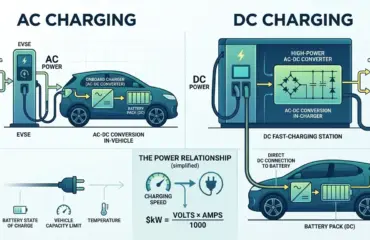
Utilities may not choose the charger brand, but the technical shape of the charger plan still affects the review outcome. A site centered on AC charging will usually present a different electrical profile than one centered on large, fast-turnaround DC charging.
That does not mean one approach is inherently better. It means charger selection must fit the site’s actual operating need, utility context, and buildout strategy.
In commercial planning, charger architecture affects:
- Total connected load
- Likely simultaneity
- Service upgrade probability
- Demand charge exposure
- Need for smart controls or phased deployment
- Long-term expansion feasibility
When those decisions are made too late, the utility review often becomes a correction exercise instead of a validation exercise.
How PandaExo Helps Teams Prepare More Realistic Projects
PandaExo supports organizations that need charging strategy aligned with site power reality, not just product availability. With a portfolio spanning EV charging infrastructure, AC and DC hardware, and smart energy management capability, PandaExo can help buyers think through what a site can realistically support today and how it may scale over time.
That is especially useful in projects where make-ready scope, transformer limits, phased energization, and future expansion all need to be considered together. PandaExo’s OEM and ODM flexibility is also relevant for partners that need region-specific deployment formats or tailored hardware strategies across different commercial site types.
Final Takeaway
Utilities evaluate commercial EV charging projects as grid-impact proposals, not just site upgrades. Make-ready scope, transformer capacity, feeder limits, load behavior, and documentation quality all shape the path to approval.
For developers, fleets, property owners, and CPOs, the practical lesson is clear: utility readiness starts well before formal submission. The stronger the project definition, the easier it is to reduce delays and align charger strategy with actual electrical conditions.
If your organization is planning a commercial charging rollout and needs hardware and infrastructure strategy that fit real utility constraints, contact the PandaExo team to discuss a site-ready deployment approach.