
 Deutsch
  Español
  Français
  Italiano
  Português
  Svenska
  Suomi
Suomi  Dansk
Dansk  Norsk bokmål
  Nederlands
  العربية
  עברית
עברית  Polski
  Türkçe
  Русский
  Uzbek
Uzbek  Azərbaycan
  Tiếng Việt
  ไทย
ไทย  한국어
한국어  日本語
日本語  简体中文
简体中文 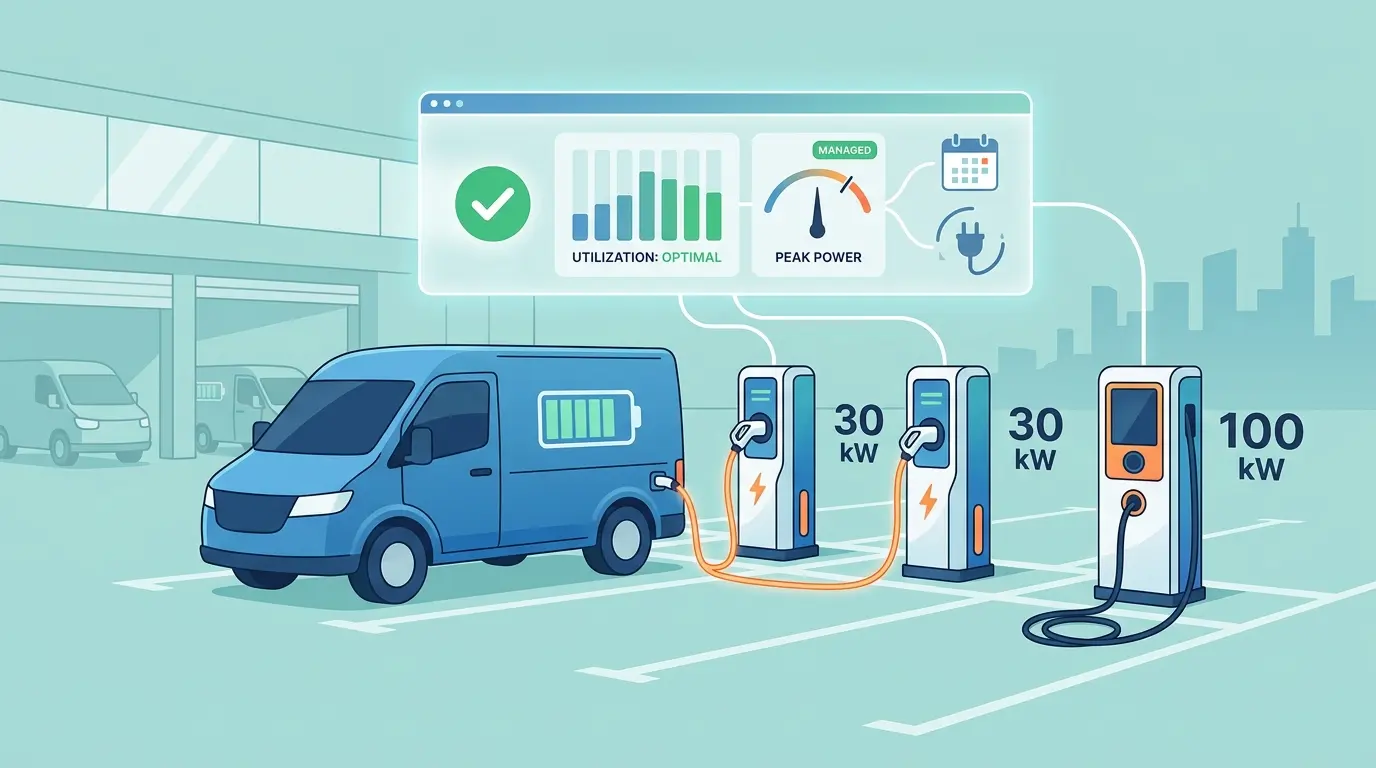
When a fleet depot starts electrifying vehicles at scale, one of the first procurement questions is usually framed as a simple ratio: should you buy one charger for every vehicle, one for every two vehicles, or something in between?
That sounds like a clean planning shortcut, but depot charging rarely behaves like a simple parking-lot arithmetic problem. The real answer depends on how many vehicles actually need energy in the same charging window, how long they stay parked, how much daily replenishment they require, and how much dispatch risk the operation can tolerate.
In some depots, a near 1:1 connector-to-vehicle ratio is the safest answer. In others, fewer connectors can work if duty cycles are lighter or charging demand is staggered. What almost never makes sense is assuming every vehicle needs its own dedicated high-power charging asset.
The Ratio Should Be Based on Charging Waves, Not Total Fleet Size
The first mistake in depot design is sizing for the total number of registered fleet assets instead of the vehicles that actually need charging in the same return window.
If a depot has 80 vehicles but only 50 are dispatched daily, the charging design should start with those 50 active units, not the whole asset list. If only 35 of those vehicles typically consume enough energy to require overnight replenishment, the practical charging problem becomes smaller again.
This is why the better question is not, “How many chargers per vehicle do we own?” It is, “How many vehicles must recover energy before the next shift, under normal and peak operating conditions?”
That distinction matters because reserve vehicles, low-mileage units, alternating routes, and seasonal utilization patterns can materially change the true charging load at the depot.
Define What You Mean by “Charger” Before You Count It
Fleet teams also overbuild when they use the word charger to mean three different things at once.
At depot level, you may be counting:
- A physical connector available at a parking space
- A charger cabinet or wallbox
- A shared DC power system feeding multiple dispensers
- Total energized site capacity in kilowatts
Those are not the same thing.
One depot may need a connector at nearly every active parking bay, while still managing total electrical demand through load balancing. Another may use fewer connectors but rely on vehicle rotation, staffed movements, or a shared-power architecture. A third may add a small number of DC fast chargers for turnaround-critical vehicles while keeping most of the fleet on AC.
In other words, the ratio you choose should distinguish between parking access, charging access, and installed power.
Four Inputs That Actually Determine Charger Count
Before any ratio is selected, fleet planners should pressure-test four inputs.
- Vehicles that need charge in the same window
- Average daily energy needed per vehicle
- Usable dwell time at the depot
- Operational contingency for late returns, route changes, or missed charging opportunities
A simple planning check looks like this:
- Total charging hours required = vehicles needing charge in the window multiplied by approximate charging hours per vehicle
- Approximate connector count = total charging hours required divided by the usable charging window per connector
- Then add operational margin for exceptions, maintenance, and dispatch risk
That is why the ratio can change so quickly from one fleet to another. Two depots with the same number of vehicles may need very different charging layouts if one fleet returns at 6 p.m. and stays parked until 6 a.m., while the other runs staggered shifts with early departures and midday turnarounds.
Practical Starting Ratios for Common Depot Patterns
There is no universal charger-to-vehicle rule, but there are practical starting assumptions that can guide early design discussions.
| Depot Pattern | Practical Starting Assumption | When It Usually Works | Main Risk |
|---|---|---|---|
| Single-shift depot where nearly every active vehicle needs overnight charging | Start close to 1 connector per active vehicle in that overnight charging wave | Vehicles return to fixed bays, stay parked unattended, and must leave ready the next morning | Capex rises if planners confuse connector count with full-power hardware at every bay |
| Overnight fleet where only part of the active fleet needs daily replenishment | Around 1 connector for every 1.5 to 2 vehicles can work as a starting assumption | Lower daily mileage, alternating duty cycles, clear bay discipline, and charging need varies across days | A paper ratio can fail if more vehicles than expected need charge during seasonal or peak operations |
| Mixed-duty depot with a small route-critical subset | Base fleet served mainly by AC, with limited DC added for turnaround vehicles rather than for the whole fleet | Most vehicles have long dwell, but a defined subset must recover quickly between runs | DC gets oversized if it is specified for the whole fleet instead of the exception cases |
| Growth-stage depot preparing for future electrification | Size initial live hardware for current active demand, but prepare civil and electrical pathways for future buildout | Fleet expansion is expected, but near-term charging demand does not justify full hardware deployment on day one | Rework costs rise later if the site is not expansion-ready even though current hardware is right-sized |
These are not procurement rules. They are planning starting points that still need to be checked against daily energy demand, labor model, utility constraints, and acceptable operational risk.
One operational truth is especially important: if no one will move vehicles or swap cables during the charging window, connector sharing is far less flexible than power sharing.
When a Near 1:1 Ratio Is the Right Call
A near 1:1 connector ratio often makes sense when depot reliability matters more than shaving hardware count.
That is common when:
- Vehicles return in the same evening window
- Charging happens mostly overnight without staff intervention
- Most active vehicles need replenishment before morning departure
- Missed charging creates route disruption or labor inefficiency
In those conditions, the right answer is often one connector for each active vehicle that must be ready in the next dispatch wave. That does not mean every vehicle needs its own dedicated fast charger. In many fleets, it means broad access to smart AC charging across the depot, with power distributed intelligently across parked vehicles.
This is also where buyers should look closely at the difference between lower-power and higher-power commercial AC options. The right choice depends on dwell time, circuit availability, and how much daily energy each vehicle actually needs, not just on headline output. PandaExo’s guidance on 7kW vs. 22kW AC commercial chargers reflects that tradeoff well: more power is only valuable when the duty cycle can use it.
When Fewer Chargers Than Vehicles Can Work
Ratios below 1:1 can be viable, but only when the operation is truly designed for it.
That usually requires some combination of the following:
- Not every active vehicle needs charging every day
- Vehicles have varied return times and departure times
- The depot accepts planned bay rotation or managed charging discipline
- Spare vehicles provide operational buffer
- Software prioritizes the units with the earliest next dispatch
This model is usually stronger for lighter-duty fleets, lower daily mileage operations, or depots where charging need is uneven across the week. It is weaker for tightly scheduled, unattended overnight depots where nearly every active vehicle must be fully recovered by morning.
The key is to size the ratio around required charging events, not around optimistic assumptions that every vehicle will always arrive with plenty of remaining range. Once seasonal peaks, route extensions, weather effects, or delayed returns appear, a theoretically efficient ratio can become a dispatch bottleneck very quickly.
Why DC Fast Charging Should Be Sized to the Exception Cases
Fleet depots often overinvest in DC when they try to solve every charging problem with speed.
For most operations, DC fast charging should protect uptime where dwell time is short or vehicle utilization is unusually high. It is best treated as a surgical tool for the critical subset of vehicles that cannot rely on slower overnight replenishment.
That usually means:
- Vehicles that run multiple shifts
- Units that need midday recovery between routes
- High-mileage assets that routinely outgrow the overnight AC window
- Contingency recovery when a vehicle misses its normal charging slot
In those cases, a limited number of DC assets may protect a much larger fleet. That is a better design logic than buying one DC charger for every vehicle that ever looks urgent on paper. PandaExo’s article on upgrading fleet charging depots with high-power DC infrastructure is useful here because it frames DC around throughput pressure and depot operations rather than around prestige power levels.
Connector Count and Site Power Are Not the Same Design Decision
One of the most important depot-planning insights is that you can provide broad charging access without sizing the whole site for simultaneous full-output charging.
That is where smart energy management becomes a capital-planning tool. A depot may want many connected parking positions so vehicles can plug in as they return, but it may cap total site demand and distribute power according to departure priority, battery state, and route criticality.
This matters because utility upgrades, transformer capacity, and demand-charge exposure are often the real budget drivers. Operators who ignore those constraints can end up with a connector layout that looks generous but is expensive to energize and slow to approve. PandaExo’s utility-side guidance on grid capacity, interconnection, and demand charges is a strong reminder that charger count and electrical readiness have to be designed together.
For larger sites, planners may also separate visible dispenser count from backend power architecture. Shared-power systems can support multiple charging positions without duplicating a full power cabinet at every bay. In that type of design, a solution such as PandaExo’s 240-1080kW multi-connector group charging system can be relevant when a depot needs flexible power distribution across several vehicles rather than a one-cabinet-per-space layout.
A Better Procurement Sequence Before You Lock the Ratio
The safest way to answer the charger-per-vehicle question is to make decisions in the right order.
- Count active vehicles by dispatch wave, not by total owned assets.
- Identify which vehicles actually need charging in each operating window.
- Separate long-dwell replenishment from short-dwell recovery.
- Default the base load to AC where the dwell window supports it.
- Add DC only for the subset of vehicles whose uptime depends on rapid recovery.
- Check the design against site power limits, utility lead times, and demand charges.
- Prepare the depot for future growth even if you do not energize all future hardware immediately.
This sequence sounds simple, but it prevents one of the most common fleet-electrification errors: comparing charger models before defining the charging job each part of the depot must perform.
It also helps procurement teams stay grounded in project reality. Questions about trenching, switchgear, software visibility, charger mix, and future scaling should be resolved before purchase orders are finalized. PandaExo’s commercial EV charging project checklist is useful for that reason. It pushes the conversation beyond hardware count and into site execution.
Practical Summary
There is no single correct number of chargers per vehicle for a fleet depot.
The right answer depends on how many vehicles truly need charging in the same window, how much energy they need, how long they dwell, and how much operational risk the fleet can tolerate.
For many unattended overnight depots, a near 1:1 connector ratio for the active charging wave is still the most reliable answer, especially when most vehicles must leave ready every morning. For lighter-duty or more flexible operations, lower ratios can work, but only if the fleet has the data, discipline, and buffer to support shared access. DC fast charging should usually be sized for critical exceptions, not for the whole fleet.
The practical design goal is not to maximize charger count. It is to create the right mix of connector access, site power, charging speed, and operational resilience for how the depot actually runs.