
 Deutsch
  Español
  Français
  Italiano
  Português
  Svenska
  Suomi
Suomi  Dansk
Dansk  Norsk bokmål
  Nederlands
  العربية
  עברית
עברית  Polski
  Türkçe
  Русский
  Uzbek
Uzbek  Azərbaycan
  Tiếng Việt
  ไทย
ไทย  한국어
한국어  日本語
日本語  简体中文
简体中文 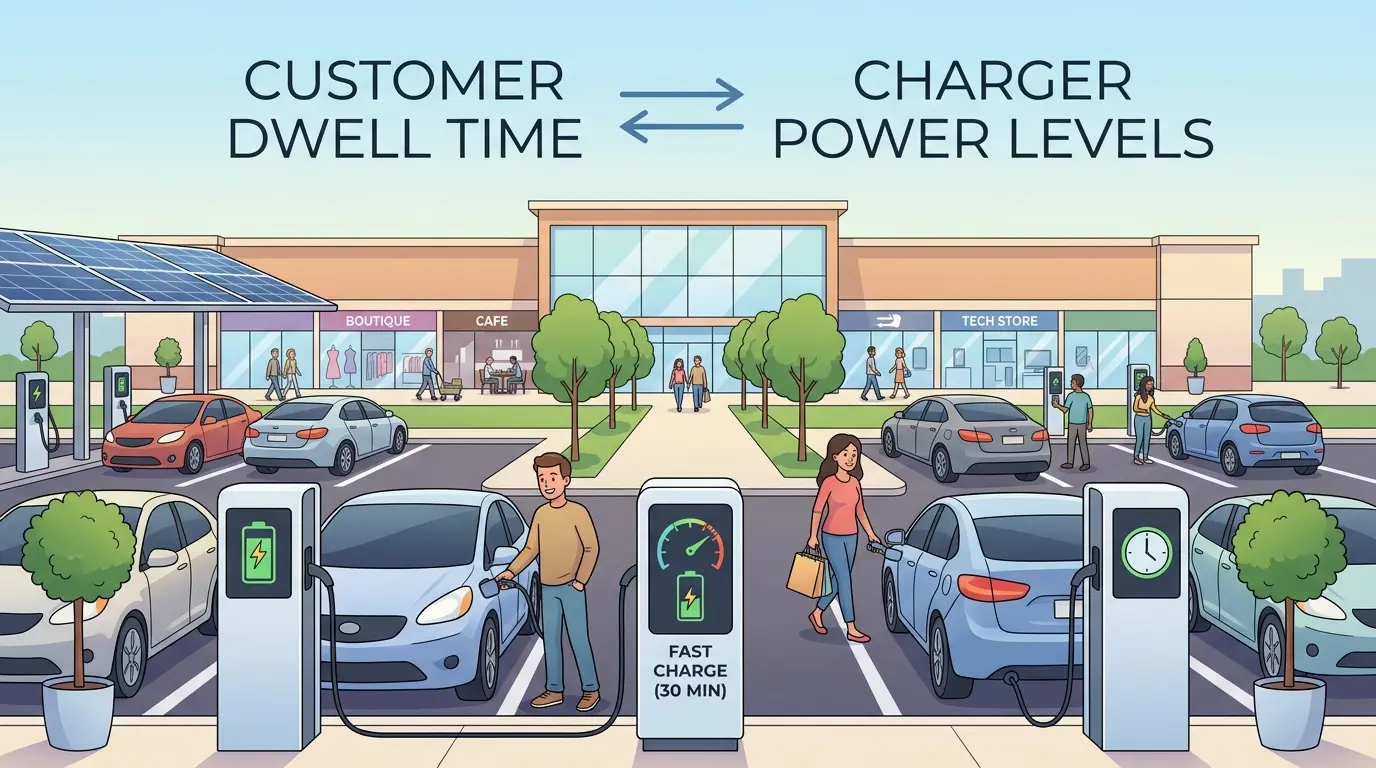
Retail charging only works when the charging experience fits the shopping visit. A site built around short, convenience-driven stops needs a different power mix from a lifestyle center where customers stay for an hour, watch a movie, or spend half a day moving across multiple tenants.
That is why the best retail charging strategy is not “install the fastest units everywhere.” It is to match charger power levels to real customer dwell time, parking behavior, site electrical constraints, and the commercial role charging is supposed to play. When those factors are aligned, retail centers can improve driver satisfaction, protect grid capacity, and avoid paying for power that the site will rarely use efficiently.
Start With Retail Visit Behavior, Not Peak Charger Output
Many retail charging projects begin with a product discussion when they should begin with a traffic-pattern discussion. The first question is not how much power a charger can deliver. The first question is how long customers actually stay parked, and whether the site wants charging to support quick turnover, longer basket-building visits, or a mix of both.
The table below is a practical way to think about the relationship between dwell time and charger selection.
| Retail visit pattern | Rough dwell window | What drivers usually need | Better-fit power strategy | Business objective |
|---|---|---|---|---|
| Convenience-led stops, food pickup, quick errands | 10 to 30 minutes | A meaningful top-up during a short stay | A limited number of higher-power DC chargers in premium bays | Fast turnover and visible convenience |
| Grocery, gym, pharmacy, mixed-needs centers | 30 to 90 minutes | Useful range recovery without overengineering every space | A blended site with some DC and some lower-power smart charging | Balanced throughput and practical cost control |
| Lifestyle retail, cinema, destination shopping, extended parking | 90 minutes and up | Reliable charging during a longer visit | AC smart charging across more bays, with selective faster options if needed | Higher bay coverage and lower cost per parking space |
For centers still evaluating where charging should sit within the broader property plan, PandaExo’s guide to EV charging site selection is useful because it frames demand around property type, visit behavior, and deployment context rather than around hardware specs alone.
Why Maximum Power Can Reduce Real Retail ROI
High-power charging has a clear role in retail, but it is easy to misuse. If every bay is designed for short-stay, high-power sessions, the site can end up carrying more electrical complexity and more procurement cost than the parking pattern justifies.
The mismatch appears in several ways. First, long-dwell customers do not always need fast energy delivery. If a vehicle will remain parked well after it has taken enough charge, premium power is being tied up without improving turnover. Second, higher-power infrastructure can increase pressure on transformers, switchgear planning, interconnection work, and demand-charge exposure. Third, when fast bays are blocked by vehicles that remain parked after charging, customer frustration rises even though the site technically installed more power.
In other words, charger speed alone does not create a better retail outcome. What matters is how power level interacts with bay occupancy, queueing risk, and how the charging offer supports the center’s tenant mix.
Build a Layered Charging Mix Instead of a Single-Speed Site
Retail centers often perform better with a layered charging model than with a uniform one. That means assigning different charger roles to different parking zones rather than asking one charger type to solve every use case.
A visible short-stay zone near key entrances or circulation routes may justify a small number of higher-output units from a broader DC charging portfolio. Those bays are best reserved for drivers who value time, need a practical top-up before the next leg of a trip, or are making a deliberate charging stop tied to a quick retail visit.
That does not mean the entire site should follow the same model. Once the short-stay layer is in place, the next question is how to cover the larger population of customers who are already parked for a meaningful period.
For those longer stays, wider deployment of AC charging solutions often makes more commercial sense. AC smart charging usually supports a better bay-to-cost ratio, makes it easier to spread charging access across ordinary parking rows, and aligns well with drivers who are shopping, dining, or spending time in anchor stores rather than waiting for a rapid session to finish.
The practical goal is not to force every driver into the same charging experience. It is to create a site where short-stay drivers can move quickly, while longer-stay customers can charge steadily without pushing the center into unnecessary electrical overbuild.
Use Load Management to Make More Power Go Further
Once a retail center adopts a mixed charging model, software and energy management become just as important as the chargers themselves. Without that layer, operators may still oversize the site because they assume every unit must perform at full simultaneous output.
That assumption is often too conservative. As PandaExo’s article on utilities, grid capacity, interconnection, and demand charges makes clear, the real planning challenge is how the site behaves under coincident load, not just what the nameplate ratings look like on paper.
Smart energy management helps retail centers do several things at once:
- Cap total site charging load to stay within practical electrical limits.
- Prioritize faster delivery to premium short-stay bays during busy windows.
- Shift lower-priority charging to customers who are already parked longer.
- Monitor utilization patterns by tenant mix, daypart, or season.
- Add bays over time without redesigning the whole charging strategy from scratch.
This is where PandaExo’s broader positioning matters. A charging partner that combines hardware with platform visibility gives operators a better chance of matching site behavior to commercial reality instead of planning only around worst-case assumptions.
Match Charging Strategy to the Retail Outcome You Actually Want
Retail operators sometimes talk about EV charging as a traffic driver, sometimes as a tenant amenity, and sometimes as an ancillary revenue stream. Those are not identical goals, and each one points to a different power mix.
If the goal is faster turnover and stronger roadside visibility, a concentrated fast-charging offer near prominent bays may be justified. If the goal is to support routine shopping trips and improve convenience across a broad customer base, wider AC coverage is usually more efficient. If the goal is to serve multiple tenant types at once, the right answer is usually a blended site where charger classes are mapped to parking duration and circulation logic.
This is also why retail centers should be careful about copying another property’s charging design. A grocery-anchored suburban center, an urban mixed-use development, and a destination retail complex may all need different charger power distributions even if they have similar parking counts.
Procurement Questions Before You Lock the Power Mix
Before committing to equipment selection, retail centers should pressure-test the business case with a few operational questions. PandaExo’s commercial EV charging project checklist is a strong starting point because it frames procurement around deployment decisions rather than around isolated hardware features.
The most important questions usually include:
- What share of visitors stay less than 30 minutes, around an hour, or much longer?
- Which parking zones should prioritize visibility and turnover, and which should prioritize coverage?
- How much electrical capacity is realistically available now, and how easily can the site expand later?
- Will the project benefit more from a few premium fast bays, broader lower-power coverage, or a staged combination of both?
- Does the vendor support both hardware classes and the management layer needed to control them over time?
- If the center serves different regional or tenant requirements, would OEM or ODM flexibility help simplify rollout across multiple properties?
These questions usually reveal whether the site is solving for customer experience, fleet-like utilization, tenant support, or a phased long-term infrastructure plan. Once that is clear, charger power levels become easier to assign rationally.
A Practical Model for Common Retail Formats
For many retail projects, the most defensible model looks like this:
- Convenience-heavy centers: keep the fast-charging offer small, visible, and purpose-built for quick stops.
- Grocery and mixed-needs centers: combine a limited fast-charging layer with broader smart charging coverage for routine shoppers.
- Destination retail and entertainment sites: prioritize wider lower-power coverage, then add selective faster bays where traffic patterns support it.
This structure usually does a better job of balancing customer dwell time with charger power levels than an all-fast or all-slow deployment. It supports more realistic utilization patterns, gives the operator more control over future expansion, and avoids turning electrical infrastructure into an oversized fixed cost.
Practical Summary
Retail centers do not need the highest charger power level in every parking bay. They need the right mix of power levels for the way customers actually use the site.
Short stays justify some faster charging. Longer stays often justify broader, lower-power smart charging. The strongest retail deployments usually combine both, then use software and load management to control how the site behaves under real operating conditions.
For operators, developers, and charging planners, the best outcome is not simply faster charging. It is better alignment between visit duration, parking turnover, electrical capacity, and future scaling. That is the balance that protects capital, improves customer utility, and creates a charging strategy retail centers can live with as EV demand grows.