
 Deutsch
  Español
  Français
  Italiano
  Português
  Svenska
  Suomi
Suomi  Dansk
Dansk  Norsk bokmål
  Nederlands
  العربية
  עברית
עברית  Polski
  Türkçe
  Русский
  Uzbek
Uzbek  Azərbaycan
  Tiếng Việt
  ไทย
ไทย  한국어
한국어  日本語
日本語  简体中文
简体中文 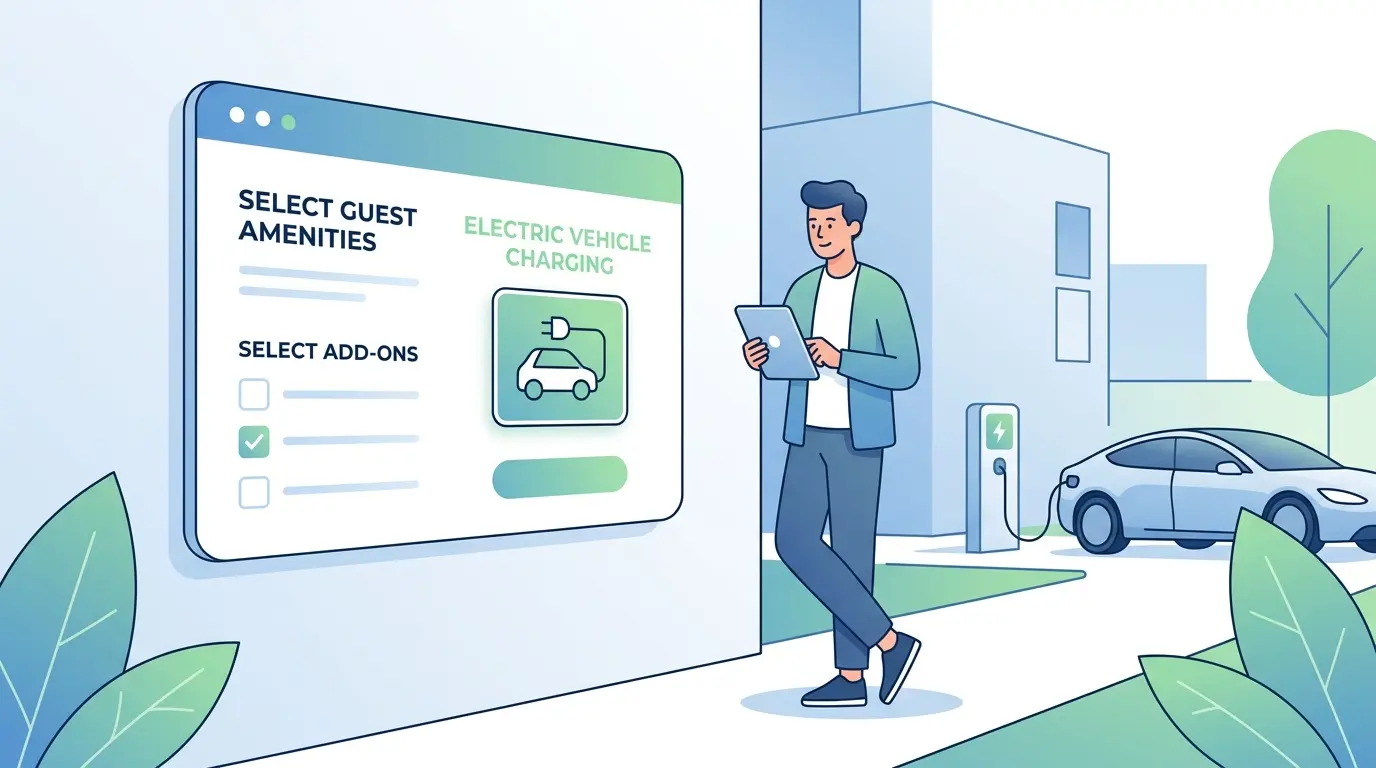
A hotel rarely struggles with guest EV charging because the chargers are too visible. The friction usually appears somewhere else: the front desk becomes a manual access gate, premium parking spaces turn into queue disputes, staff have no rule for idle vehicles, and finance teams cannot explain who should pay for the electricity. If the workflow is unclear, even a well-located charger can create complaints instead of loyalty.
The practical objective is not simply to offer EV charging. It is to make charging feel like a controlled hotel service rather than a daily exception. That means choosing the right access model, matching charger power to guest dwell time, separating parking rules from payment rules, and giving staff a workflow that does not depend on ad hoc intervention.
Why Hotel EV Charging Becomes an Operations Problem
Hotels sit in an unusual middle ground. They are not pure public charging sites, but they are not private fleet depots either. Guests stay for different lengths of time, arrival peaks cluster in the evening, and parking inventory already supports several priorities at once: check-in flow, valet handling, accessible bays, premium parking, and overnight occupancy.
This is why hotel charging should be planned as a hospitality operation first and a hardware deployment second. Property type matters. A city-center business hotel, an airport hotel, a resort, and a highway-adjacent overnight stop can all justify different charger mixes, which is why early planning should look more like a site-fit exercise than a generic amenity rollout. This broader location logic is worth aligning with a structured EV charging site selection guide before hardware is locked in.
Start With the Service Model, Not the Charger Model
Before selecting power level or mounting style, hotel operators should decide what kind of charging service they are actually offering.
| Service Model | Best Fit | Main Risk | Control Needed |
|---|---|---|---|
| Complimentary guest amenity | Luxury stays, resorts, premium loyalty positioning | Overuse by non-paying users or long idle parking | Guest authentication, time limits, clear overnight policy |
| Paid guest-only charging | Full-service hotels, managed parking environments | Front-desk billing complexity if sessions are handled manually | App-based billing, PMS-linked access rules, automated receipts |
| Mixed guest and public charging | Urban hotels, airport hotels, roadside properties | Bay congestion and guest dissatisfaction during peak hours | Reserved guest windows, pricing tiers, occupancy monitoring |
| Valet-managed charging | High-touch hotels with dense parking layouts | Staff workload, key handling delays, liability questions | Standard operating procedure, charger assignment rules, shift ownership |
The point is simple: operational friction usually starts when the hotel tries to solve a service-model question with a hardware purchase. A charger cannot decide whether guest access should be free, bundled, reserved, time-limited, or open to the public. Management has to define that first.
Match Charger Type to Real Guest Dwell Time
For most hotel properties, AC charging stations are the operational baseline because overnight dwell time is long and the service expectation is convenience rather than the fastest possible turnover. They are generally easier to fit into existing parking layouts, easier to scale across more bays, and less likely to create a queue-management problem at check-in.
That does not mean AC is always enough. Hotels with heavy short-stay traffic, airport turnover, roadside demand, or mixed public access may justify some DC capacity. The decision is less about headline speed and more about whether the hotel benefits from faster bay turnover or simply needs dependable overnight replenishment.
| Charger Approach | Typical Hotel Use Case | Operational Advantage | Operational Tradeoff |
|---|---|---|---|
| AC smart charging | Overnight guests, resorts, business hotels, valet lots | Lower friction, broader bay coverage, easier scaling | Slower recovery for short-stay users |
| Lower-power DC charging | Airport hotels, roadside hotels, mixed public and guest demand | Better turnover without full ultra-fast infrastructure | Higher installation and operating complexity |
| High-power DC fast charging | Transit corridors, destination-adjacent sites with non-guest traffic | Fast sessions and stronger throughput | Greater utility coordination, stronger traffic management needs, less aligned with pure overnight hospitality use |
A blended model often works best: several AC bays for overnight guests and a smaller number of faster chargers only where guest mix and site economics justify them.
Keep the Front Desk Out of the Charging Workflow
The fastest way to create operational friction is to make charging dependent on reception staff. If guests must request activation codes, ask for cable authorization, or settle charging disputes at checkout, the hotel has effectively turned every charging session into a service exception.
A better structure uses platform rules, not staff improvisation. Guests should be able to authenticate through app, RFID, room-linked entitlement, or pre-authorized reservation logic. Pricing, time limits, and access windows should be visible before a session starts. This is the same principle behind semi-public AC charging billing workflows: the transaction should be governed by the system, not by a manual explanation at the desk.
Hotels should also define who sees which alerts. Front desk staff may need a simple occupancy view or guest-facing script, but charger faults, load alarms, and network issues should route to engineering, parking operations, or the external service partner. Not every team needs the same control layer.
Separate Parking Policy From Charging Policy
Many hotel charging disputes are not really charging disputes. They are parking-policy problems in disguise.
A charger bay needs rules for who may occupy it, how long a fully charged vehicle may remain there, whether overnight parking is permitted after a session ends, and what happens when a non-charging EV takes a charging bay during peak demand. Those rules should exist independently of the electricity price.
A workable hotel policy usually includes:
- A definition of whether charger bays are reserved for active charging only or may be used for overnight guest parking after a session ends.
- A guest-facing expectation for move times where valet is not involved.
- A distinction between guest access and public access if the site allows both.
- Clear signage that explains occupancy rules, not just charger instructions.
- A documented escalation path for blocked bays, overstays, or failed sessions.
If parking policy is vague, even a technically successful charging rollout will feel inconsistent at the property level.
Design for Load Management Before Demand Spikes Appear
Hotels often start with a small number of chargers and assume load management can wait until later. That is usually backward. The right time to define power allocation, expansion sequencing, and panel capacity strategy is before demand patterns harden and guest complaints begin.
This matters even more for hotel groups that expect EV adoption to rise across multiple properties. Expansion gets easier when the first phase already accounts for electrical headroom, network visibility, and control logic. Procurement teams should also validate open communication standards and reporting depth early, especially if they want to avoid being trapped in a closed operating model. That is why understanding what OCPP means for commercial EV stations is an operations question, not just an IT question.
Dynamic load management is especially valuable in hotels because arrival demand is often concentrated in the same evening window when other building loads are still active. Intelligent distribution can reduce the need for oversized first-phase infrastructure while still protecting the guest experience.
Standardize Exception Handling Before Guests Need It
Every hotel charging program needs a rulebook for edge cases. Otherwise the burden falls back on whoever happens to be on shift.
| Exception | Primary Owner | Recommended Response |
|---|---|---|
| Charger offline | Engineering or external support partner | Remote diagnosis first, physical inspection second, guest reassignment if needed |
| Guest cannot start session | Guest services with scripted fallback | Verify authentication, direct to alternate bay, escalate only if system fault is confirmed |
| EV remains in bay after charging | Parking operations or valet | Apply posted policy consistently; do not invent case-by-case rules |
| Public driver occupies guest-priority bay | Parking operations | Enforce site access rules and time windows already posted |
| Billing dispute | Finance or platform support | Use session data and automated receipts, not verbal reconstruction |
The goal is not to eliminate every issue. It is to prevent small issues from becoming expensive, staff-intensive incidents.
Build a Repeatable Model for Multi-Property Growth
Single-property success does not automatically translate across a hotel portfolio. A resort may need relaxed overnight charging logic, while an airport hotel may need stricter turnover and mixed-access controls. But the underlying framework should stay consistent: define the service model, define the parking rules, automate access, and keep technical alerts away from front-line guest staff.
This is where a broader EV charger portfolio becomes more useful than a one-off hardware decision. Hotel groups often need different charger classes across different asset types, but they still benefit from a consistent approach to monitoring, access control, and expansion planning. Suppliers that can support AC, DC, and platform visibility within the same operational framework are usually easier to scale across mixed property types.
For chains, operators, and brand-affiliated developers, OEM or ODM flexibility can also matter when charger branding, enclosure format, or regional adaptation needs to align with the hotel experience rather than sit outside it as a generic parking-lot add-on.
Practical Summary
Hotels do not need to overcomplicate guest EV charging, but they do need to structure it deliberately. The lowest-friction model is usually the one that treats charging as a managed hospitality service with clear rules, automated access, and limited staff intervention.
In practice, that means:
- Choosing the access and pricing model before choosing the charger count.
- Matching power level to actual guest dwell time instead of defaulting to the fastest available hardware.
- Keeping front desk teams out of routine activation, billing, and fault handling.
- Defining bay-use policy separately from the charging tariff.
- Planning load management and network standards early enough to support expansion.
When hotels get those decisions right, EV charging stops feeling like a special request and starts functioning like any other well-run guest amenity: visible when needed, predictable in use, and quiet in the background.