
 Deutsch
  Español
  Français
  Italiano
  Português
  Svenska
  Suomi
Suomi  Dansk
Dansk  Norsk bokmål
  Nederlands
  العربية
  עברית
עברית  Polski
  Türkçe
  Русский
  Uzbek
Uzbek  Azərbaycan
  Tiếng Việt
  ไทย
ไทย  한국어
한국어  日本語
日本語  简体中文
简体中文 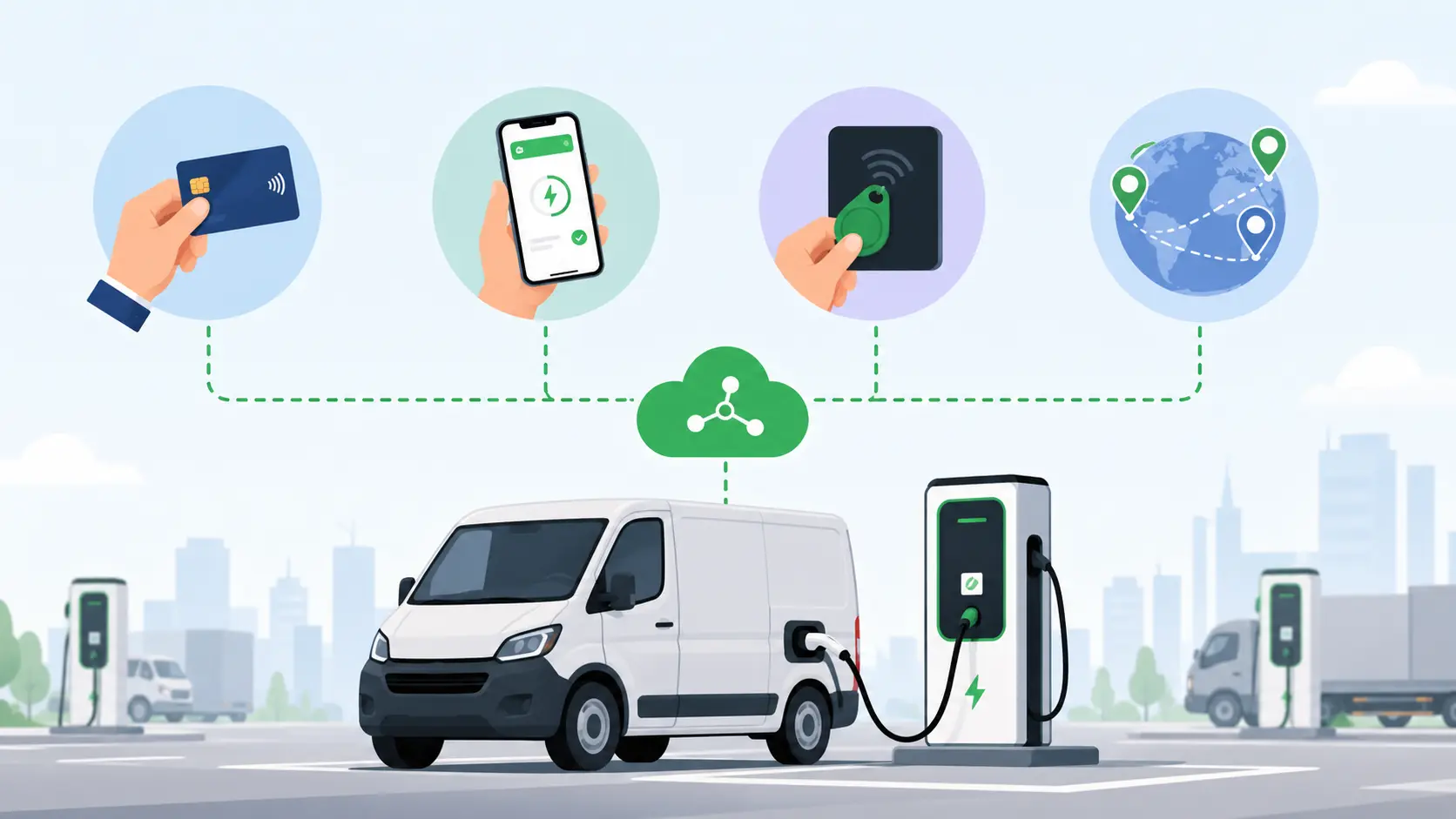
A charging site can have the right power level, the right parking layout, and the right business case, yet still underperform if drivers struggle to start and pay for a session.
That is why payment design should be treated as part of commercial EV charging infrastructure planning, not as a software add-on chosen at the end. A retail fast-charging site serving occasional drivers needs a very different payment experience from a workplace car park, a hotel, a mixed-use property, or a fleet depot.
For most operators, the real question is not which payment method is best in isolation. It is which combination reduces user friction, fits the site model, and keeps the network scalable as utilization grows.
Why Payment Choice Affects Site Performance
Payment systems shape more than revenue collection. They influence charger throughput, driver confidence, staff workload, support tickets, and the quality of session data available to the operator.
If ad hoc users arrive at a public site and discover they must download an app, create an account, verify email, and preload funds before charging, some of them will leave. If a workplace site uses only bank cards for employees who charge every day, the operator may miss the control and reporting benefits of account-based access. If a roaming setup is poorly configured, the site may appear available in third-party apps while sessions fail at the point of authentication.
In other words, payment architecture is partly a user-experience decision and partly an operations decision. The right design helps match access control with site economics, whether the goal is higher charger utilization, fair billing, faster driver turnover, or easier multi-site management.
The Main Payment Options at a Glance
| Option | What It Really Does | Best Fit | Main Tradeoff |
|---|---|---|---|
| Bank card or contactless card reader | Lets drivers pay directly at the charger with minimal onboarding | Public-facing sites, destination charging, fast-charging hubs | Adds terminal hardware, maintenance, and transaction-management complexity |
| Mobile app | Handles account-based payment, session control, receipts, pricing, and often support workflows | Recurring users, semi-public sites, portfolio management, branded networks | Creates onboarding friction for one-time users |
| RFID card or token | Identifies approved users quickly and starts a session tied to an account or tariff rule | Fleets, workplaces, apartments, hotels, managed access sites | Not ideal as the only access method for unfamiliar or occasional drivers |
| Roaming | Allows drivers to use a third-party app or RFID credential across networks | Public charging networks, regional coverage strategies, cross-network access | Requires interoperability, settlement logic, and tariff consistency |
The important point is that these are not direct substitutes. A bank card is mainly a payment tool. RFID is mainly a fast authentication tool. An app can combine identity, payment, and support. Roaming is a network-to-network access layer. Most commercial sites that scale successfully use more than one of them.
When Card Payments Make Sense
Card acceptance is strongest when the site serves unfamiliar drivers who want immediate, low-friction access, especially at public-facing DC charging locations where speed, convenience, and turnover matter. Highway corridors, retail fast-charging sites, and mixed-use public destinations often benefit from direct card payment because it reduces the risk of abandoned sessions caused by registration friction.
For infrastructure buyers, the operational value is straightforward. Card acceptance can widen the addressable user base, support guest charging, and help a site feel more like mainstream fueling rather than a closed membership system. That can matter when the business model depends on transient drivers rather than a fixed internal user group.
But card readers are not automatically the right answer everywhere. They add field hardware, software integration, payment-terminal support, and reconciliation requirements. On lower-power long-dwell sites, those extra layers may not create enough commercial benefit to justify the added complexity. A workplace or residential site with predictable repeat users may gain more from controlled account access than from fully open card acceptance.
Where App-Based Payment Adds More Than Billing
Apps do more than collect money. In commercial charging, they often become the control layer for pricing rules, user permissions, receipts, remote session start and stop, overstay fees, support messaging, and network visibility.
That makes app-based payment especially useful where the operator needs more than simple ad hoc access. Hotels can use apps to separate guest and public tariffs. Property portfolios can apply different pricing by site. Fleet operators can use account-based workflows to connect driver groups, vehicle classes, or charging policies to the same hardware estate.
Apps are also well suited to semi-public environments where users come back repeatedly but the site still needs flexible billing logic. The tradeoff is obvious: every extra onboarding step can reduce conversion for a first-time user. In weak-signal environments or time-sensitive use cases, app-first access can become a source of friction unless there is a reliable fallback.
Why RFID Still Matters for Repeat Users
RFID remains one of the most practical tools in commercial charging because it is fast, familiar, and easy to use in repeat-access environments. For employees, residents, hotel guests, depot staff, and authorized drivers, tap-to-start access is often smoother than launching an app every time.
It is particularly effective in managed charging programs where speed of authentication matters more than open public access. The same logic appears in How RFID & App Billing Work in Semi-Public AC Charging Stations, where repeat users benefit from low-friction access while operators still retain account-linked billing and session visibility in the backend.
The limitation is that RFID is rarely enough on its own. It works best when each card or token is tied to a tariff, user group, payment rule, or internal account structure. For public sites, RFID-only access can exclude casual drivers. For operators, that means RFID is usually a strong controlled-access layer, not a universal payment strategy.
What Roaming Actually Changes
Roaming is often misunderstood as just another payment method. In practice, it is an interoperability model that lets drivers use credentials from one mobility service provider or charging app across another operator’s network.
That matters most for public and regional charging networks. Instead of forcing every driver to join every platform separately, roaming extends access through external apps and credentials, a topic explored in Open Charging Networks Explained: OCPP, OCPI, Roaming, and EV Charger Interoperability Trends. For network planners, the advantage is broader reach without requiring the charger itself to become a closed island.
The tradeoff is backend complexity. Roaming brings tariff mapping, session data exchange, settlement workflows, dispute handling, and support coordination across multiple parties. It can expand utilization, but it also demands cleaner data and stronger interoperability discipline. Roaming is most valuable when network reach is part of the commercial strategy, not when the site serves a fixed private user base.
Most Commercial Sites Need a Hybrid Payment Stack
The most effective payment design is usually not card versus app versus RFID versus roaming. It is a site-specific combination.
| Site Type | Typical User Pattern | Payment Stack That Usually Fits Best | Why |
|---|---|---|---|
| Highway or corridor fast charging | Mostly ad hoc, high urgency, low loyalty | Card plus app plus roaming | Supports guest access, branded users, and third-party network reach |
| Retail or mixed-use destination site | Blend of first-time and repeat users | Card plus app | Balances convenience with better pricing and session control |
| Workplace charging | Known repeat users, predictable dwell | RFID plus app or account portal | Keeps daily access simple while preserving reporting and policy control |
| Fleet depot | Closed user base, operational priority | RFID or account-based access, sometimes no public card layer | Reduces friction for drivers and supports controlled scheduling or internal billing |
| Hotel or managed parking | Guests plus selected external users | RFID or app for approved users, card if public guest charging is a priority | Matches hospitality workflow while preserving optional public access |
| Multifamily or semi-public property | Residents, tenants, and occasional visitors | RFID plus app, sometimes guest payment overlay | Supports fairness, recurring access, and differentiated tariffs |
This is also where charger type and site mission intersect. Long-dwell AC charging sites often prioritize repeat-access control and tariff flexibility. Public fast charging sites usually need stronger guest payment support. The payment stack should reflect the operational purpose of the charger, not just the hardware specification.
The Buyer Questions That Matter Before Procurement
If payment architecture is decided too late, operators may end up redesigning workflows after installation. That is why it belongs in early scoping alongside access policy, communications, and network management, much like the planning checkpoints covered in the Commercial EV Charging Project Checklist.
Before selecting a platform or charger configuration, buyers should ask:
- Can the same charger support multiple access methods without creating a confusing user journey?
- How are guest users, repeat users, fleet drivers, and staff separated in the tariff logic?
- What happens if connectivity drops during authorization or payment?
- Can the operator view failed sessions, refunds, and payment exceptions centrally?
- How are overstay fees, reservation rules, and time-based policies handled?
- If roaming is enabled, how are settlement, dispute handling, and tariff visibility managed?
- Can the system scale across multiple sites without forcing different apps or workflows on drivers?
These questions matter because payment is tied directly to support cost and site scalability. A payment method that looks acceptable in a small pilot can become a major operating problem once the network expands across regions, user groups, or charger classes.
Payment Design Should Match Charging Strategy
Commercial charging networks perform better when payment systems reinforce the intended charging behavior.
If a site needs fast turnover, the payment journey should be immediate and intuitive. If a site serves recurring users, the system should minimize repeat friction. If the operator is building a public network, third-party discoverability and roaming may matter more. If the goal is controlled depot charging, internal authentication and reporting may outrank public payment convenience.
That is why payment planning should be connected to broader infrastructure decisions such as charger power level, user mix, dwell time, site visibility, and backend platform choice. In PandaExo-style commercial infrastructure thinking, the advantage comes from aligning hardware, software, and operating logic so the site is easier to use and easier to scale.
Final Takeaway
Cards, apps, RFID, and roaming solve different problems in commercial EV charging.
Cards reduce friction for ad hoc public users. Apps add tariff control, receipts, and network visibility. RFID makes repeat access fast and practical. Roaming extends reach across networks. None of them is universally best on every site, and most serious commercial deployments benefit from a mix rather than a single payment method.
For infrastructure buyers, the right question is not which payment option sounds most modern. It is which payment structure supports the site’s user profile, charging strategy, and scaling plan with the least operational friction. When that decision is made early, payment stops being a bottleneck and becomes part of the network’s commercial strength.