
 Deutsch
  Español
  Français
  Italiano
  Português
  Svenska
  Suomi
Suomi  Dansk
Dansk  Norsk bokmål
  Nederlands
  العربية
  עברית
עברית  Polski
  Türkçe
  Русский
  Uzbek
Uzbek  Azərbaycan
  Tiếng Việt
  ไทย
ไทย  한국어
한국어  日本語
日本語  简体中文
简体中文 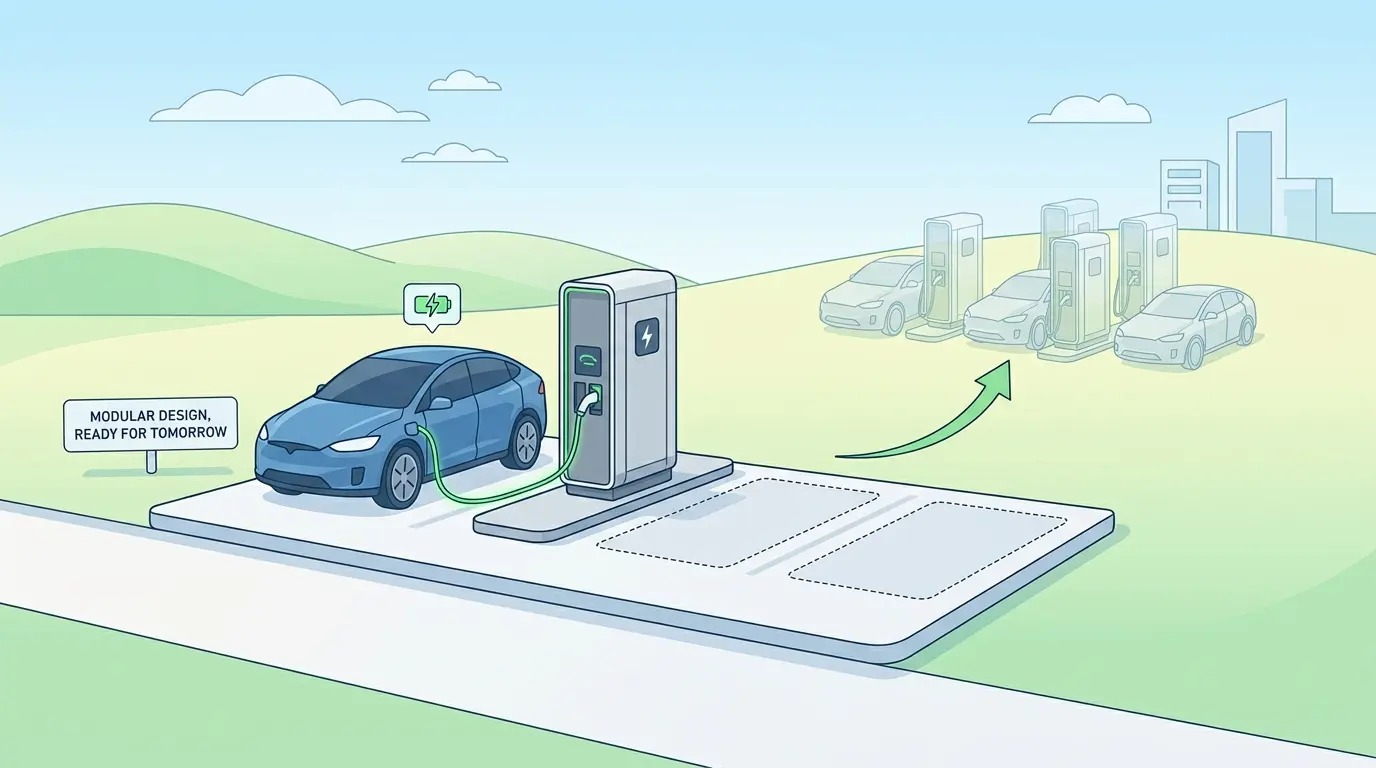
The hardest EV charging decision is usually not whether demand will grow. It is how much of that future demand you should pay for right now.
Many site hosts, fleet operators, property owners, and charging-network planners know expansion is coming. More EVs will enter the fleet. Tenant expectations will change. Utilization will climb. The mistake is turning that valid long-term expectation into an oversized day-one build.
If you install every charger, energize every circuit, and size every electrical component for the final buildout immediately, you can lock capital into infrastructure that sits underused for years. A better approach is to make the site expansion-ready without forcing today’s budget to carry tomorrow’s full hardware burden.
Why EV Charging Projects Overspend So Early
Most overspending starts with one flawed assumption: future expansion only works if the full capacity plan is installed at the beginning.
In practice, future readiness and full deployment are not the same thing. A site can be prepared for growth long before every charger is active. Problems arise when buyers collapse long-term planning into one procurement event and treat all future bays as immediate operational demand.
That usually creates four cost pressures at once:
- Too many chargers installed before utilization justifies them
- Electrical infrastructure sized for theoretical peak rather than real managed demand
- Civil works repeated inefficiently because expansion pathways were not planned early
- Utility upgrade decisions made without enough clarity on phased load growth
The right objective is not to build small. It is to build in layers, so the site can scale without rework while avoiding idle capital.
Separate Site Readiness From Hardware Activation
One of the most useful planning moves is to divide charging capacity into two categories: what the site should be physically ready to support and what the site should actively energize today.
This distinction matters because some project elements are expensive to revisit, while others are relatively easy to phase.
| Planning Layer | Best Decision for Future Expansion | Best Decision for Cost Control Today |
|---|---|---|
| Parking layout and charger placement | Plan around the long-term bay layout | Reserve future spaces without installing every charger |
| Conduit, trenching, and cable pathways | Prepare enough routes for future phases | Avoid reopening pavement later |
| Switchgear and distribution strategy | Leave room for staged additions | Do not energize all downstream hardware immediately |
| Charger hardware | Choose products that fit the long-term architecture | Install only the chargers current demand needs |
| Software and controls | Use a platform that can scale across more chargers and sites | Manage current load intelligently before adding more power |
That is why many buyers treat civil and electrical preparation as a long-horizon investment, while keeping charger deployment modular. A broad EV charger portfolio can support that strategy more effectively than a one-format product decision, because expansion often changes the charger mix as the site matures.
Start With Demand Growth Scenarios, Not a Single Forecast
Future expansion planning becomes expensive when teams rely on one growth estimate and design everything around it. EV adoption rarely follows such a neat curve. Some sites ramp slowly, then accelerate after a fleet refresh, a tenant turnover cycle, or a new policy mandate. Others add demand in bursts across multiple phases.
Instead of using one forecast, build three scenarios:
- Base case: expected adoption under current business plans
- Fast-growth case: accelerated fleet or user demand
- Delayed-growth case: slower ramp due to budget, vehicle supply, or utilization patterns
For each scenario, quantify:
- Number of EVs expected on site
- Average daily energy demand
- Peak charging windows
- Minimum turnaround requirements
- Likely mix of AC and DC charging needs
This approach helps teams identify which investments are universal across all futures and which should wait for clear growth triggers. Reserved conduit may make sense under every scenario. Ten additional active chargers may not.
Plan Capacity Around Managed Demand, Not Full Simultaneous Peak
A common planning error is assuming every connected vehicle will need maximum charging power at the same moment. That assumption can dramatically inflate transformer sizing, panel design, cabling cost, and utility coordination.
Real charging behavior is usually more staggered. Vehicles arrive at different times. Some need a full recharge. Some need only a top-up. Some can wait until lower-demand periods. Some bays may stay occupied longer than the actual charging session requires.
That means the capacity question should be framed around managed concurrency, not just installed connectors.
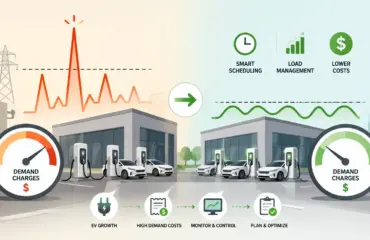
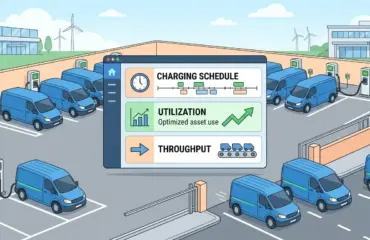
Smart scheduling, prioritization rules, and dynamic load management can materially reduce how much electrical capacity a site needs to energize on day one. If the software can cap total site demand, prioritize urgent sessions, and shift flexible charging into available windows, the project may avoid a larger utility upgrade until utilization actually requires it.
This is especially important for workplace, depot, multifamily, and mixed-use sites where many vehicles have meaningful dwell time. The site does not need to be weakly designed. It needs to be intelligently controlled.
Match Charger Type to Expansion Risk, Not Just to Speed Goals
Future expansion does not always mean adding more fast chargers. In many cases, it means adding more charging access points while keeping capital intensity under control.
That is where charger-role planning matters.
| Charging Role | Best Use in a Growth Plan | Overspending Risk If Misused |
|---|---|---|
| AC smart charging | Daily replenishment, longer dwell, lower-cost distributed growth | Underestimating future turnover needs at high-utilization sites |
| Targeted DC fast charging | Turnaround-sensitive fleets, short dwell windows, high-throughput locations | Treating DC as the default for vehicles that could use AC |
| Shared high-power infrastructure | Hub sites expecting concentrated growth over time | Installing too much high-power hardware before traffic supports it |
The key is to ask what problem the new capacity is solving. If vehicles are parked for hours, adding more AC capacity may scale the site more economically than defaulting to high-power DC. If operational uptime depends on short recovery windows, a smaller number of strategically placed DC chargers may protect throughput without converting the entire site into a fast-charging build.
This is also why phased capacity planning should be tied to actual dwell time, dispatch urgency, and session turnover rather than headline charger power alone.
Decide Which Infrastructure Must Be Future-Proofed Now
Not every component deserves the same level of up-front investment. A disciplined plan identifies what becomes expensive or disruptive if deferred, then funds those items first.
Often, these are the elements worth future-proofing early:
- Trenching and conduit pathways under finished pavement
- Space allocation for cabinets, pedestals, or future charging rows
- Switchgear layout that leaves expansion room
- Communication architecture for additional chargers and monitoring
- Platform selection that can support more connectors, more users, or more sites later
By contrast, these elements can often be phased more aggressively:
- Individual charger units beyond near-term demand
- Secondary charging rows for later fleet additions
- Noncritical high-power circuits that depend on future throughput
- Redundant hardware for demand that has not materialized yet
For buyers evaluating expansion across several property or fleet types, this kind of sequencing is often more important than the charger model itself. The site should be hard to disrupt later, but easy to expand later.
Use Expansion Triggers Instead of Guesswork
The best way to avoid overspending is to define in advance what conditions justify the next investment phase. Without triggers, teams tend to expand either too late, after utilization problems appear, or too early, based on abstract future optimism.
Useful expansion triggers can include:
- Charger utilization consistently exceeding a defined threshold during peak windows
- A fleet procurement plan that adds a confirmed number of EVs within a fixed timeline
- Repeated charging conflicts that threaten departures, route completion, or user experience
- Utility upgrade lead times that require earlier reservation of make-ready work
- Site-level demand-charge economics shifting in favor of a different charging mix
This creates a more defensible capital roadmap. Instead of asking whether to build for the next five years immediately, the organization can ask what evidence should trigger Phase 2, Phase 3, or a shift from distributed AC to more selective DC capacity.
That same mindset also improves procurement discipline. Teams can specify what must remain compatible across phases instead of overbuying today out of fear of future mismatch.
Bring the Utility Into the Expansion Plan Early
Even the most careful internal charging strategy can fail if utility assumptions are wrong. Service capacity, transformer lead times, interconnection approvals, and demand-charge exposure often determine whether a phased build is financially efficient or unexpectedly expensive.
For that reason, utility coordination should happen during the planning stage, not after hardware selection. PandaExo’s guidance on grid capacity, interconnection, and demand charges aligns with a practical reality many project teams discover late: the utility timeline often shapes the expansion timeline.
Early utility engagement helps answer questions such as:
- How much spare service capacity is actually available today?
- What upgrade threshold would trigger transformer or service changes?
- Can the project phase load growth to delay major make-ready costs?
- How will demand charges change if DC capacity is introduced later?
- What approvals should be reserved now to protect future expansion options?
This is where overspending can sometimes be avoided without cutting long-term ambition. If the site is designed around staged capacity release and managed demand, the business may be able to defer heavier utility spending until utilization justifies it.
Capacity Planning Should Also Protect Procurement Flexibility
Expansion planning is not only an engineering exercise. It is also a procurement and operating-model decision.
If a business expects future changes in branding, software integration, user access rules, regional standards, or channel strategy, the charging plan should preserve room for those shifts. That is particularly relevant for distributors, multi-site operators, and organizations exploring OEM or ODM charging programs alongside broader infrastructure growth.
In other words, buying only for today’s installation can create a different kind of overspending later if the original platform, hardware family, or supplier model does not fit how the network actually expands. PandaExo’s broader educational content on what businesses should know before expanding EV charging infrastructure reflects this broader planning lens.
Practical Summary
Planning EV charging capacity for future expansion does not mean paying for the final buildout on day one. It means knowing which parts of the project must be ready early, which parts can wait, and which decisions should be tied to measurable growth triggers.
- Prepare the site for expansion before demand forces disruptive rework.
- Install only the hardware that current operations can justify.
- Model multiple growth scenarios instead of one forecast.
- Use managed concurrency to reduce unnecessary peak-capacity spending.
- Match AC and DC roles to real dwell time and throughput needs.
- Bring utility constraints into the roadmap before procurement is finalized.
- Define clear expansion triggers so future capital is released on evidence, not anxiety.
The most effective charging projects are not the ones that install the most hardware first. They are the ones that combine long-term site readiness with disciplined phase-by-phase activation. That is how operators, property owners, and charging-network planners can scale with confidence while keeping today’s capital aligned with today’s actual demand.