
 Deutsch
  Español
  Français
  Italiano
  Português
  Svenska
  Suomi
Suomi  Dansk
Dansk  Norsk bokmål
  Nederlands
  العربية
  עברית
עברית  Polski
  Türkçe
  Русский
  Uzbek
Uzbek  Azərbaycan
  Tiếng Việt
  ไทย
ไทย  한국어
한국어  日本語
日本語  简体中文
简体中文 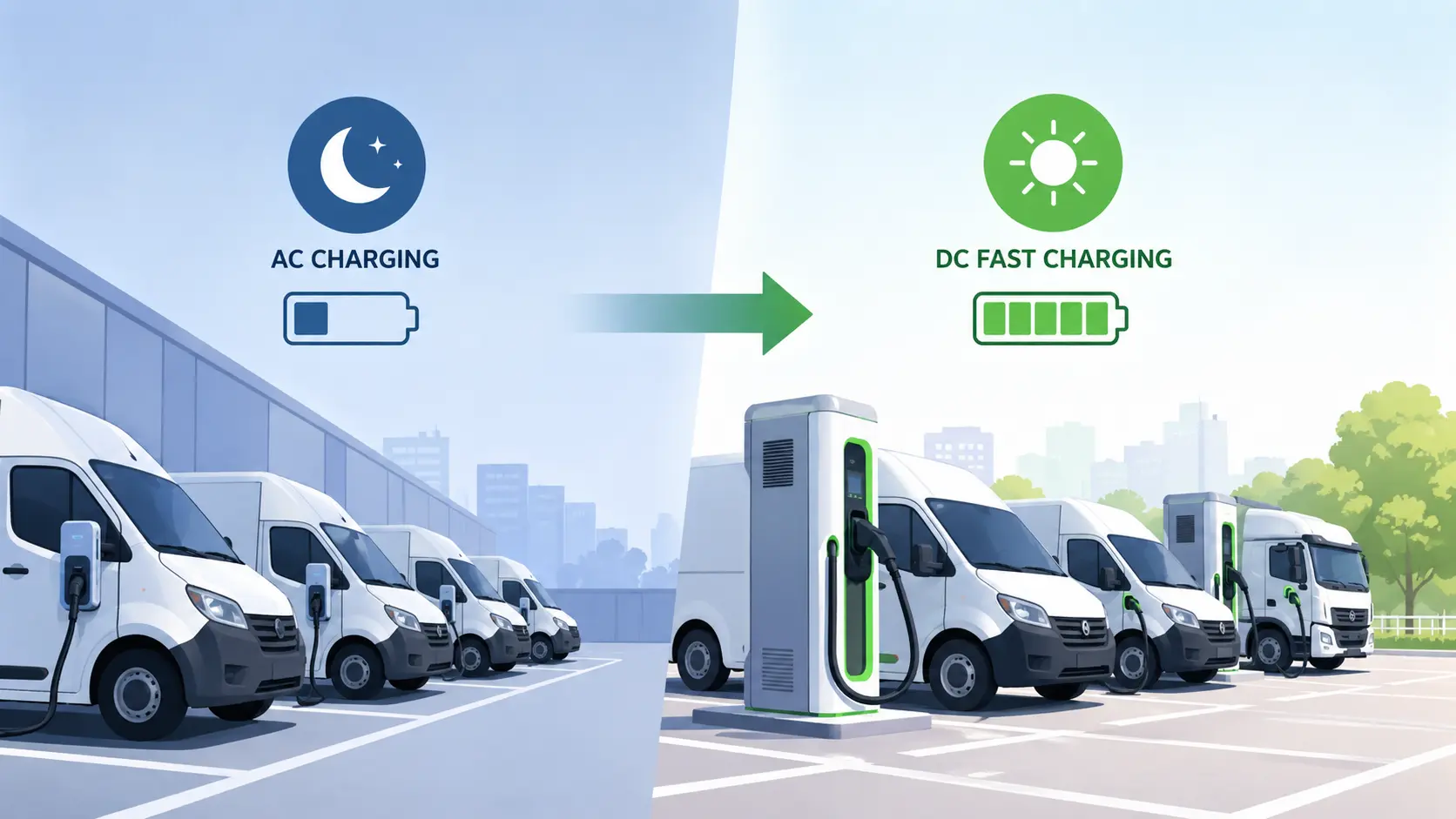
The moment to upgrade is usually not when a fleet manager decides DC fast charging looks more advanced. It is when overnight charging stops protecting morning dispatch.
A depot can run well on AC for a long time if vehicles return predictably, sit for enough hours, and only need daily replenishment. But once route density increases, batteries get larger, shift patterns tighten, or vehicles begin returning with too little dwell time, AC can shift from being cost-effective to becoming a bottleneck.
That is the real decision point. The question is not whether DC fast charging is faster. The question is whether faster energy delivery now creates measurable operational value at the depot.
AC Charging Works Until the Dwell-Time Math Breaks
For many fleet depots, AC charging remains the right foundation. It is well suited to overnight parking, predictable return-to-base operations, and fleets where vehicles have enough time to recover the energy they consumed during the day. It also tends to be easier to distribute across parking bays and often supports lower installation complexity than a fast-charging-first design.
The challenge appears when the charging window shrinks while the energy requirement per vehicle keeps rising. A depot that once had ten hours to replenish a vehicle may now have six. A van that once consumed a modest daily energy load may now run a denser route, a second shift, or more accessory load. At that point, the charger is no longer just a utility connection. It becomes part of the dispatch workflow.
A useful rule is simple: AC remains effective when dwell time is comfortably longer than charging time. Once that buffer disappears, the depot needs a different charging strategy.
Start with Operational Throughput, Not Charger Labels
Before upgrading, depot planners should evaluate how charging supports vehicle availability, not just what power level sounds future-ready. A charger upgrade is justified when it removes an operational constraint that AC can no longer manage.
The most important planning inputs are:
- Average daily energy needed per vehicle
- Actual arrival and departure windows
- Number of vehicles that must be ready within short turnaround periods
- How often vehicles miss target state of charge before dispatch
- Whether route growth is predictable or volatile
- Whether the depot is moving from one shift to two or more shifts
If these factors point to repeated compression between energy demand and dwell time, the site is moving toward DC territory. If they do not, staying with managed AC may still be the better business choice.
| Planning Question | AC Charging Still Fits When | DC Fast Charging Starts to Fit When |
|---|---|---|
| How long do vehicles stay parked? | Several hours or overnight | Short windows between shifts or trips |
| What is the charging goal? | Daily replenishment | Rapid turnaround for route continuity |
| How much dispatch risk comes from undercharging? | Low and manageable | High enough to affect service levels |
| How many vehicles need fast recovery? | Few or none | A defined subset needs it regularly |
| How much utility and civil complexity can the site absorb? | Limited appetite for major upgrades | Operational gain justifies additional infrastructure |
The Operational Signals That It Is Time to Upgrade
Most fleet depots do not need DC everywhere. They need DC when specific operating patterns start exposing the limits of an all-AC design.
The clearest signals include:
- Vehicles regularly leave below target state of charge despite being plugged in on time.
- A growing portion of the fleet runs two shifts, late returns, or midday redeployment.
- Higher-capacity vehicles have been added, but the depot still relies on the same overnight charging assumptions.
- Charger queues appear at the end of the day or before early departures.
- Route-critical vehicles need recovery charging after unexpected mileage, weather impact, or traffic-related detours.
- Depot utilization has become dense enough that one missed charging window creates a service problem the next morning.
These are not abstract technology trends. They are throughput warnings. When they become routine, the depot is no longer choosing between cheap charging and premium charging. It is choosing between slower energy delivery and higher operational resilience.
For a broader look at site transition logic, PandaExo’s guide to upgrading fleet charging depots with high-power DC infrastructure is useful because it frames fast charging as an operational upgrade, not a default hardware decision.
DC Fast Charging Is Usually a Targeted Upgrade, Not a Full Replacement
One of the most expensive mistakes in depot planning is assuming that once DC becomes useful, AC should be removed or sidelined. In practice, most successful fleet depots use a layered charging model.
AC remains the workhorse for vehicles with dependable dwell time. DC is introduced for the portion of the fleet that cannot wait. That hybrid structure often creates the best balance between capital control and operational flexibility.
| Depot Need | Best-Fit Charging Approach | Why |
|---|---|---|
| Overnight replenishment for stable routes | AC smart charging | Lower site burden for energy that can be delivered gradually |
| Midday recovery for high-utilization units | DC fast charging | Protects route continuity when dwell time is limited |
| Unexpected dispatch changes | Shared DC capacity | Creates operational contingency without oversizing the whole depot |
| Scaled multi-vehicle scheduling | AC plus software-managed prioritization, with targeted DC | Reduces unnecessary peak-cost design while preserving fleet uptime |
This is where smart energy management matters. If the site can prioritize urgent vehicles, cap total demand, and monitor charger utilization, buyers can avoid the false choice between “all slow” and “all fast.” The better answer is often “mostly AC, selectively DC, centrally managed.”
Check Whether AC Optimization Can Delay the Upgrade
Before committing to DC, fleet operators should test whether the current depot is underperforming because AC is inherently too slow or because the site is being managed inefficiently.
In some depots, AC still works once operators improve:
- Vehicle-to-bay assignment
- Plug-in compliance at return
- Load balancing rules
- Departure-priority charging schedules
- Charger distribution across parking patterns
- Shift-based charging windows
If the problem is poor sequencing rather than insufficient power, DC may be premature. But if optimized AC still cannot meet departure readiness, then the issue is structural, and a DC layer becomes easier to justify.
This is also why buyers should think beyond charger count. A broader EV charger portfolio matters because depot evolution rarely happens in one step. Sites often start with AC, add selective DC, then expand both hardware and software visibility as fleet demand changes.
Utility Readiness and Site Economics Matter More Than Many Buyers Expect
A fleet depot may have a strong case for DC from an operations perspective and still struggle to justify or execute it if utility, transformer, and demand-charge realities are ignored.
DC fast charging changes the site burden. It can require stronger service capacity, different protection strategy, more involved thermal considerations, revised equipment placement, and closer coordination with the utility. It can also change the economics of peak-demand events if charging is not actively managed.
That is why the upgrade decision should always include:
- Utility service availability and upgrade lead time
- Make-ready scope and transformer constraints
- Trenching distance and equipment footprint
- Demand-charge exposure during simultaneous fast-charging events
- Whether DC chargers will serve a small critical subset or a wider operational role
- Whether future fleet growth will increase the number of vehicles needing rapid turnaround
PandaExo’s educational resource on grid capacity, interconnection, and demand charges is especially relevant here because the business case for DC is often won or lost at the utility interface, not in the charger brochure.
Choose DC Power Level Based on Turnaround Need, Not Ego
Once a depot has decided to add DC, the next mistake is overshooting on power without matching the real charging job.
Not every fleet depot needs the highest-power architecture available. If the operational requirement is controlled turnaround for light commercial vehicles or a limited number of route-critical units, a moderate DC solution may deliver the right balance between throughput and site burden. If vehicles are heavier, battery packs are larger, and turnaround windows are extremely tight, higher power may become more compelling.
The correct question is: how much energy must be added in the actual dwell window to keep the vehicle productive? That answer should guide charger power class, cable strategy, and how many DC ports the site truly needs.
For buyers comparing power classes, PandaExo’s article on 60kW vs. 120kW DC EV chargers is a practical reference because it frames charger selection around use case and site economics rather than headline speed alone.
A Practical Upgrade Path for Fleet Depots
In most cases, the cleanest upgrade path looks like this:
- Measure actual energy demand, missed-charge events, and dispatch pressure by vehicle group.
- Optimize current AC operations to confirm whether the issue is management or charging speed.
- Identify the subset of vehicles that truly need short-window recovery.
- Add DC capacity for those critical use cases first rather than redesigning the whole depot around fast charging.
- Integrate software controls so AC and DC work as one depot energy system.
- Prepare utility and civil infrastructure for future expansion, but phase hardware activation to match fleet growth.
This approach protects against two common risks at the same time: waiting too long and harming operations, or upgrading too aggressively and overspending on infrastructure the depot does not yet need.
Practical Summary
A fleet depot should upgrade from AC charging to DC fast charging when slow charging stops supporting vehicle availability.
That usually happens when dwell time becomes too short, route energy demand rises, missed-charge events become operationally significant, or a defined group of vehicles needs rapid turnaround to keep the fleet moving. DC is not automatically better than AC. It is better when faster charging directly improves throughput, dispatch reliability, or fleet resilience.
For most depots, the strongest strategy is not AC versus DC. It is AC for planned replenishment, DC for time-sensitive recovery, and smart site management that keeps both working together.
When buyers frame the decision around utilization, dwell time, utility readiness, and operational risk, the upgrade becomes much clearer. The right time to move to DC is not when the market says fast charging is the future. It is when the depot’s daily workflow proves that AC alone is no longer enough.