
 Deutsch
  Español
  Français
  Italiano
  Português
  Svenska
  Suomi
Suomi  Dansk
Dansk  Norsk bokmål
  Nederlands
  العربية
  עברית
עברית  Polski
  Türkçe
  Русский
  Uzbek
Uzbek  Azərbaycan
  Tiếng Việt
  ไทย
ไทย  한국어
한국어  日本語
日本語  简体中文
简体中文 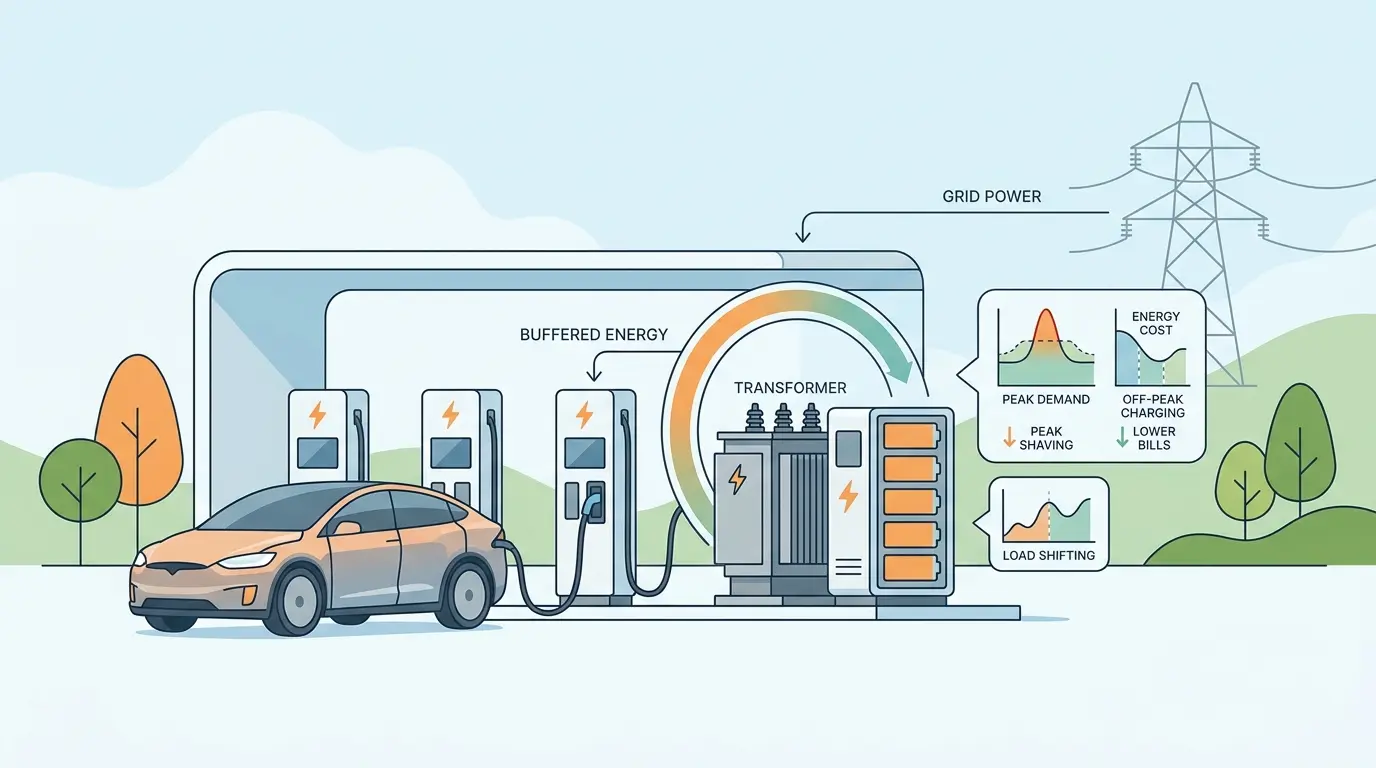
A lot of DC fast charging projects look attractive until the utility quote arrives.
On paper, the site has traffic, dwell demand, and a reason to offer fast charging. In practice, the project can stall because the local grid connection is limited, transformer work takes too long, or demand charges make peak-power sessions expensive enough to weaken the operating model.
That is where battery storage starts to change the conversation around DC fast charging. It does not make every site viable. It does change how buyers think about power availability, peak pricing, phased deployment, and the amount of utility infrastructure a project needs on day one.
Why the Traditional DC Fast Charging Business Case Gets Tight
The core business case for DC fast charging is simple: faster energy delivery can reduce dwell time, increase charger throughput, protect route continuity, and make a site more useful for drivers or fleet operations that cannot wait for slower charging.
The problem is that the charger itself is only part of the project. A fast-charging site can also trigger higher interconnection costs, more demanding electrical design, larger equipment footprints, longer utility coordination, and greater exposure to peak-demand charges. In some cases, the revenue or operational benefit is real, but the supporting power infrastructure makes the rollout harder to justify.
That tension is strongest at sites where charging demand is intense but intermittent. A retail site may see short but sharp peaks. A fleet depot may need a few vehicles turned quickly between shifts, not continuous high-power output all day. A corridor site may experience bursty utilization rather than flat demand. In each case, the grid connection may be sized for average conditions while the charging experience depends on managing short periods of much higher power draw.
What Battery Storage Actually Changes
Battery storage changes the business case when it helps the site separate charger performance from grid limitations.
Instead of forcing the utility connection to cover every short-duration charging spike directly, storage can act as a power buffer. It can charge more gradually from the grid, then discharge when fast-charging demand rises. That does not remove the need for sound site design, but it can reduce the pressure to build the entire project around worst-case instantaneous demand.
| Storage Effect | What It Changes Financially or Operationally | Best-Fit Situation |
|---|---|---|
| Peak shaving | Can reduce exposure to high-demand events | Sites with short, sharp charging peaks |
| Interconnection support | Can help a project move forward with limited available service | Sites facing utility or transformer constraints |
| Time-shifting energy use | Can improve energy-cost control under time-of-use pricing | Markets with clear tariff spread across the day |
| Backup and resilience support | Can help maintain service continuity during brief disturbances or outages | Fleet, commercial, or mission-sensitive sites |
| Phased deployment support | Can let operators launch with less grid capacity than the final buildout may require | Multi-stage network or depot expansion |
The business value is not that storage makes power free. The value is that storage can turn an otherwise rigid infrastructure decision into a more flexible operating model.
Where Battery Storage Most Often Strengthens the DC Charging ROI
Battery storage usually adds the most value where the grid is constrained, the charging profile is peaky, or the operator is trying to avoid building for a maximum that only occurs occasionally.
Urban commercial sites are a common example. A site may have enough demand to justify fast charging but not enough spare electrical capacity to support a straightforward high-power rollout. Storage can sometimes help the project fit the real-world utility boundary instead of forcing a larger upstream upgrade before the first charger goes live.
Fleet depots are another strong candidate. If only a subset of vehicles needs short-window recovery, storage can support those time-sensitive events without requiring the full depot electrical design to assume every vehicle needs simultaneous rapid charging. That can matter when the real goal is dispatch protection, not nonstop peak output.
It also becomes relevant in markets where demand charges, interconnection timing, and make-ready scope heavily influence project viability. PandaExo’s guide to grid capacity, interconnection, and demand charges is useful here because many fast-charging business cases are decided as much by upstream power conditions as by charger utilization itself.
What Battery Storage Does Not Solve
Storage improves some business cases, but it does not rescue a weak site strategy.
If the location has poor charging demand, weak dwell logic, the wrong user mix, or no clear reason for drivers or fleet operators to pay for fast charging, adding storage will not correct the underlying commercial problem. It may actually add cost and complexity to an already marginal project.
Storage also brings its own planning requirements. Buyers still need to evaluate footprint, thermal considerations, controls integration, lifecycle assumptions, permitting, safety requirements, and the practical difference between short-duration peak support and longer-duration energy shifting. A storage-backed charging site is not simply a charger with an extra cabinet. It is an energy system that needs to be operated deliberately.
That is why the right question is not “Should we add storage?” It is “Which cost, risk, or deployment bottleneck does storage materially improve, and is that improvement large enough to justify the added system complexity?”
Storage Can Change the Right Charger Power Class
One of the most important strategic effects of storage is that it can change how buyers think about charger sizing.
Without storage, teams often feel pushed toward one of two extremes: either keep charger power modest to fit the available grid connection, or pursue a larger utility upgrade so higher-power chargers can operate without compromise. Storage can create a middle path by helping a site deliver stronger short-duration charging performance without forcing every watt of charger output to come straight from the grid in real time.
That matters because the best power class is not always the highest one available. The correct answer still depends on dwell window, battery size, session profile, queue risk, and how many vehicles may need fast recovery at the same time. In some projects, moderate DC paired with storage and good controls may deliver a better business outcome than a larger charger class with a heavier grid burden.
| Planning Question | Grid-Only Fast Charging Often Pushes Toward | Storage-Backed Fast Charging Can Sometimes Enable |
|---|---|---|
| Limited site capacity | Lower charger power to stay within the service limit | Better burst performance without immediate full utility expansion |
| High demand-charge exposure | Avoiding fast charging altogether or accepting peak-cost risk | More controlled peak behavior |
| Phased rollout goals | Delaying launch until full infrastructure is ready | Earlier deployment with a staged expansion path |
| Mixed vehicle duty cycles | Oversizing chargers for occasional extreme cases | Better alignment between real use case and installed hardware |
Buyers should still model the economics carefully. PandaExo’s article on calculating ROI for a 120kW DC charging station is a useful reference because it reinforces a broader point: the business case should be built around throughput, utilization, tariffs, and site burden, not just charger headline power.
Why Software and Energy Management Matter More Once Storage Is Added
Battery storage is most valuable when the site knows when to charge it, when to discharge it, which vehicles or sessions should receive priority, and where the operator wants to cap demand.
That means storage usually becomes much more useful when paired with strong monitoring, load management, tariff awareness, and charger-level visibility. Otherwise, the project risks becoming an expensive hardware stack without a disciplined operating strategy.
For buyers, this is an important supplier-screening issue. Once storage enters the design, hardware quality alone is not enough. The project also depends on whether the broader system can coordinate charger output, site demand, operational priority, and future scaling across multiple assets.
This is where PandaExo’s broader EV charger portfolio becomes commercially relevant. The point is not that every site should deploy every charger type. It is that DC charging, AC charging, and site-level control often need to evolve together, especially when storage is being used to support phased or grid-constrained deployment.
A Practical Framework for Deciding Whether Storage Improves the Business Case
Before investing in storage with a DC fast charging project, operators should compare at least three scenarios: grid-only fast charging, fast charging with storage support, and a hybrid model that combines slower charging for flexible demand with targeted fast charging for urgent demand.
The evaluation should include:
- Actual charging demand by hour, not just projected annual volume.
- The difference between average site load and short-duration charging peaks.
- Utility upgrade timing, make-ready scope, and service-capacity constraints.
- Demand-charge structure and time-of-use pricing.
- Whether storage is deferring a grid upgrade, reducing operating cost, or mainly improving resilience.
- Whether the site’s user behavior is predictable enough for storage dispatch to be managed effectively.
In many projects, storage is easiest to justify when it solves a specific bottleneck: a delayed utility upgrade, a sharp peak-cost problem, a fleet dispatch risk, or a phased rollout that would otherwise wait too long to launch. It is harder to justify when it is added only because storage sounds strategically advanced.
Practical Summary
Battery storage changes the business case for DC fast charging by making the project less dependent on uncompromised grid capacity at every charging moment.
That can improve site fit where utility constraints, demand charges, or phased deployment needs would otherwise weaken the economics of fast charging. It can help operators shave peaks, support limited interconnection, improve rollout flexibility, and align charger performance more closely with real operational demand.
But storage is not a universal fix. It does not repair poor site selection, low utilization, weak charging demand, or an oversized hardware plan. It adds system complexity, so it should only be included when it clearly improves deployment timing, cost control, resilience, or charger throughput.
In practical terms, the strongest projects usually ask a narrower question. Not “Do we want storage?” but “Does storage solve a real commercial or operational constraint better than the alternatives?” When that answer is yes, battery storage can materially strengthen the case for DC fast charging. When the answer is vague, the project usually needs better site economics before it needs another layer of hardware.