
 Deutsch
  Español
  Français
  Italiano
  Português
  Svenska
  Suomi
Suomi  Dansk
Dansk  Norsk bokmål
  Nederlands
  العربية
  עברית
עברית  Polski
  Türkçe
  Русский
  Uzbek
Uzbek  Azərbaycan
  Tiếng Việt
  ไทย
ไทย  한국어
한국어  日本語
日本語  简体中文
简体中文 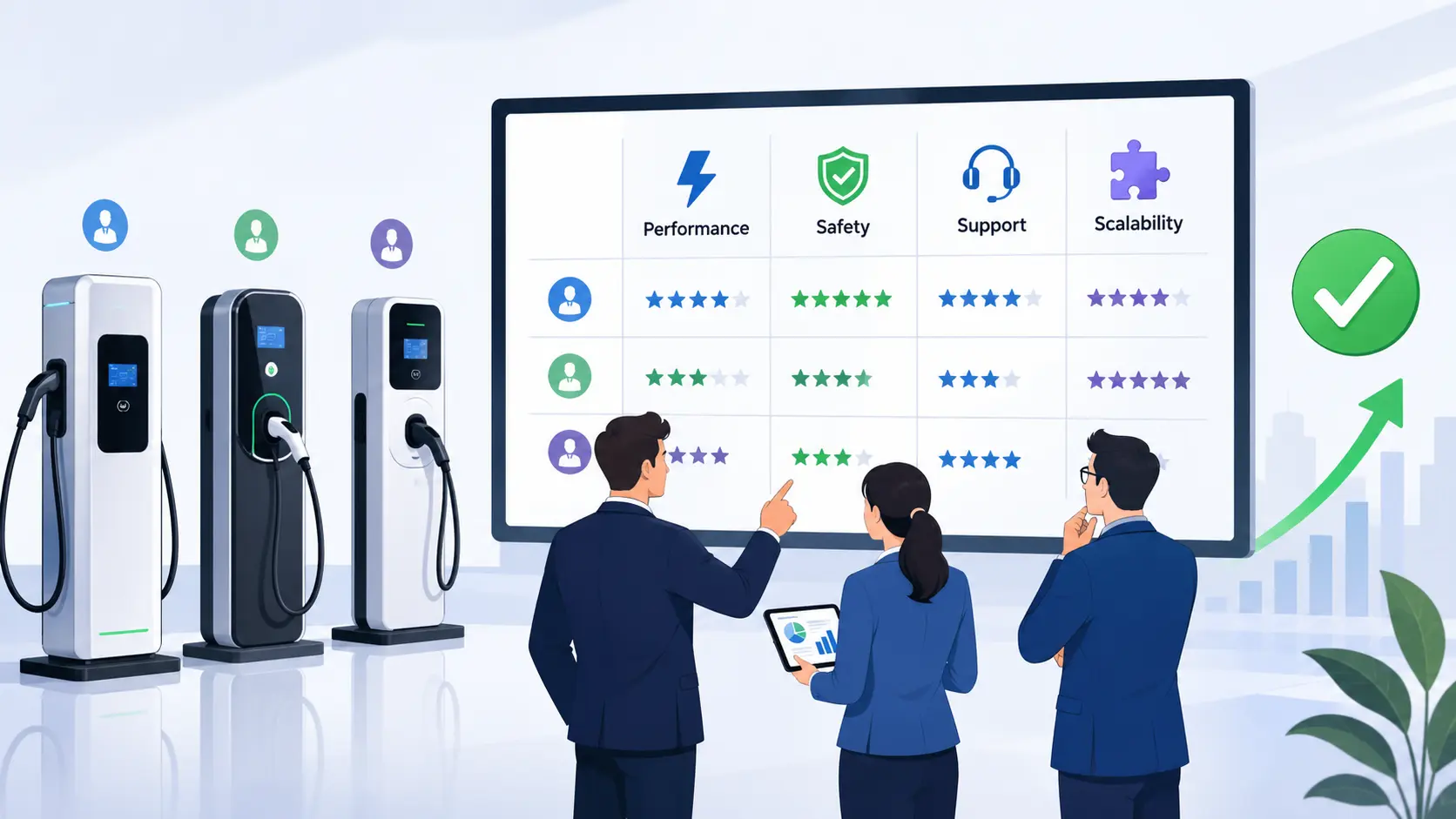
Procurement teams are often asked to compare EV charger suppliers under time pressure, with multiple quotes that look similar on the surface but are built around very different assumptions. One supplier may be pricing hardware only. Another may bundle software, commissioning, and remote support. A third may look cheapest until long lead times, weak documentation, or limited interoperability turn the purchase into an operations problem.
That is why EV charger sourcing should not be treated as a simple hardware comparison. The real task is to identify which supplier best fits the charging use case, site constraints, operating model, and expansion plan. A lower purchase price can still produce a higher total cost if the chargers are poorly matched to dwell time, difficult to integrate, or expensive to support across their service life.
Start With A Deployment-Match Filter Before You Compare Quotes
The first procurement mistake is comparing suppliers before the deployment requirement has been normalized. If one team is evaluating AC workplace charging, another is planning DC fast charging for fleet turnaround, and finance is expecting a single comparison sheet, the result will be misleading no matter how detailed the spreadsheet becomes.
Before supplier scoring begins, confirm the basics of the project: who will use the chargers, how long vehicles typically stay parked, whether charging is revenue-generating or operationally necessary, and how many sites may be added later. Many of these questions sit upstream of vendor review and belong in a broader commercial EV charging project checklist.
| Procurement Question | Why It Matters In Supplier Review |
|---|---|
| Is the site best suited to AC, DC, or a mixed rollout? | It changes charger class, installation cost, and supplier fit |
| Is charging an amenity, a revenue stream, or a fleet necessity? | It affects uptime expectations, software needs, and support requirements |
| Is this a pilot, a regional rollout, or a multi-site standardization effort? | It determines how much supply assurance and platform consistency matter |
| Will the business need white-label or custom product adaptation later? | It influences whether OEM or ODM capability should be weighted heavily |
| Will the chargers operate under a third-party network platform? | It makes interoperability and protocol support a procurement priority |
Once the deployment logic is clear, suppliers become much easier to compare on a like-for-like basis.
Compare Suppliers By Portfolio Fit, Not Just A Single SKU
Procurement teams often focus on the exact charger being quoted today. That is necessary, but not sufficient. A supplier that can support only one narrow power band may still be fine for a single fixed project. But if the business expects future workplace, retail, depot, or public charging needs to diverge, portfolio depth becomes strategically important.
For example, a buyer that may eventually need slow-to-medium AC charging at employee sites and higher-power DC charging at fleet or public-facing locations may benefit from sourcing through a supplier with a broader EV charger portfolio. That does not automatically make a broad supplier better. A narrow specialist may still be the right choice if the rollout scope is stable and technically specific. The point is to compare suppliers against the likely operating roadmap, not just today’s purchase order.
Checklist items to review at this stage:
- AC and DC product coverage aligned to your rollout path
- Available power levels and connector configurations
- Mounting formats for wall, pedestal, or ground installations
- Regional connector and voltage compatibility
- Smart load management or energy platform support
- OEM or ODM flexibility if channel branding or market adaptation matters
Verify Interoperability Before You Verify Price Leadership
An EV charger that cannot communicate cleanly with the operator’s backend, payment workflow, or network migration path can become expensive very quickly. Procurement teams should treat interoperability as a core risk category, not a technical footnote for later review.
At minimum, ask how the supplier handles protocol support, backend compatibility, firmware updates, data export, remote diagnostics, and access control integration. Buyers that are not already familiar with network standards should understand the role of OCPP in commercial EV charging before comparing connected chargers from different vendors.
Key questions include:
- Which communication protocols are supported today, and which are on the roadmap?
- Can the charger integrate with third-party software platforms without custom lock-in?
- Who controls charger data, user data, and session history?
- How are firmware updates delivered, approved, and documented?
- Can the supplier support RFID, app-based access, fleet rules, or tariff logic if needed?
- What happens if the operator changes software providers later?
If these answers are vague, the quote is not yet mature enough for confident supplier comparison.
Audit Compliance, Safety, And Documentation Quality
Procurement teams should not wait until engineering review to ask for compliance evidence. Safety certifications, installation guidance, environmental ratings, and test documentation all affect delivery risk, approval risk, and long-term supportability.
This matters especially in cross-border procurement, multi-market distribution, and large commercial rollouts where site hosts, insurers, and installers may all request evidence. A useful starting point is to review what buyers should request around CE and TUV certification for EV chargers, then align that with the actual market where the chargers will be deployed.
Procurement should ask for:
- Certification and conformity documents relevant to the target market
- Product datasheets with clear electrical and mechanical specifications
- Installation manuals and commissioning procedures
- Environmental protection details such as enclosure suitability for outdoor use
- Safety protection features and fault handling logic
- Change-control discipline when components or firmware revisions are updated
A supplier with strong documentation usually creates less friction across legal review, installer coordination, and field commissioning.
Evaluate Manufacturing Readiness And Supply Assurance
For pilot projects, supply assurance can feel secondary. For larger rollouts, it quickly becomes central. Procurement teams should understand how the supplier manufactures, sources, tests, and supports the quoted products over time.
This does not mean every buyer needs the largest possible factory base. It means the supplier’s production model should match the rollout ambition. If the project may scale across multiple sites or require repeated replenishment orders, manufacturing consistency, component continuity, and change notification processes become material buying criteria.
Useful review points include:
- Factory scale and production discipline relative to your expected order volume
- Experience with power electronics and charging hardware rather than generic assembly alone
- Lead times under normal conditions and under peak demand
- Spare-parts strategy for field replacements
- RMA workflow and warranty execution process
- Engineering support for localization, branding, or mechanical adaptation if OEM or ODM work is expected
- Product roadmap stability so the quoted model does not disappear mid-rollout
Suppliers with manufacturing depth and power-conversion expertise can often reduce procurement risk in ways that never appear on the first quote sheet. At the same time, a buyer with a narrow use case should avoid overweighting factory scale if deployment complexity is low.
Review Software, Service, And Lifecycle Support As One Package
A charger purchase is really a lifecycle decision. Hardware, firmware, monitoring, field support, and escalation workflows all determine whether the asset remains useful after commissioning.
That is why procurement should ask how the supplier manages maintenance planning, software visibility, firmware governance, and service escalation. A charger with weak update controls can create compatibility issues long after installation, which is why an EV charger firmware update strategy is not just an operations concern. It is part of procurement due diligence.
Checklist questions:
- Is remote monitoring included, optional, or dependent on a proprietary platform?
- Who performs commissioning and first-line troubleshooting?
- What support path exists for installer issues during deployment?
- How are firmware changes tested and communicated?
- Are spare parts and replacement procedures documented?
- Can the supplier support multi-site monitoring and phased expansion?
- What is excluded from the warranty or support scope?
Procurement teams should compare support models with the same rigor they apply to hardware pricing.
Compare Commercial Terms Beyond Ex-Works Unit Price
The lowest visible quote is rarely the full commercial picture. EV charger procurement should be reviewed on total landed and operating cost, not just equipment price.
| Commercial Item | Questions To Ask | Risk If Ignored |
|---|---|---|
| Hardware price | What exactly is included in the quoted configuration? | Hidden scope gaps after PO |
| Software or platform fees | Are licenses recurring, site-based, or charger-based? | Operating cost surprises |
| Commissioning support | Is startup support bundled or billed separately? | Delayed go-live or extra contractor cost |
| Warranty terms | What failures are covered, and for how long? | Higher lifecycle replacement cost |
| Logistics and duties | Who owns freight, customs, and local delivery risk? | Landed cost miscalculation |
| Spare parts | Are critical parts priced and stocked separately? | Slow recovery from field faults |
| Training and documentation | Are installer and operator resources included? | Avoidable deployment errors |
| Change management | How are revisions communicated across repeat orders? | Mixed fleets and support complexity |
This is also where procurement teams should compare payment terms, volume breaks, forecast commitments, and any commercial assumptions tied to future rollout phases. A supplier that looks competitive on unit price but weak on lifecycle cost control may not be commercially preferable.
Use A Weighted Scorecard Instead Of A General Impression
The cleanest way to compare EV charger suppliers is to use a weighted scorecard that separates mandatory pass-fail conditions from value-based scoring. This prevents price from overwhelming critical requirements such as interoperability, documentation quality, or support readiness.
An example structure could look like this:
| Evaluation Category | Suggested Weight | What Procurement Should Measure |
|---|---|---|
| Deployment fit | 20% | Match to site type, charger class, power range, and rollout roadmap |
| Interoperability and software openness | 20% | Protocol support, backend flexibility, data ownership, update model |
| Compliance and documentation | 15% | Certifications, manuals, test evidence, installation clarity |
| Manufacturing and supply assurance | 15% | Lead times, factory readiness, component continuity, spare parts |
| Service and lifecycle support | 15% | Commissioning help, troubleshooting path, warranty execution, monitoring |
| Commercial terms and total cost | 15% | Landed cost, recurring fees, warranty exposure, contract clarity |
Procurement, operations, technical stakeholders, and finance should score together where possible. That usually produces a more reliable result than letting any one team dominate the decision with a single metric.
Watch For Red Flags During Supplier Review
Some supplier risks are obvious only in hindsight. Procurement teams should treat the following warning signs seriously:
- Protocol support described in vague marketing language rather than clear integration terms
- No willingness to share meaningful compliance or test documentation
- Warranty language that sounds generous but excludes common field-failure scenarios
- Hidden software dependency that limits backend flexibility
- Weak answers on spare parts, lead times, or revision control
- Customization promises without a defined engineering approval process
- No clear escalation path for installer, operator, or commissioning issues
- Pricing that looks unusually low only because software, logistics, or service are excluded
These signals often indicate future friction in deployment, operation, or repeat procurement.
Practical Summary
Comparing EV charger suppliers is not just a sourcing exercise. It is a risk-screening exercise across hardware fit, software openness, documentation quality, manufacturing readiness, and lifecycle support.
Procurement teams will usually make better decisions when they:
- Normalize the deployment requirement before reviewing quotes
- Compare suppliers by current fit and future rollout flexibility
- Treat interoperability and data ownership as commercial issues, not just technical details
- Review certifications, manuals, and support documentation early
- Evaluate manufacturing and spare-parts readiness alongside price
- Score total lifecycle fit through a weighted comparison model
The strongest supplier is not automatically the cheapest, the broadest, or the most technically advanced. It is the one whose charger portfolio, support model, and delivery discipline best match the business case the project is actually trying to serve.