
 Deutsch
  Español
  Français
  Italiano
  Português
  Svenska
  Suomi
Suomi  Dansk
Dansk  Norsk bokmål
  Nederlands
  العربية
  עברית
עברית  Polski
  Türkçe
  Русский
  Uzbek
Uzbek  Azərbaycan
  Tiếng Việt
  ไทย
ไทย  한국어
한국어  日本語
日本語  简体中文
简体中文 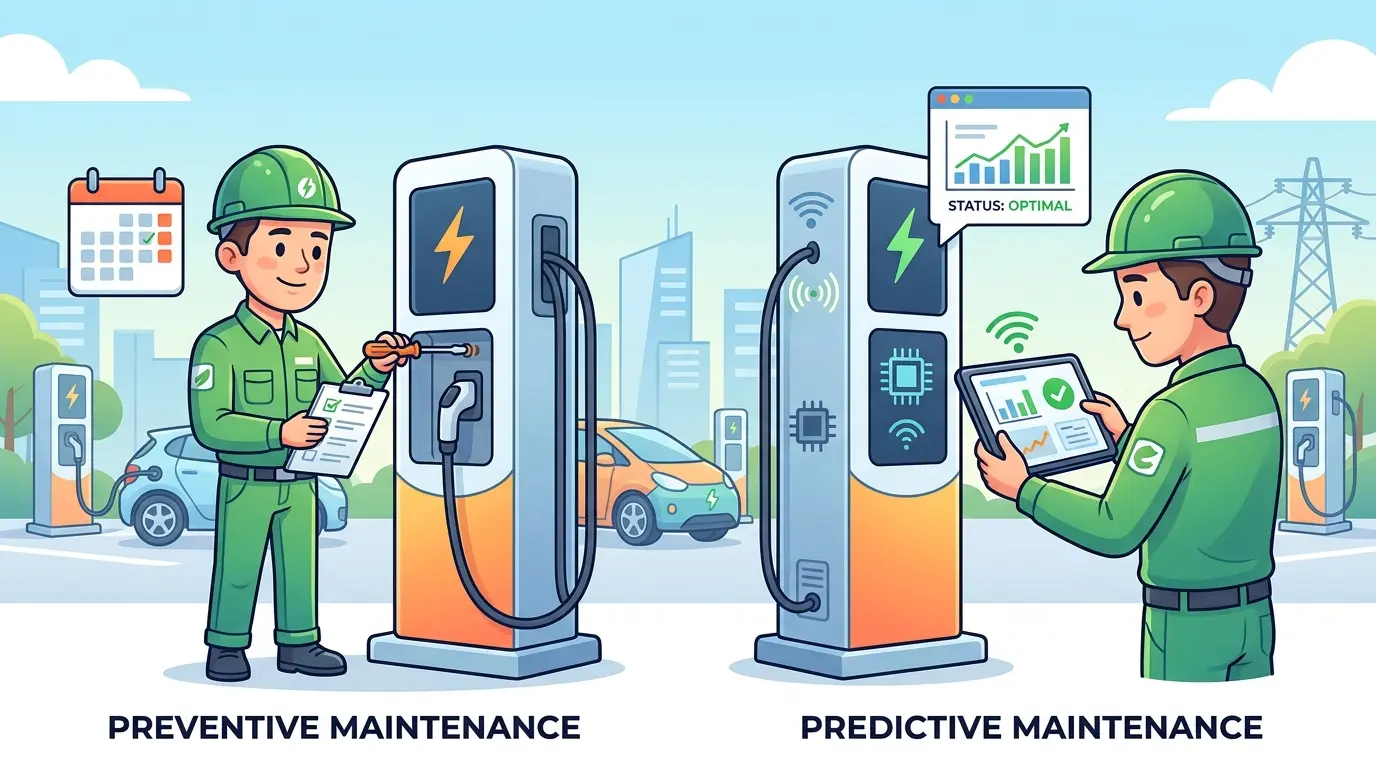
An EV charging network can have solid hardware, good locations, and strong demand and still underperform if the maintenance model is wrong. One operator may service chargers on a fixed schedule and keep costs predictable. Another may rely on telemetry, alarm patterns, and session history to intervene before faults turn into outages. Both approaches can work. The problem is that they do not work equally well for every network.
For charge point operators, fleet managers, site hosts, and infrastructure buyers, the real question is not whether maintenance matters. It is whether a scheduled maintenance program is enough for the network you are trying to run, or whether you need a more data-driven model to protect uptime, technician efficiency, and charger throughput as the portfolio grows.
Why Maintenance Strategy Has Become a Network-Level Decision
Maintenance used to be treated as a post-installation service issue. In larger charging portfolios, it is now part of network design. A fault at a low-use AC charger in an office car park has one kind of business impact. A recurring module issue at a high-utilization DC site, or a connector problem in a fleet depot with fixed departure windows, has a very different impact.
That difference is why maintenance can no longer be defined only by service intervals. It affects charger availability, dispatch planning, spare-parts strategy, customer confidence, SLA exposure, and even how much usable capacity a site really has during peak periods. Operators that already think seriously about network uptime, remote support, and escalation workflows usually understand this sooner because they see maintenance as an operations discipline, not just a repair function.
What Preventive Maintenance Actually Means in EV Charging
Preventive maintenance is the scheduled, rules-based side of charger care. The trigger is time, usage, or a documented inspection cycle rather than a predicted failure event. In practice, that can include visual checks, connector and cable inspections, enclosure sealing review, grounding and protection checks, cooling-system cleaning, filter or fan inspection, and controlled test-charge validation.
The main advantage is discipline. Preventive maintenance creates a repeatable operating rhythm, clearer service contracts, and more predictable budgeting. It is also easier to standardize across mixed site portfolios, especially for operators that are still building their maintenance playbook. PandaExo’s separate guide to preventive maintenance for EV charging stations is useful here because it frames scheduled service as a practical uptime baseline rather than a compliance exercise alone.
The limitation is that preventive maintenance does not know what is about to fail. It can catch visible wear and common degradation patterns, but it can also send technicians to healthy chargers while missing faults that develop between service windows. That tradeoff is usually acceptable when charger utilization is moderate, service response is local, and a short outage does not create broader operational disruption.
What Predictive Maintenance Adds
Predictive maintenance uses network data to identify chargers or components that are more likely to fail soon. Instead of servicing every asset on the same cycle, operators look for warning signs such as repeated fault codes, rising connector temperature, abnormal session interruption patterns, communication instability, power derating, or increasing restart frequency.
The goal is not to eliminate scheduled service altogether. It is to prioritize interventions where the risk is highest. That can reduce unnecessary truck rolls, improve first-time fix rates, and help service teams arrive with the right parts and the right fault context.
But predictive maintenance is not a switch you turn on. It depends on charger telemetry quality, consistent event logging, stable communications, and a software layer that can separate signal from noise. Operators that do not clearly understand the relationship between charger software and firmware often struggle here because predictive workflows depend on knowing whether a problem is tied to hardware condition, embedded logic, configuration, or backend behavior.
Preventive vs. Predictive: A Practical Comparison
| Dimension | Preventive Maintenance | Predictive Maintenance | Operational Effect |
|---|---|---|---|
| Primary trigger | Time-based or usage-based schedule | Telemetry, alarm trends, and condition indicators | Changes how service is prioritized |
| Planning model | Standard recurring service visits | Risk-based intervention | Predictive models can reduce unnecessary visits |
| Data requirement | Low to moderate | Moderate to high | Predictive maintenance needs cleaner network visibility |
| Best use case | Stable, lower-complexity portfolios | High-utilization, high-impact assets | Not every site gains equally from prediction |
| Downtime control | Reduces wear-related failures over time | Helps catch failures before visible outage | Predictive is stronger where downtime is expensive |
| Budget profile | Easier to forecast | More variable but potentially more efficient | Depends on maturity of service operations |
| Service team workflow | Checklist-driven | Prioritized by fault probability and business impact | Predictive improves triage when data is trustworthy |
| Main weakness | Can miss sudden failures between intervals | Can produce false alerts if data quality is poor | Both models fail when process discipline is weak |
The key point is that preventive maintenance optimizes consistency, while predictive maintenance optimizes intervention timing. Those are not the same objective, and mature networks often need both.
Where Preventive Maintenance Still Makes the Most Sense
Preventive maintenance is often the better starting point for workplace charging, multifamily AC charging, smaller regional portfolios, or early-stage public charging rollouts that are not yet data-rich. In those environments, the operator usually needs a dependable service standard more than a sophisticated condition model.
It also makes sense when the asset base is relatively homogeneous and the business can tolerate occasional unplanned outages without a chain reaction. A missed charging session at a lightly used site is inconvenient. It is not necessarily network-critical.
For many buyers, preventive maintenance is also easier to procure. Service expectations are simpler to define, vendor scopes are clearer, and field teams can follow a repeatable inspection framework across a broad range of EV charging infrastructure. That matters when the operational goal is basic consistency first, optimization second.
Where Predictive Maintenance Creates Clearer Value
Predictive maintenance becomes more attractive when charger downtime is expensive in operational terms, not just technical terms. That includes high-throughput DC fast charging sites, fleet depots with narrow charging windows, mixed portfolios spread across multiple regions, and networks where technician travel time is a major cost driver.
In those cases, the cost of waiting for a visible failure can be far higher than the cost of data analysis or remote monitoring. A single avoidable outage can create queueing, reduced charger throughput, delayed departures, lost charging revenue, and strained customer support workflows. Predictive maintenance helps most when the business impact of failure is concentrated and time-sensitive.
It also has strategic value when spare parts are constrained. If a network can identify which chargers show early signs of degradation, procurement and service teams can stage replacements more intelligently instead of reacting only after assets fail in the field.
Why a Hybrid Model Usually Wins
For most EV charging networks, the real answer is not preventive or predictive. It is preventive plus predictive.
Scheduled maintenance remains important for safety, environmental exposure, mechanical wear, and recurring inspection tasks that should not depend on an algorithm. Predictive maintenance adds value by telling operators where to look sooner, which assets deserve priority, and which conditions are likely to lead to downtime if ignored.
That hybrid approach usually looks like this:
- Routine preventive inspections for all chargers based on asset class, location, and utilization.
- Continuous remote monitoring for alarms, communication drops, abnormal charging sessions, and power-related events.
- Condition-based service triggers for high-risk chargers, high-value sites, or components showing measurable degradation.
- Post-update validation workflows after configuration or firmware changes.
This is also where smart energy management platforms start to matter more. Operators moving toward predictive workflows need better site visibility, cleaner alarm handling, and more consistent control across geographically distributed chargers. Providers that combine hardware with platform visibility can support that transition more cleanly because the data path is less fragmented, even if the operator still uses preventive service routines as the baseline.
The Platform and Data Questions Buyers Should Ask
Predictive maintenance only works when the operating environment supports it. That makes procurement and platform architecture important long before an operator starts building advanced maintenance rules.
The first question is data quality. Are fault events consistent across sites? Are charger logs detailed enough to show recurring behavior rather than isolated alarms? Can the platform distinguish between communication instability, component stress, user error, and true hardware deterioration?
The second question is interoperability. Predictive maintenance gets harder when every charger family exposes events differently or when backend integrations are brittle. That is one reason open charging network architecture and OCPP-based interoperability matter operationally, not just technically. Better protocol alignment does not guarantee predictive maintenance success, but it improves the odds that fleet-wide data can be normalized and acted on.
The third question is workflow readiness. Can the operations team turn alerts into work orders? Can spare-parts planning reflect known failure patterns? Can service teams see whether the issue is urgent, recurring, or likely tied to a recent firmware or configuration change? Predictive maintenance without workflow discipline often produces dashboards, not better uptime.
A Simple Decision Framework for Network Operators
| Network Profile | Better Starting Model | Why |
|---|---|---|
| Small AC portfolio with moderate utilization | Preventive-led | Lower complexity and easier standardization |
| Growing mixed AC/DC regional network | Hybrid | Scheduled care plus targeted monitoring reduces scaling risk |
| High-utilization DC charging corridor | Predictive-enhanced hybrid | Downtime has immediate throughput and revenue impact |
| Fleet depot with fixed dispatch windows | Predictive-enhanced hybrid | Early fault detection protects operational continuity |
| Multi-site network with limited field service coverage | Hybrid leaning predictive | Better triage reduces wasted technician travel |
| Early-stage rollout with limited telemetry maturity | Preventive first, predictive later | Data and process foundations need to be built before prediction adds value |
This is the practical lesson: predictive maintenance is not automatically more advanced in a useful way. It only becomes better when the network has enough data quality, enough operational maturity, and enough business exposure to downtime that smarter timing produces a real return.
Practical Summary
Preventive maintenance gives EV charging networks a service baseline. Predictive maintenance gives them a way to focus effort where failure risk is rising. One emphasizes routine discipline. The other emphasizes better timing.
For lower-complexity portfolios, preventive maintenance may be enough for a long time. For high-utilization DC sites, fleet depots, and multi-site portfolios where downtime carries real operating cost, predictive workflows can become much more valuable. In most cases, though, the strongest strategy is a hybrid model: scheduled inspections for core reliability and safety, supported by data-driven intervention on the chargers that matter most.
That is the maintenance tradeoff operators should evaluate clearly. The best model is not the one with the most sophisticated language. It is the one that protects uptime, fits the network’s maturity, and scales without turning service operations into guesswork.