
 Deutsch
  Español
  Français
  Italiano
  Português
  Svenska
  Suomi
Suomi  Dansk
Dansk  Norsk bokmål
  Nederlands
  العربية
  עברית
עברית  Polski
  Türkçe
  Русский
  Uzbek
Uzbek  Azərbaycan
  Tiếng Việt
  ไทย
ไทย  한국어
한국어  日本語
日本語  简体中文
简体中文 
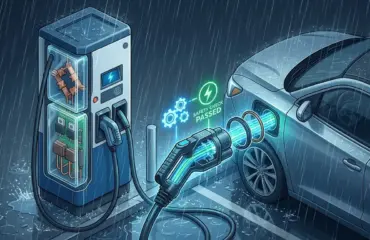
As the global transition to electric vehicles (EVs) accelerates, the demand for accessible and reliable charging infrastructure has never been higher. While portable EV chargers offer unparalleled convenience for drivers on the go, they frequently face a critical engineering challenge: thermal management.
When a portable EV charger overheats, it doesn’t just throttle charging speeds—it presents severe safety hazards, degrades component lifespans, and damages user trust. For fleet operators, infrastructure providers, and EV hardware distributors, understanding the technical drivers behind thermal failure is essential for sourcing safe, high-performance equipment.
Drawing on PandaExo’s deep heritage in power semiconductors and smart energy management, this article explores the root causes of portable EV charger overheating and outlines advanced prevention strategies to ensure reliable power delivery.
Why Do Portable EV Chargers Overheat?
Heat is a natural byproduct of electrical resistance and power conversion. However, when a portable charger reaches unsafe operating temperatures, it is typically due to one or more of the following system failures:
1. Inferior Power Electronics and Components
A portable charger’s ability to safely manage high continuous loads relies heavily on the quality of its internal circuitry. During the power conversion process, low-quality semiconductors and bridge rectifiers can suffer from high forward voltage drops, generating excess heat that the compact casing cannot effectively dissipate. Over time, this chronic thermal stress accelerates component degradation.
2. High Electrical Resistance in Contacts and Cables
Overheating frequently originates outside the main control box, specifically at the plug or wall socket.
- Worn Receptacles: Plugging a high-draw portable charger into an old, loose, or degraded wall outlet creates high electrical resistance, leading to rapid heat buildup.
- Undersized Cabling: Cables with inadequate copper cross-sections will experience significant resistive heating when pushed to their maximum rated current for hours at a time.
3. Inadequate Thermal Management Systems
Unlike stationary wallboxes, portable chargers are highly compact and lack the space for robust passive heat sinks or active cooling fans. If the manufacturer utilizes poor-quality thermal potting compounds or designs an enclosure with insufficient surface area for heat dissipation, the unit will quickly become thermally saturated.
4. Environmental and Ambient Factors
Portable chargers are often used outdoors or in poorly ventilated garages. Operating a charger under direct sunlight or in extreme summer ambient temperatures dramatically reduces the temperature delta between the device and its surroundings, severely limiting its ability to shed heat.
Prevention Strategies: Engineering for Reliability
Mitigating thermal issues requires a combination of smart hardware engineering, advanced software monitoring, and responsible deployment.
Implement Smart Thermal Monitoring and Derating
Modern, high-quality portable chargers must feature integrated NTC (Negative Temperature Coefficient) thermistors within both the control box and the plug head.
- Thermal Derating: If temperatures approach an unsafe threshold (typically around 65°C to 75°C), the charger’s smart energy management system should automatically reduce the current (e.g., dropping from 32A to 16A) to lower heat generation while maintaining a charge.
- Auto-Shutoff: In extreme cases, the system must trigger an automatic hard stop to prevent melting or fire hazards.
Upgrade to Dedicated Stationary Infrastructure
While portable chargers are excellent for travel or emergency backups, they are not designed to be primary, daily-use infrastructure for commercial applications or high-mileage EV owners.
- For consistent, daily charging at home or in commercial depots, upgrading to dedicated AC chargers or smart wallboxes provides superior thermal performance, thicker internal wiring, and better safety certifications.
- For commercial fleets requiring rapid energy delivery and continuous back-to-back charging, transitioning to high-power DC chargers with active cooling architectures is the most reliable operational choice.
Specify High-Quality Hardware in Your Supply Chain
For businesses sourcing hardware, the most effective prevention strategy is partnering with an OEM/ODM manufacturer that prioritizes engineering tolerances. Ensure that the EV chargers you deploy are built with top-tier power semiconductors, highly conductive copper alloys in the terminal pins, and flame-retardant enclosures (UL94 V-0 rated).
The PandaExo Advantage: Precision and Power
At PandaExo, we understand that reliability is the cornerstone of EV infrastructure. Operating from our 28,000-square-meter advanced manufacturing base, we leverage a profound expertise in power semiconductors to engineer chargers that excel in thermal management and energy efficiency.
Whether you need a customized OEM/ODM portable charging solution with rigorous thermal safeguards, or you are looking to scale your network with robust AC/DC infrastructure, PandaExo delivers factory-direct scale without compromising on precision.
Ready to upgrade your EV charging portfolio with hardware built to last? Explore our full catalog of smart, thermally-optimized energy solutions in the PandaExo shop, or contact our engineering team today to discuss your customized OEM/ODM requirements.