
 Deutsch
  Español
  Français
  Italiano
  Português
  Svenska
  Suomi
Suomi  Dansk
Dansk  Norsk bokmål
  Nederlands
  العربية
  עברית
עברית  Polski
  Türkçe
  Русский
  Uzbek
Uzbek  Azərbaycan
  Tiếng Việt
  ไทย
ไทย  한국어
한국어  日本語
日本語  简体中文
简体中文 
In the high-stakes world of electric vehicle (EV) infrastructure, the “race to the top” is often measured in kilowatts and charging speeds. However, as power densities increase and footprints shrink, the industry’s greatest challenge isn’t just delivering energy—it’s managing the heat generated during the process.
For CPOs (Charge Point Operators) and fleet managers, thermal management is the invisible boundary between a high-uptime, profitable charging network and a maintenance-heavy liability. At PandaExo, we leverage our deep heritage in power semiconductors to engineer DC charging solutions where thermal efficiency is the foundational design principle.
The Heat Challenge in High-Power Charging
EV power modules are the “beating heart” of a charging station. They convert AC grid power into the high-voltage DC required by vehicle batteries. During this conversion, energy loss is inevitable, manifesting primarily as heat.
When power modules operate at extreme temperatures, several critical issues arise:
- Efficiency Drop: High temperatures increase the internal resistance of components, leading to greater energy waste.
- Component Degradation: Electrolytic capacitors and power semiconductors have a lifespan that decreases exponentially as operating temperatures rise.
- Thermal Throttling: To prevent hardware failure, many chargers will automatically reduce output power, frustrating end-users who expect a “fast” charge.
Core Technologies in Thermal Management
To maintain peak performance, PandaExo utilizes a multi-layered approach to heat dissipation, ensuring our EV chargers remain cool under pressure.
1. Advanced Heat Sink Design
Modern power modules utilize high-thermal-conductivity aluminum heat sinks with optimized fin geometries. By increasing the surface area, heat is transferred more effectively from the semiconductors to the cooling medium.
2. Forced Air vs. Liquid Cooling
The choice of cooling architecture often depends on the power level and environment:
- Forced Air Cooling: Uses high-speed, PWM-controlled fans to pull heat away. Ideal for AC charging units and standard DC stations due to its cost-effectiveness and ease of maintenance.
- Liquid Cooling: Uses a coolant loop to extract heat directly from the power components. This is essential for ultra-fast charging (350kW+) where air cooling reaches its physical limits.
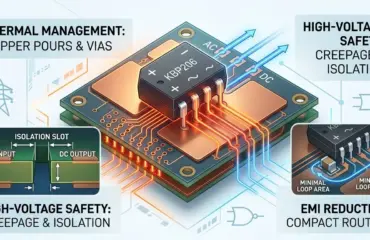
3. Semiconductor Selection: The Bridge Rectifier Advantage
The quality of the core components significantly impacts thermal overhead. Utilizing high-efficiency bridge rectifiers with low forward voltage drops reduces the initial heat generation, making the job of the cooling system much simpler.
Comparing Thermal Management Strategies
| Feature | Forced Air Cooling | Liquid Cooling |
|---|---|---|
| Cooling Efficiency | Moderate | Very High |
| Noise Level | Higher (Fan noise) | Low/Silent |
| System Complexity | Low | High (Pump, Radiator, Coolant) |
| Maintenance | Simple (Filter cleaning) | Specialized (Coolant checks) |
| Best For | AC Wallboxes & 30-120kW DC | 150kW – 480kW+ DC Fast Chargers |
The Business Impact of Superior Thermal Engineering
For B2B stakeholders, thermal management isn’t just a technical spec—it’s a financial metric.
Reduced Total Cost of Ownership (TCO)
A well-cooled system experiences fewer component failures. By keeping the internal temperature stable, PandaExo modules extend the mean time between failures (MTBF), directly reducing the frequency of costly on-site repairs.
Consistent Revenue Streams
Charging stations located in hot climates or high-traffic areas are prone to thermal throttling. A superior cooling system ensures that a 120kW charger actually delivers 120kW throughout the entire session, ensuring customer satisfaction and maximizing throughput.
Future-Proofing with PandaExo
Operating a 28,000-square-meter advanced manufacturing base allows PandaExo to integrate precision thermal sensors and smart energy management platforms. Our systems don’t just react to heat; they predict and mitigate thermal stress through intelligent load balancing.
As the EV market matures, the focus is shifting from “how fast can it charge?” to “how long will it last?” Thermal management is the answer to that question. By prioritizing heat dissipation through advanced materials and rigorous factory-direct testing, PandaExo delivers infrastructure that stands the test of time.
Whether you are looking for reliable factory-direct hardware or customized OEM/ODM services, our engineering team is ready to help you build a cooler, more efficient future.
Are you ready to optimize your EV infrastructure for peak performance? Contact PandaExo today to explore our range of thermally optimized DC fast chargers and smart energy solutions.