
 Deutsch
  Español
  Français
  Italiano
  Português
  Svenska
  Suomi
Suomi  Dansk
Dansk  Norsk bokmål
  Nederlands
  العربية
  עברית
עברית  Polski
  Türkçe
  Русский
  Uzbek
Uzbek  Azərbaycan
  Tiếng Việt
  ไทย
ไทย  한국어
한국어  日本語
日本語  简体中文
简体中文 
The rapid acceleration of global electric vehicle (EV) adoption has shifted the conversation from if we need charging infrastructure to how fast we can deploy it. For charge point operators (CPOs), fleet managers, and commercial real estate developers, selecting the right hardware is a critical business decision. At the heart of this deployment strategy is Direct Current Fast Charging (DCFC).
Understanding the technical and commercial nuances of DC chargers—from compact 20kW units to ultra-fast 240kW hubs—can mean the difference between an underperforming asset and a highly profitable, future-proof charging network.
In this guide, we break down the varying power levels of DC fast chargers, their ideal commercial applications, and what makes PandaExo a trusted partner in building high-performance EV infrastructure.
Understanding the Mechanics of DC Fast Charging
To understand why DC charging is essential for commercial operations, we must look at how power is delivered. The electrical grid supplies Alternating Current (AC). However, EV batteries store energy as Direct Current (DC).
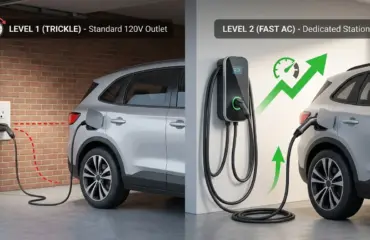
In standard AC charging, the vehicle’s onboard charger handles the heavy lifting of converting AC to DC. Because onboard space and thermal management are limited, this conversion process is relatively slow.
DC fast charging bypasses the vehicle’s onboard charger entirely. The conversion happens off-board, within the charging station itself, allowing massive amounts of power to flow directly into the vehicle’s battery.
This efficient conversion is driven by sophisticated power electronics, including high-grade semiconductors and bridge rectifiers that rectify and stabilize the immense power loads before they reach the vehicle. By utilizing industrial-scale cooling and high-capacity components, DC stations drastically reduce charging times from several hours to mere minutes.
The DC Power Spectrum: Which Charger Fits Your Application?
Not all DC chargers are created equal. Matching the kilowatt (kW) output to your specific use case ensures you optimize your capital expenditure (CapEx) while delivering the right user experience.
20kW to 40kW: Destination Fast Charging
Often referred to as “compact DC” or “wallbox DC,” these units bridge the gap between slow AC overnight charging and high-power highway charging.
- Charging Time: Adds roughly 60 to 120 miles of range per hour.
- Ideal Applications: Auto dealerships, workplace parking, retail centers, and medium-duty delivery fleets returning to depots.
- Business Advantage: They offer a substantial speed upgrade over AC stations without requiring the massive grid upgrades and high installation costs associated with high-power DC units.
60kW to 120kW: The Commercial Standard
This is the sweet spot for most public charging networks and commercial applications, providing rapid energy delivery that aligns with a standard user dwell time of 30 to 60 minutes.
- Charging Time: Can charge a standard EV battery from 20% to 80% in about 30 to 45 minutes.
- Ideal Applications: Shopping malls, highway rest stops, fast-food restaurants, and high-turnover municipal parking lots.
- Business Advantage: Excellent ROI for commercial locations where you want customers to stay long enough to shop or eat, but move quickly enough to ensure high charger turnover.
150kW to 240kW: Ultra-Fast High-Power Infrastructure
Designed for next-generation EVs with advanced battery architectures, these ultra-fast chargers are the heavyweights of the EV infrastructure world.
- Charging Time: Adds up to 100 miles of range in less than 10 minutes; 20% to 80% charge in 15 to 20 minutes.
- Ideal Applications: Interstate highway corridors, heavy-duty electric trucking hubs, and dedicated EV charging stations (replacing traditional gas stations).
- Business Advantage: Maximizes vehicle throughput. These units often feature dynamic load sharing, allowing a single 240kW cabinet to split its power (e.g., two vehicles charging simultaneously at 120kW each), optimizing the grid draw and user satisfaction.
Key Considerations When Selecting DC Charging Infrastructure
When investing in a broader network of EV chargers, hardware specifications are just the beginning.
- Modularity and Scalability: Look for charging stations with modular power units. A station that houses multiple 30kW or 40kW power modules allows you to scale up (e.g., from 120kW to 240kW) simply by adding modules as user demand grows, rather than replacing the entire unit.
- Grid Constraints: Ultra-fast charging requires significant localized grid capacity. Understanding your site’s power availability is critical before opting for 240kW systems. Smart energy management platforms can help mitigate peak load constraints.
- Reliability and Uptime: In the B2B sector, charger downtime equals lost revenue. High-quality power semiconductors and advanced thermal management are non-negotiable for ensuring 99%+ uptime in harsh environmental conditions.
Why Partner with PandaExo?
At PandaExo, we don’t just assemble chargers; we engineer them from the silicon up. Operating a state-of-the-art 28,000-square-meter manufacturing base, we leverage our deep heritage in power semiconductors to deliver world-class AC/DC EV charging stations and smart energy management platforms.
Our factory-direct scale guarantees unmatched precision, competitive pricing, and robust OEM/ODM capabilities tailored to your specific deployment needs. Whether you are building an urban fast-charging network or electrifying a national transit fleet, our hardware is designed for maximum efficiency, safety, and longevity.
Ready to future-proof your EV infrastructure? Explore our full range of factory-direct hardware in our shop or contact the PandaExo engineering team today to discuss a customized power solution for your next project.