
 Deutsch
  Español
  Français
  Italiano
  Português
  Svenska
  Suomi
Suomi  Dansk
Dansk  Norsk bokmål
  Nederlands
  العربية
  עברית
עברית  Polski
  Türkçe
  Русский
  Uzbek
Uzbek  Azərbaycan
  Tiếng Việt
  ไทย
ไทย  한국어
한국어  日本語
日本語  简体中文
简体中文 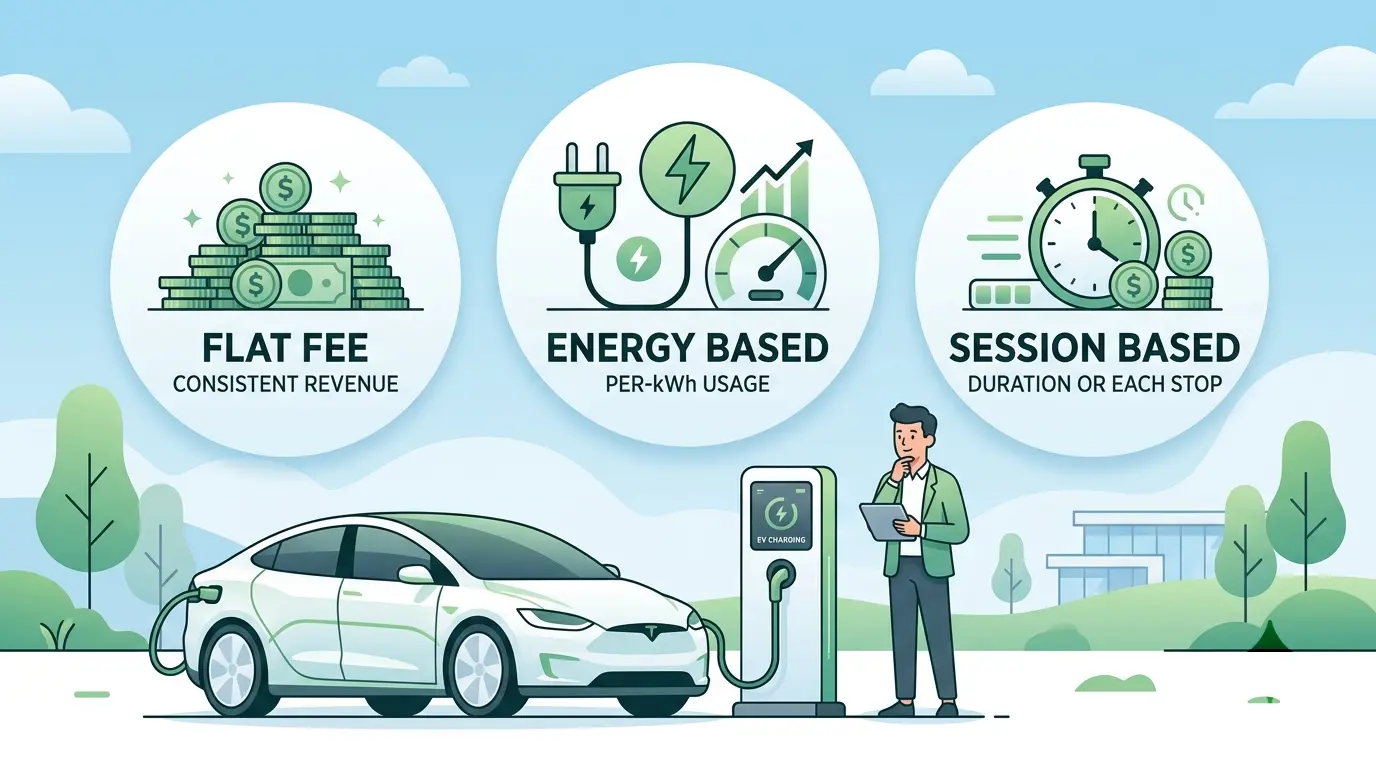
For most site hosts, the difficult pricing question is not whether drivers should pay. It is how the price structure should support the job the charging site is supposed to do.
A workplace charger meant to improve tenant value should not usually be priced the same way as a highway fast-charging site, a mixed-use retail parking lot, or a private fleet depot. The wrong model can create long dwell times, weak cost recovery, frustrated drivers, and billing disputes. The right model aligns charging behavior with site economics, user expectations, and operational goals.
That is why pricing should be treated as part of infrastructure planning rather than a decision made after the chargers are already installed.
Why Pricing Model Selection Matters
Pricing changes how people use chargers. It affects how long vehicles stay connected, how fairly energy costs are recovered, how easy the site is to explain to users, and whether the host can scale the network without constant manual intervention.
For a host evaluating how to monetize a parking lot with commercial EV charging stations, pricing is not just a finance topic. It is also a traffic-management, customer-experience, and asset-utilization decision.
Before choosing a model, site hosts should define which of these objectives matters most:
- Recover electricity and operating costs
- Generate direct charging revenue
- Increase site dwell and retail spend
- Improve charger turnover and parking availability
- Support employee, tenant, or fleet charging as an amenity
- Keep administration simple across multiple sites
Once that objective is clear, the pricing structure becomes much easier to evaluate.
The Four Core Models at a Glance
| Pricing Model | How It Works | Best Fit | Main Risk |
|---|---|---|---|
| Flat fee | One fixed charge per use period, day, or access window | Controlled-access or simple amenity charging | Weak alignment with actual energy use |
| Energy-based | User pays for the electricity consumed | Fair cost recovery and transparent usage billing | May not control overstays on its own |
| Session-based | User pays a fixed amount per charging session | Simple access pricing or low-complexity public use | Can feel unfair for short or low-energy sessions |
| Hybrid | Blends two or more pricing elements | Most commercial networks with mixed cost drivers | Requires stronger platform logic and clearer communication |
No single model is universally best. The right answer depends on charger type, user profile, and the commercial role of the site.
Flat Fee Works Best When Charging Is Secondary to Simplicity
Flat-fee pricing is appealing because it is easy to communicate. A driver pays a set amount for access, and the host avoids explaining meter readings, tariff bands, or variable billing rules.
This model is usually most workable in low-variance environments, especially long-dwell AC charging settings such as workplaces, small hospitality sites, residential communities, or controlled private parking where the host values convenience over precise billing accuracy.
It can also work when the charger is functioning more like a bundled amenity than a standalone profit center. For example, a hotel may prefer a simple overnight charging fee because it matches the guest stay rather than the exact amount of energy used.
The tradeoff is that flat fees rarely reflect real usage well. Light users may feel overcharged. Heavy users may consume far more energy than the price anticipated. If the site has meaningful differences in charging duration, battery size, or energy draw, flat-fee billing can distort both fairness and margin.
Flat fee is usually weakest when:
- Session lengths vary widely
- Vehicle types have very different charging needs
- Electricity costs fluctuate materially by demand profile
- The host needs accurate cost allocation across users or departments
In short, flat fee is best when simplicity matters more than precision.
Energy-Based Pricing Is Usually the Cleanest Model for Fairness
Energy-based pricing charges users for what they actually consume, typically by kilowatt-hour. For many site hosts, this is the most intuitive way to connect billing to energy cost.
It is especially strong where pricing transparency matters. Public charging users generally understand paying for energy. Fleet operators often prefer it for internal cost allocation. Commercial property owners can also use it to separate charging cost from general parking operations more clearly.
Energy-based pricing is often the most defensible approach when the host wants billing to feel proportional. A driver who takes more energy pays more. A driver who takes less energy pays less.
That said, energy pricing is not only a billing choice. It also depends on metering quality, payment workflows, and local regulatory requirements. In some markets, hosts should confirm whether specific calibration, measurement, or resale-of-electricity rules apply before rolling out pure kWh billing.
It also does not automatically solve utilization problems. On its own, a per-kWh tariff may not discourage drivers from remaining plugged in after charging has effectively finished. That is why some semi-public environments pair usage billing with stronger app, RFID, or session-control tools, similar to the workflows described in how RFID and app billing work in semi-public AC charging stations.
Energy-based pricing is usually strongest when:
- The host wants fair, consumption-linked billing
- User sessions vary in energy demand
- Cost recovery is a priority
- The site serves a broad public or mixed user base
It is usually weaker when turnover control matters more than pure fairness.
Session-Based Pricing Can Be Useful, But It Should Be Applied Carefully
Session-based pricing charges a fixed fee each time a user starts a charging event. Hosts sometimes choose it because it is operationally simple and can cover access, payment processing, or administrative overhead without requiring users to interpret a more detailed tariff.
This model can be useful in controlled environments where the act of reserving or starting a session has value in itself. That may include managed parking, private access-controlled sites, or locations where the charging experience is part of a broader service bundle.
The main problem is that session-based pricing does not scale well when energy delivery varies significantly. A driver using a small top-up may resent paying the same amount as someone taking a much larger charge. At busy sites, it can also encourage users to maximize each session once they have already paid the fixed fee.
That makes session-based pricing a poor standalone fit for many high-turnover DC charging environments. Fast-charging sites usually need a model that reflects both energy use and site throughput, not just session initiation.
Session-based pricing can still have a role, but it is often more effective as one component in a broader pricing structure rather than as the entire tariff logic.
Hybrid Pricing Is Often the Most Practical Commercial Answer
Most site hosts do not face a single cost driver. They face several at once: electricity consumption, peak demand exposure, parking opportunity cost, payment processing, backend software, support workflows, and the business need to keep chargers available for the next user.
That is why hybrid pricing is often the most practical long-term model. It lets hosts combine fairness with behavior control.
Common hybrid structures include:
- A connection fee plus an energy charge
- A per-kWh tariff plus an idle or overstay fee
- A monthly membership plus discounted energy pricing
- A parking fee combined with charging access
- Time-based pricing overlays during peak utilization windows
Hybrid pricing is especially useful when the site must do two jobs at once: recover energy cost while also protecting charger turnover. That is often the reality for mixed-use commercial sites, destination charging, or public networks with both recurring and transient users.
It also aligns better with the real economics of charging infrastructure. A host may need one part of the tariff to recover electricity and another part to manage user behavior. If the site is exposed to grid constraints or peak-load risk, that logic becomes even more important, particularly where utilities evaluate grid capacity, interconnection, and demand charges as part of commercial charging projects.
In practice, hybrid pricing often becomes the preferred choice once a site moves beyond a simple pilot and starts treating charging as an operational system rather than a standalone socket.
Match the Model to the Site Type, Not Just the Charger
Hosts often choose pricing by copying what another site uses. A better approach is to match the tariff structure to the charging behavior the site actually needs.
| Site Type | Primary Objective | Most Suitable Pricing Model | Why It Fits |
|---|---|---|---|
| Workplace parking | Amenity with moderate cost recovery | Flat fee or low-intensity hybrid | Keeps administration light while discouraging abuse if needed |
| Multifamily or tenant parking | Fair resident billing over long dwell windows | Energy-based or membership hybrid | Reflects real use without treating charging like retail fast charging |
| Hotels and destination sites | Guest convenience with manageable cost recovery | Flat fee or hybrid | Easy to communicate, especially when parking and charging are bundled |
| Retail or mixed-use commercial sites | Encourage visits but preserve turnover | Hybrid | Balances customer convenience with charger availability |
| Public fast-charging site | High throughput and transparent billing | Energy-based with idle or time overlay | Supports fairness while protecting utilization |
| Fleet depot | Operational uptime and internal cost control | Energy-based or hybrid | Links charging cost to usage while supporting dispatch priorities |
The point is not that one site should always use one model. It is that pricing should match the site’s commercial purpose and dwell pattern.
Do Not Ignore the Cost Stack Behind the Tariff
Hosts sometimes underprice charging because they focus only on electricity consumption. In reality, the cost structure is broader.
A robust pricing decision should account for:
- Energy cost
- Demand-charge or peak-load exposure
- Parking-space opportunity cost
- Software platform and payment processing fees
- Maintenance and support workflows
- User authentication and access-control complexity
- The value of keeping chargers available for the next vehicle
For multi-user or multi-site deployments, pricing also interacts with load management. If the site can intelligently prioritize and distribute power, it may avoid unnecessary infrastructure stress and make a hybrid model more effective. That is one reason smart controls and dynamic load management matter even outside residential or multifamily contexts.
As charging portfolios grow, the tariff is no longer just a price list. It becomes part of the operating model.
A Simple Decision Framework for Site Hosts
If the pricing choice feels unclear, this sequence usually helps:
- Define the role of charging at the site: amenity, cost recovery, revenue center, or operational necessity.
- Segment users by behavior: employees, residents, guests, retail visitors, public drivers, or fleet vehicles.
- Estimate where cost variability is highest: energy, demand, parking time, or support overhead.
- Decide whether fairness, simplicity, or turnover control matters most.
- Add a second pricing layer only if the first model leaves a clear operational gap.
- Review actual session data after launch and adjust instead of assuming the first tariff will be permanent.
This approach is more reliable than choosing a model based only on what competitors display in their apps.
Practical Summary
Flat fee works when the host wants simple access and charging is a secondary amenity.
Energy-based pricing is usually the clearest choice when fairness and cost transparency matter most.
Session-based pricing can be useful in narrow controlled-use cases, but it is rarely the best standalone answer for sites with wide variation in charging behavior.
Hybrid pricing is often the strongest commercial model because most real charging sites have hybrid objectives. They need to recover cost, shape user behavior, and protect charger availability at the same time.
For site hosts, the best pricing model is the one that fits how the location operates, how users behave, and what the charging infrastructure is meant to achieve. When pricing is planned with the same discipline as charger selection, load management, and site design, the network becomes easier to scale and easier to justify commercially.