
 Deutsch
  Español
  Français
  Italiano
  Português
  Svenska
  Suomi
Suomi  Dansk
Dansk  Norsk bokmål
  Nederlands
  العربية
  עברית
עברית  Polski
  Türkçe
  Русский
  Uzbek
Uzbek  Azərbaycan
  Tiếng Việt
  ไทย
ไทย  한국어
한국어  日本語
日本語  简体中文
简体中文 
Fast charging matters because EV convenience is measured in time, not only in battery capacity. Drivers want shorter stops, fleet operators want tighter vehicle turnaround, and charging networks want each bay to serve more sessions per day. Supercharging addresses all three needs by moving large amounts of energy into a battery within a limited window.
But that speed is never just about pushing harder. A supercharging session works only when the charger, battery pack, vehicle controls, and thermal system stay in balance. What looks simple at the plug is actually a tightly managed process shaped by power electronics, battery chemistry, and software.
The Core Difference Between AC Charging And Supercharging
The starting point is where AC power becomes DC power. In everyday charging, the vehicle relies on its On-Board Charger (OBC) to convert grid electricity into the form the battery can store. That works well for home, workplace, and destination charging, but the onboard charger is constrained by space, heat, weight, and cost.
Supercharging removes that bottleneck by shifting the conversion work outside the vehicle. The station itself handles high-power AC-to-DC conversion and sends DC directly into the battery pack. This is what allows DC charging systems to operate at much higher power than standard AC charging.
| Category | AC Charging | Supercharging |
|---|---|---|
| Power conversion location | Inside the vehicle | Inside the charging station |
| Typical role | Daily replenishment | Fast top-up and route recovery |
| Main limiting factor | Onboard charger size and heat | Battery acceptance and thermal control |
| Best-fit environments | Home, workplace, destination sites | Highways, fleets, retail, high-turnover public sites |
What Actually Makes Charging Fast
Charging speed comes from power, and power depends on voltage and current working together. In practical terms, faster charging means delivering more usable energy in less time. That can be done by increasing voltage, increasing current, or improving both the power electronics and thermal design so the system can sustain high output safely.
In real infrastructure, current is often the harder variable to push. Very high current increases resistive heat in cables, connectors, and internal components. That is why ultra-fast charging systems increasingly rely on better cooling strategies and, at the highest outputs, technologies such as liquid-cooled charging cables.
This is also why higher-voltage vehicle platforms matter. An 800V architecture can reach the same power target with less current than a 400V platform, which reduces cable burden and thermal stress. For operators and buyers, the implication is straightforward: charger rating alone does not define performance. Vehicle architecture and thermal conditions matter just as much.
Why The Battery Sets The Real Limit
A charger may be capable of very high output, but the battery decides how much of that power it can accept at a given moment. The fastest possible session is not the one with the biggest nameplate rating. It is the one that stays within the battery’s safe operating window while still delivering meaningful energy quickly.
Several factors shape that window:
- State of charge: batteries usually accept the highest power when they are at a lower to mid charge level.
- Cell temperature: batteries that are too cold or too hot cannot charge aggressively without additional risk.
- Chemistry limits: pushing ions too quickly can increase stress and contribute to degradation mechanisms such as lithium plating.
- Battery health: older or more stressed packs may accept less power than newer packs under the same conditions.
This is why fast charging is never a flat, constant-speed event. Instead, it follows a charging curve that changes as the session progresses.
The Charging Curve Explains The Driver Experience
The best-known fast-charging window is usually 10 to 80 percent, and that is not a marketing trick. It reflects the part of the session where the battery can accept substantial power without requiring severe tapering.
| State Of Charge Range | What Usually Happens | Practical Meaning |
|---|---|---|
| 0 to 10 percent | Power ramps up as systems stabilize | The vehicle may still be preparing the pack for higher intake |
| 10 to 50 percent | Charging is often at or near its most productive | This is where supercharging delivers its strongest time advantage |
| 50 to 80 percent | Power gradually tapers | The battery is filling, so charging becomes more controlled |
| 80 to 100 percent | Charging slows significantly | The last portion takes disproportionately more time |
For commercial operators, this matters because charger throughput depends on session behavior, not just charger rating. A site built around quick top-ups performs differently from a site where users insist on charging close to full every time.
Thermal Management Is What Keeps Speed Sustainable
Heat is one of the main reasons charging power has to be managed so carefully. High output generates heat in the battery, the power electronics, the connector, and the cable path. Without strong thermal management, a supercharging session would either slow down quickly or place too much stress on the system.
Modern EVs control this with liquid cooling, pumps, valves, heat exchangers, and battery preconditioning logic. In cold weather, the pack may need to be warmed before it can accept high current. In hot conditions, the system may reduce charge power to protect the cells and maintain reliability.
This is one of the most overlooked truths in EV infrastructure: fast charging speed is not only an electrical issue. It is equally a thermal issue. Strong thermal design allows a charger and a vehicle to sustain useful high-power operation for longer rather than peaking briefly and tapering early.
The Charger And The Vehicle Are Constantly Negotiating
Supercharging is a live coordination process between the charger and the vehicle’s battery management system. The charger does not simply force power into the pack at a fixed rate. Instead, the vehicle continuously signals what voltage and current it can safely accept based on pack condition, temperature, and state of charge.
That communication is what keeps fast charging both fast and safe. If the battery is in the right temperature range and still relatively empty, the charger can stay at a stronger output. If the pack heats up, approaches a higher state of charge, or detects an abnormal condition, the vehicle can request lower power immediately.
For site operators, this is why two EVs connected to the same charger may show different charging speeds. The charger rating is only one part of the outcome. Vehicle platform, pack temperature, starting SOC, and battery health all shape the real session profile.
Where Supercharging Delivers The Most Commercial Value
Supercharging is most effective where the business model depends on shorter dwell time and higher vehicle turnover. It is not always the right answer for every site, but it becomes highly valuable when charging speed directly affects asset utilization, customer experience, or route reliability.
| Deployment Scenario | Why Supercharging Fits | Main Planning Concern |
|---|---|---|
| Highway corridors | Drivers need meaningful range in a short stop | Site power availability and uptime |
| Retail and roadside commercial sites | Charging aligns with short-duration visits | Session turnover and customer flow |
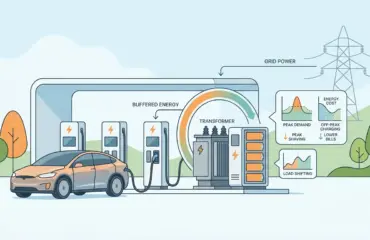
| Fleet depots with tight schedules | Vehicles may need rapid turnaround between duties | Load orchestration and demand charges |
| Urban quick-charge hubs | Drivers may not have long parking windows | Queue management and throughput planning |
In contrast, lower-power AC charging often remains the better fit for overnight charging, workplace dwell, residential applications, or any location where vehicles naturally remain parked for longer periods.
What Buyers Should Evaluate Beyond Peak kW
When comparing fast-charging hardware, buyers should look beyond the headline power number and assess how the system will perform under real operating conditions. The most important questions usually include:
- What mix of 400V and 800V vehicles will use the site?
- What is the expected arrival SOC and average dwell time?
- How much utility capacity is actually available at the location?
- How strong is the system’s thermal design under repeated use?
- What monitoring, load management, and software visibility does the platform provide?
- Can the deployment scale without forcing a complete redesign later?
That is where PandaExo’s broader value becomes relevant. The company combines AC and DC charging hardware with smart energy management capability, manufacturing scale, and OEM and ODM flexibility, helping buyers align charging architecture with real deployment needs rather than peak-power marketing alone.
Final Takeaway
EV supercharging works because external hardware handles high-power DC conversion while the vehicle continuously manages what the battery can safely absorb. Charging speed depends on power delivery, but it is ultimately governed by battery acceptance, temperature control, and real-time communication between the car and the charger.
For charging networks, fleets, and infrastructure developers, that means supercharging is not only a speed story. It is a system design story shaped by throughput, battery protection, grid constraints, and long-term operational reliability. If you are evaluating fast-charging infrastructure and want a solution matched to real-world deployment conditions, contact the PandaExo team to discuss scalable EV charging solutions.