
 Deutsch
  Español
  Français
  Italiano
  Português
  Svenska
  Suomi
Suomi  Dansk
Dansk  Norsk bokmål
  Nederlands
  العربية
  עברית
עברית  Polski
  Türkçe
  Русский
  Uzbek
Uzbek  Azərbaycan
  Tiếng Việt
  ไทย
ไทย  한국어
한국어  日本語
日本語  简体中文
简体中文 
The global transition to electric mobility is no longer a “future” trend—it is a present-day industrial shift. For businesses, fleet operators, and property developers, understanding the nuances of charging speeds is the difference between a high-return investment and an obsolete installation.
Navigating the landscape of EV power delivery requires more than just knowing “fast” from “slow.” It requires a deep dive into the technical architecture of Level 1, Level 2, and DC Fast Charging. In this guide, we break down the engineering specifications, commercial applications, and strategic advantages of each level to help you optimize your EV charging infrastructure.
Level 1 Charging: The Entry-Point Baseline
Level 1 charging is the simplest form of power delivery, utilizing a standard 120V AC household outlet. While it requires no additional infrastructure investment, its utility in a professional or commercial context is highly limited.
- Voltage: 120V AC
- Charging Speed: 3 to 5 miles of range per hour.
- Best For: Residential overnight use for plug-in hybrids (PHEVs) or low-mileage drivers.
From a B2B perspective, Level 1 is rarely a viable solution for public or workplace charging due to its inability to support high turnover or rapid “top-offs.”
Level 2 Charging: The Workhorse of Commercial Infrastructure
Level 2 charging represents the most versatile solution for workplaces, multi-family housing, and hospitality sectors. Operating on 208V to 240V AC power, these stations strike a balance between installation cost and charging efficiency.
- Performance: Delivering anywhere from 3.7 kW to 22 kW, these reliable charging points can fully charge a standard EV battery in 4 to 8 hours.
- Smart Integration: Modern Level 2 stations, like those manufactured at PandaExo’s 28,000-square-meter facility, feature OCPP (Open Charge Point Protocol) compatibility. This allows for load balancing and user authentication.
- Application: Ideal for locations where vehicles are parked for two hours or more, such as office complexes, retail centers, and residential hubs.

DC Fast Charging (Level 3): High-Performance Power Delivery
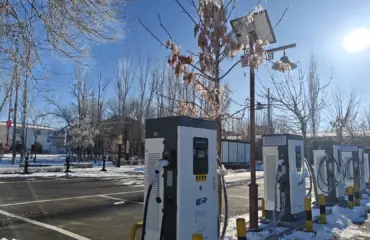
When time is the primary constraint, Direct Current Fast Charging (DCFC) is the industry standard. Unlike AC charging, which relies on the vehicle’s onboard converter, DC charging bypasses the onboard charger to feed power directly to the battery.
- Voltage and Speed: Utilizing 400V to 1000V DC, these stations can provide an 80% charge in as little as 15 to 30 minutes.
- Scalability: DCFC stations are available in various power outputs, typically ranging from 50 kW to 400 kW+ for ultra-fast “megawatt” charging.
- Strategic Use: These are essential for highway rest stops, commercial fleet depots, and urban “fueling” stations where rapid turnaround is critical for operational uptime.

Comparing the Core Specifications
| Feature | Level 1 (AC) | Level 2 (AC) | DC Fast Charging (DC) |
|---|---|---|---|
| Voltage | 120V | 208V – 240V | 400V – 1000V |
| Power Output | ~1.2 kW – 1.9 kW | 3.7 kW – 22 kW | 50 kW – 400 kW |
| Charging Speed | 3–5 miles/hr | 15–35 miles/hr | 100–300+ miles/hr |
| Typical Location | Residential | Workplace/Retail | Highways/Fleets |
Selecting the Right Solution for Your Business
Choosing between AC and DC solutions involves a technical audit of your site’s grid capacity and your users’ behavior.
- Dwell Time: If users stay for hours (offices/apartments), Level 2 is the most cost-effective choice.
- Throughput Requirements: For logistics hubs or high-traffic corridors, the high-power density of DC Fast Charging is mandatory to prevent bottlenecks.
- Future-Proofing: PandaExo’s modular designs allow businesses to scale their infrastructure as EV adoption increases, ensuring that today’s hardware remains compatible with tomorrow’s battery technology.
Ready to upgrade your facility with world-class charging technology? Whether you need high-performance AC wallboxes or industrial-grade DC rapid chargers, PandaExo provides the engineering precision and manufacturing scale to power your transition.