
 Deutsch
  Español
  Français
  Italiano
  Português
  Svenska
  Suomi
Suomi  Dansk
Dansk  Norsk bokmål
  Nederlands
  العربية
  עברית
עברית  Polski
  Türkçe
  Русский
  Uzbek
Uzbek  Azərbaycan
  Tiếng Việt
  ไทย
ไทย  한국어
한국어  日本語
日本語  简体中文
简体中文 
In the world of high-performance electric vehicle (EV) infrastructure, efficiency isn’t just a metric—it’s the foundation of the entire ecosystem. While most of the industry focuses on how energy moves from the grid into the vehicle, one of the most elegant pieces of engineering happens in the opposite direction: Regenerative Braking.
For fleet operators, charging station installers, and automotive engineers, understanding how alternating current (AC) motors act as generators to recharge direct current (DC) batteries is critical. This process doesn’t just extend vehicle range; it reduces mechanical wear and optimizes the entire power cycle.
In this article, we’ll break down the physics of energy recovery, the role of power electronics, and how this “closed-loop” efficiency influences the design of modern EV charging infrastructure.
1. The Physics of Momentum: From Motor to Generator
In a standard driving state, an EV battery sends DC power to an inverter, which converts it to AC to drive the induction or permanent magnet motor. However, the moment a driver lifts their foot off the accelerator or applies the brake, the roles are reversed.
The Principles of Electromagnetism
Regenerative braking relies on Faraday’s Law of Induction. When the vehicle’s kinetic energy keeps the motor spinning after the power supply is cut, the motor no longer “consumes” electricity to create motion. Instead, the wheels drive the motor.
- Kinetic Energy Capture: The mechanical energy of the moving vehicle spins the motor’s rotor.
- Magnetic Induction: As the rotor spins within the stator’s magnetic field, it induces an alternating current (AC).
- Negative Torque: This process creates “braking torque,” which slows the vehicle down without relying solely on friction-based brake pads.
2. The Conversion Path: AC to DC
A battery cannot store AC power directly. To make regenerative braking useful, the energy must be processed through the vehicle’s sophisticated power electronics.
The Role of the Inverter and Rectifier
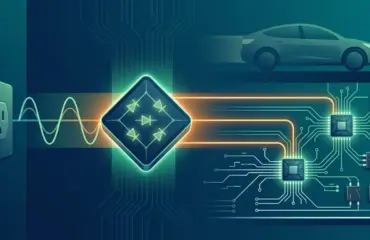
The onboard traction inverter, which usually converts DC to AC for driving, acts as a rectifier during braking. It takes the multi-phase AC generated by the motor and “straightens” it into a stable DC voltage compatible with the battery pack.
This conversion requires high-precision semiconductors. In many industrial applications and high-power charging systems, components like a bridge rectifier are foundational to ensuring that power conversion is handled with minimal thermal loss.
Managing the Voltage Spike
The energy captured during a hard braking event can be significant. The Battery Management System (BMS) must communicate instantly with the inverter to ensure the charging current doesn’t exceed the battery’s “C-rating” (the rate at which it can safely absorb energy), preventing cell degradation.
3. Comparing Braking Systems: Regenerative vs. Friction
While traditional vehicles dissipate kinetic energy as wasted heat through brake pads, EVs reclaim that energy.
| Feature | Friction Braking | Regenerative Braking |
|---|---|---|
| Energy Action | Dissipated as heat | Reclaimed as electricity |
| Component Wear | High (pads and rotors) | Low (electro-magnetic) |
| Efficiency | 0% energy recovery | Up to 70% recovery |
| Heat Generation | Significant | Minimal |
| Primary Use Case | Emergency stops / low speeds | Deceleration / downhill |
4. Why This Matters for EV Infrastructure
The efficiency of a vehicle’s onboard energy recovery system directly impacts how often it needs to visit a charging station. However, the hardware within the vehicle and the hardware at the station share a common lineage: Power Electronics.
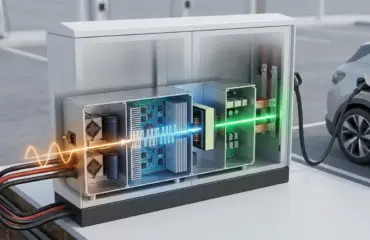
The same principles of AC/DC conversion found in regenerative braking are mirrored in DC charging technology. In a DC Fast Charger, the “rectification” happens outside the vehicle within the charging station itself, allowing for massive power transfer directly to the battery.
By understanding how motors generate AC, engineers can better design AC charging systems that communicate with the vehicle’s onboard charger to optimize the overall State of Charge (SoC).
5. The Business Case for High-Efficiency Systems
For B2B stakeholders—from property developers to municipal fleet managers—investing in infrastructure that understands these power dynamics is essential.
- Reduced Maintenance: Vehicles using regenerative braking require fewer brake pad replacements, but they put a unique “cycling” stress on the battery.
- Smart Grid Integration: As V2G (Vehicle-to-Grid) technology matures, the ability to manage AC/DC conversion efficiently becomes a revenue-generating asset.
- Optimized Range: Efficient energy recovery can extend a vehicle’s range by 10-20% in urban “stop-and-go” environments, reducing the “dwell time” required at charging points.
Precision Engineering for a Greener Future
Regenerative braking is a masterclass in recycling. By turning the motor into a generator and utilizing advanced power electronics to bridge the gap between AC and DC, the EV industry has set a new standard for mechanical efficiency.
At PandaExo, we apply this same level of engineering precision to our charging hardware. Whether you are looking for high-capacity power semiconductors or turnkey charging station deployments, our factory-direct solutions ensure that every kilowatt is managed with peak efficiency.
Ready to upgrade your infrastructure with smart, high-performance hardware?
Explore our full range of factory-direct EV charging solutions today and join the movement toward a more efficient electric future.