
 Deutsch
  Español
  Français
  Italiano
  Português
  Svenska
  Suomi
Suomi  Dansk
Dansk  Norsk bokmål
  Nederlands
  العربية
  עברית
עברית  Polski
  Türkçe
  Русский
  Uzbek
Uzbek  Azərbaycan
  Tiếng Việt
  ไทย
ไทย  한국어
한국어  日本語
日本語  简体中文
简体中文 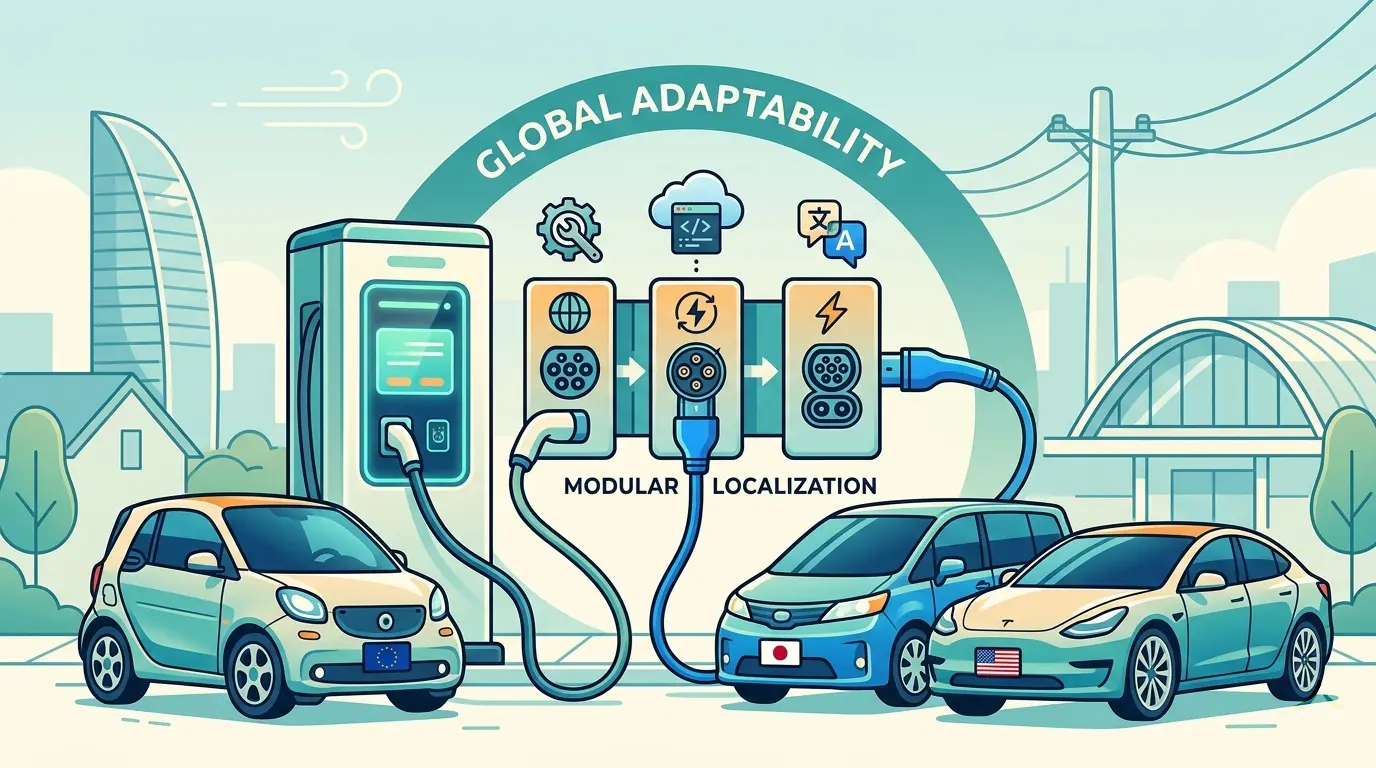
When EV charging companies expand into a new region, the biggest delays usually do not come from charger power alone. They come from connector mismatches, certification gaps, billing workflows that do not fit local expectations, utility requirements that change the site design, and service models that break down once the first units are installed.
That is why a charger that is easy to localize is not simply one with a translated user interface. It is a platform that can adapt to local electrical standards, compliance rules, software expectations, climate conditions, installation habits, and after-sales requirements without forcing a full product redesign.
For infrastructure buyers, distributors, and OEM partners, that distinction matters. A charger that localizes well lowers market-entry friction, shortens approval cycles, reduces engineering rework, and makes multi-country scaling more realistic.
Localization Starts Before Translation
Many buyers first think about localization in terms of language. That matters, but it is only the surface layer.
In practice, EV charger localization includes five connected decisions:
- Whether the electrical design matches local site power reality
- Whether the connector, cable, and charging format fit market norms
- Whether the charger and its documentation can clear local compliance reviews
- Whether the software, payment, and network layer match operator workflows
- Whether the physical product can be installed, serviced, and stocked efficiently in that region
If one of those layers fails, the charger may still be technically capable but commercially difficult to deploy. That is the difference between a charger that can be sold internationally and one that can actually scale across markets.
Power Architecture Must Match Local Grid Reality
A charger becomes easier to localize when its electrical architecture can accommodate different voltage environments, single-phase or three-phase installations, grounding approaches, site-load constraints, and utility approval processes.
This matters because charging demand looks different from market to market. Some regions have more workplace and residential charging demand, where longer dwell time can make lower-power AC infrastructure the better economic choice. Other markets prioritize fleet turnaround, highway corridors, or commercial depots, where faster charging may be essential.
The right answer is not universal. In some regions, more AC charging makes sense because installation is simpler and grid upgrades are slower. In others, higher-power DC equipment is justified because asset utilization depends on shorter dwell time and higher throughput.
Localization gets easier when a charger family can be configured around those realities instead of being pushed into every market with the same assumptions. Buyers should also remember that utility-side requirements often reshape the deployment plan before procurement is final. PandaExo’s guide to grid capacity, interconnection, and demand charges is a useful reminder that market fit often starts upstream of the charger itself.
Connectors, Cables, and Charging Habits Vary by Region
An EV charger is much easier to localize when its connector strategy is adaptable.
Different markets may center around different connector standards, fleet vehicle mixes, and charging behaviors. Passenger vehicles, commercial fleets, imported models, and mixed-site environments can create very different compatibility requirements. A charger that works well in one region may need a different socket format, cable configuration, or plug mix in another.
Connector localization is not only about technical compatibility. It also affects user confidence, session completion rates, maintenance complexity, and site planning. If the wrong connector mix is chosen, operators may face underused assets, adapter workarounds, or avoidable support requests.
This is why buyers should evaluate chargers with a clear view of local standards and future vehicle mix, especially when entering markets where imported and domestic EV fleets overlap. PandaExo’s article on IEC 62196 Type 2 vs. SAE J1772 shows how connector decisions quickly become commercial decisions, not just electrical ones.
Compliance Readiness Can Delay a Launch More Than Hardware
In many expansion projects, the product is ready before the paperwork is.
An EV charger that is easy to localize should be designed with market-specific compliance adaptation in mind. That includes not just the hardware itself, but also labels, user instructions, installation manuals, technical files, testing support, and region-appropriate documentation for regulators, utilities, distributors, or project developers.
From a buyer’s perspective, this reduces procurement risk in three ways:
- It shortens the time between sourcing and site approval
- It lowers the chance of costly redesign requests late in the process
- It makes channel onboarding easier for local distribution partners
This is especially important for companies entering multiple markets over a short period. A charger platform that requires heavy compliance rework for every country can drain engineering resources and slow revenue ramp. A charger platform built for repeatable adaptation is far easier to scale.
Software, Billing, and Network Rules Are Part of Localization Too
Hardware localization gets most of the attention, but software localization often determines whether a charger is operationally usable.
For many operators, the real market-fit questions are these:
- Can the interface support the right languages and local terminology?
- Can the charger handle local billing expectations, receipts, taxation logic, and user authentication methods?
- Can the platform support local roaming or interoperability requirements?
- Can the operator configure access rules, pricing structures, and time-based policies by market?
- Can remote diagnostics, updates, and alerting work across time zones and regional support teams?
This is where many otherwise capable chargers become hard to localize. If the software stack is rigid, every regional adaptation becomes a custom project. If the stack is configurable, the same hardware platform can serve multiple market models more efficiently.
Interoperability is part of that equation. Many CPOs and site hosts need confidence that chargers can sit inside broader network ecosystems rather than a closed environment. PandaExo’s explainer on OCPP, OCPI, and roaming highlights why open-network readiness is not a niche feature. It is often a localization requirement.
Physical Design and Serviceability Matter in the Field
A charger may be electrically compatible and software-ready, but still be difficult to localize if the physical format does not fit how sites are built and maintained in that market.
Examples include:
- Wall-mounted vs. pedestal-mounted preferences
- Cable lengths and cable management expectations
- Screen brightness for outdoor conditions
- Enclosure durability for heat, cold, rain, dust, or coastal environments
- Spare-parts strategy and field-replaceable components
- Installer familiarity with the product architecture
These details matter because localization is ultimately a field operation, not a slide deck. The easier it is for a regional installer to mount the charger, connect it, commission it, diagnose faults, and replace parts, the easier that product is to localize in practice.
This is also where after-sales structure becomes a market-entry issue. Buyers should look for chargers that support clear fault visibility, remote troubleshooting, and realistic spare-parts planning. A charger that depends on centralized support for every service event is harder to scale across multiple regions.
Modular OEM and ODM Support Reduces Market-Entry Friction
One of the clearest signs that an EV charger is easy to localize is whether the supplier can adapt the platform without treating every market as a one-off engineering program.
That is where modular OEM and ODM capability becomes valuable. For distributors, charging brands, and project developers, localization often requires some combination of:
- Regional branding or white-label requirements
- Different housings or installation formats
- Connector and cable variations
- UI and documentation changes
- Market-specific software behavior
- Different packaging, labeling, or channel support materials
When a supplier can support those changes through an established workflow, localization becomes a controlled commercial process rather than a custom engineering scramble.
This is one reason buyers often prefer partners with a broader portfolio of EV charging stations rather than a single fixed hardware family. In PandaExo’s case, the combination of AC and DC charging products, smart platform support, and OEM/ODM capability is relevant because it aligns with how multi-market expansion actually happens: through adaptation, not through a single universal SKU.
A Practical Buyer Checklist for Localization Readiness
Before selecting a charger for cross-market deployment, buyers can use the following decision table to separate products that are internationally sellable from products that are operationally localizable.
| Evaluation Area | What to Ask | Why It Matters |
|---|---|---|
| Electrical fit | Can the charger be configured for local voltage, phase, and site-load constraints? | Reduces redesign risk and improves site fit |
| Charging format | Does the connector and power mix match local vehicle and dwell-time behavior? | Improves utilization and user compatibility |
| Compliance support | Are market-specific labels, manuals, and technical documents ready or adaptable? | Speeds approvals and channel onboarding |
| Software flexibility | Can pricing, language, access, and network behavior be configured by region? | Reduces operational friction after deployment |
| Installation model | Does the physical format match local installer expectations and site conditions? | Lowers commissioning delays and service burden |
| Service readiness | Are spare parts, diagnostics, and maintenance workflows practical for the region? | Supports uptime and lowers after-sales risk |
| OEM/ODM process | Can the supplier adapt branding, hardware details, and documentation without starting from zero? | Makes multi-market expansion more scalable |
If a vendor cannot answer those questions clearly, localization will likely become the buyer’s problem later.
Practical Summary
An EV charger is easier to localize when it is built as an adaptable platform rather than a fixed product.
For buyers, that usually means looking beyond headline charging speed and asking whether the charger can fit local grid conditions, connector standards, compliance requirements, software workflows, climate realities, and service expectations. It also means evaluating whether the supplier can support those changes in a repeatable way through portfolio breadth, documentation readiness, and OEM or ODM execution.
In other words, the most localizable charger is rarely the one with the most aggressive specification sheet. It is the one that can enter a new market with fewer surprises, less engineering rework, better operational fit, and a clearer path to scale.