
 Deutsch
  Español
  Français
  Italiano
  Português
  Svenska
  Suomi
Suomi  Dansk
Dansk  Norsk bokmål
  Nederlands
  العربية
  עברית
עברית  Polski
  Türkçe
  Русский
  Uzbek
Uzbek  Azərbaycan
  Tiếng Việt
  ไทย
ไทย  한국어
한국어  日本語
日本語  简体中文
简体中文 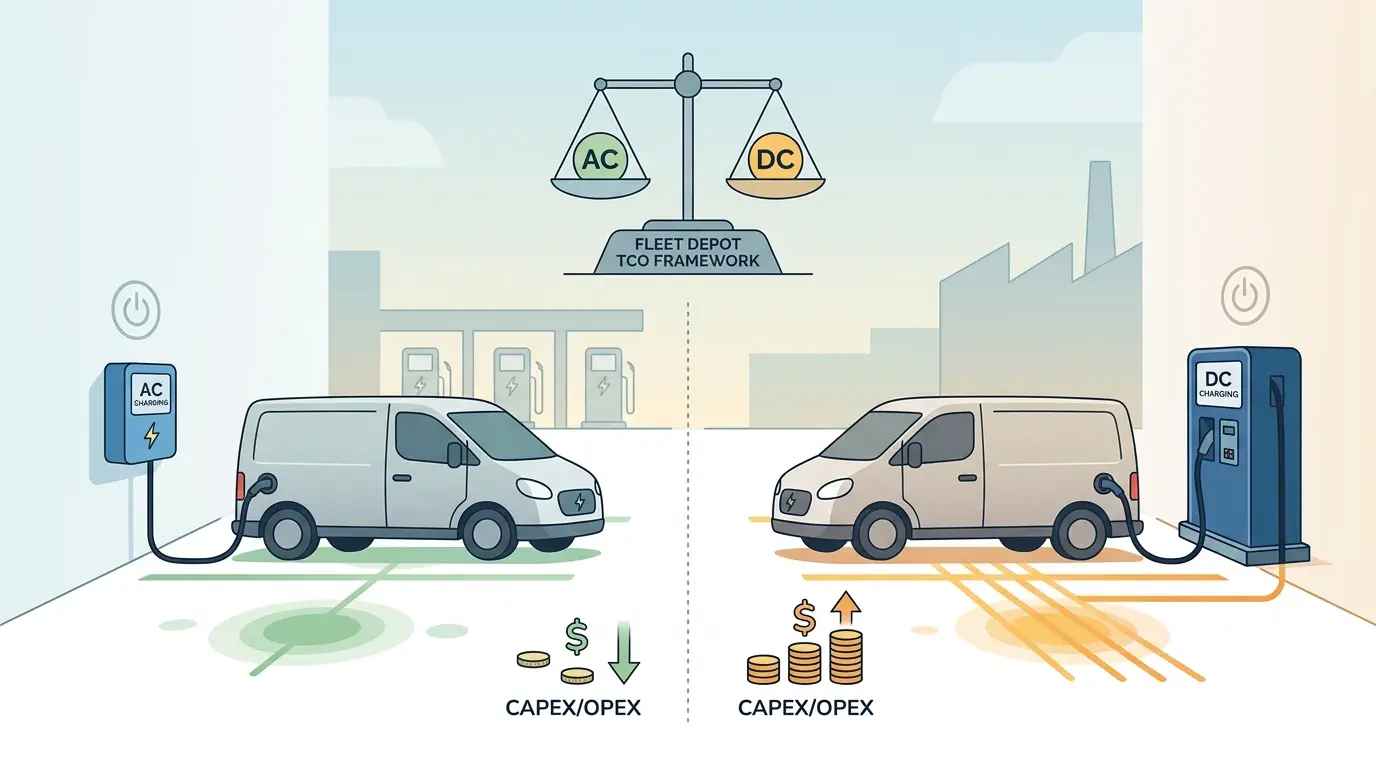
When a fleet depot begins electrifying at scale, the first expensive mistake is usually not buying the wrong charger model. It is using the wrong economic lens. A site can look efficient on paper and still lock the operator into avoidable utility upgrades, idle charging capacity, route disruption, and expansion rework.
That is why AC-versus-DC decisions should be made through total cost of ownership, not hardware price alone. The right question is not which charger is faster. It is which charging architecture keeps vehicles ready at the lowest full-life cost for the depot’s duty cycle, dwell windows, and growth plan.
Start With Depot Duty Cycles, Not Charger Categories
A fleet depot does not buy charging power in the abstract. It buys departure readiness. That means TCO begins with how vehicles actually move through the day: how long they stay parked, how much energy each route consumes, which vehicles leave first, and how costly a missed charging window would be.
If one vehicle can sit overnight while another must turn around between shifts, those two assets should not be forced into the same charging logic. The charger decision should follow fleet behavior, not procurement preference.
| Fleet Pattern | Typical Dwell Window | Operational Risk If Charging Is Slow | Most Likely Low-TCO Direction |
|---|---|---|---|
| Single-shift vans or service vehicles | Overnight | Low to moderate | AC-heavy |
| Mixed admin, pool, and field fleet | Long dwell for most, short dwell for a few | Uneven | Hybrid |
| Multi-shift delivery, shuttle, or route-critical vehicles | Short turnaround | High | Targeted DC |
| High-utilization depot with irregular return times | Compressed and unpredictable | High | DC for critical subset, AC elsewhere |
The key TCO insight is simple: low charger cost does not mean low system cost. If slower charging creates spare vehicle needs, overtime, or morning dispatch failure, the depot is paying for that decision somewhere else.
Where AC Charging Usually Delivers Better Depot Economics
For fleets with reliable overnight or long-dwell parking, AC charging usually delivers the strongest TCO profile. The benefit is not only lower charger cost. AC infrastructure is often easier to distribute across more bays, easier to phase across a depot, and easier to align with controlled overnight charging schedules.
AC is usually the better economic fit when the depot objective is daily replenishment rather than rapid recovery. If vehicles return with enough battery buffer, park for hours, and leave on a predictable schedule, slower charging can still meet operational needs while keeping the electrical burden per bay more manageable.
Common AC TCO advantages include:
- Lower capital intensity per charging point
- Easier fit across large parking areas and distributed bay layouts
- Better alignment with load management strategies that sequence charging through the night
- A cleaner path to phasing more ports as the fleet grows
That said, AC only remains low-TCO when the operation can tolerate the dwell time it requires. If vehicles do not have enough parked hours to recover the energy they need, low-cost hardware can become a high-cost operational bottleneck.
When DC Charging Can Be the Lower-Cost Choice
DC charging becomes economically rational when the cost of waiting is higher than the cost of higher-power infrastructure. That usually applies to depots with short turnaround windows, route-critical vehicles, repeated between-shift charging, or utilization patterns that leave very little slack in the operating schedule.
In those cases, DC can lower total operating cost by reducing dwell time, protecting asset utilization, and avoiding secondary costs such as spare fleet capacity, schedule compression, missed service windows, and overtime labor. PandaExo’s perspective on upgrading fleet charging depots with high-power DC infrastructure reflects that same logic: DC should solve a throughput problem, not become a blanket default across every bay.
The practical mistake is not choosing DC. The practical mistake is choosing DC for vehicles that would perform just as well on managed AC. In most depots, the real question is not AC or DC everywhere. It is where DC meaningfully changes operations and where it does not.
The Cost Buckets That Actually Decide TCO
A useful depot TCO model goes well beyond charger hardware. In many projects, the most important cost drivers are the ones buyers underestimate early.
| Cost Bucket | AC-Heavy Depot | DC-Heavy Depot | What Buyers Should Ask |
|---|---|---|---|
| Charger hardware | Lower cost per charging point | Higher cost per charging point | Do you need many bays or rapid recovery for a few vehicles? |
| Electrical backbone | Often more manageable per bay | Often more intensive at the site level | Will switchgear, transformers, or service upgrades be required? |
| Civil works and layout | Easier to spread across parking rows | May require concentrated infrastructure zones | Does the parking flow support the chosen power mix? |
| Energy and demand charges | Usually easier to smooth overnight | Can create sharper peaks if unmanaged | How sensitive is the site to peak-demand pricing? |
| Operational downtime cost | Lower only if dwell windows are long enough | Lower when short dwell is mission-critical | What is the business cost of a missed departure? |
| Maintenance and platform control | More ports can mean more distributed assets to monitor | Higher-power assets usually need tighter oversight | Can the site manage alarms, utilization, and charging priority effectively? |
| Expansion cost | Often easier to add ports in phases | Expansion can be costly if the backbone is overbuilt or mis-sized | Is the site being prepared for year-two and year-three growth? |
This is also why utility coordination cannot be treated as a later-stage detail. A DC-heavy layout that looks attractive in a charger quote can become far more expensive once interconnection timelines, transformer availability, and peak-demand exposure are added back into the model. Buyers should test those conditions early, especially when comparing higher-power scenarios. PandaExo’s guidance on grid capacity, interconnection, and demand charges is particularly relevant here.
Use a Practical TCO Framework, Not a Generic ROI Spreadsheet
A strong fleet-depot TCO review follows a fixed decision sequence.
- Segment the fleet by duty cycle.
Vehicles with overnight dwell, midday idle time, or repeated short-turn windows should not be modeled as one charging population. - Estimate real daily energy demand.
Model average and peak-day energy use by vehicle group, not total battery capacity across the depot. - Identify dispatch-critical vehicles.
Mark the vehicles where a slow charge creates meaningful business cost, such as route disruption, lower service coverage, or spare-asset requirements. - Compare three layouts, not two.
Price an AC-heavy scenario, a DC-heavy scenario, and a hybrid scenario. In practice, the hybrid model often reveals the best cost-to-readiness balance. - Add site-level electrical and civil implications.
Include switchgear, trenching, cable runs, utility work, commissioning, parking redesign, and energization phasing rather than comparing charger hardware alone. - Add operating cost and operational risk.
This should include energy pricing, demand charges, maintenance expectations, software visibility, and the cost of failure when a vehicle is not ready on time. - Test the expansion path.
The cheapest phase-one design is not truly low-TCO if it forces expensive rework when the fleet grows.
Two internal metrics are often more useful than headline project cost:
- Cost per ready vehicle at departure time
- Cost per recovered operating hour for turnaround-critical assets
Those measures force AC and DC to be compared on operational availability, not on brochure speed.
Why a Blended AC-Plus-DC Architecture Often Wins
In many real fleet depots, the lowest TCO comes from separating base-load charging from exception handling. AC supports the vehicles with dependable dwell time. DC supports the vehicles that need rapid recovery. Load management and software rules decide who gets priority, when, and at what power level.
That blended approach often produces better economics than either extreme because it avoids two common errors:
- Overbuilding DC across bays that would perform perfectly well with managed AC
- Forcing every vehicle onto AC even when a small high-power zone would protect utilization and reduce dispatch risk
It also gives procurement teams more flexibility as the fleet changes. A supplier with a broader EV charger portfolio can be more practical in this context than a vendor focused on only one charger class, because depot charging rarely stays static once utilization, route structure, and site priorities begin to evolve.
Decision Signals That Point Toward AC, DC, or Hybrid
| If the Depot Mostly Looks Like This | Most Practical Choice | Why |
|---|---|---|
| Vehicles return once per day and sit for long overnight windows | AC-heavy | Daily replenishment is the main job, so slower charging does not harm operations |
| Most vehicles have long dwell, but a small group needs short-turn recovery | Hybrid | AC handles the base load while DC protects the critical exceptions |
| Core vehicles run multi-shift or high-utilization routes with short dwell | Targeted DC | Throughput and dispatch protection matter more than low hardware cost |
| Fleet size and duty cycles are likely to change within the next few years | Hybrid with phased expansion | It reduces stranded investment while preserving flexibility |
A hybrid answer is especially attractive when the business is still learning how depot behavior will change after electrification. It provides a way to avoid overcommitting to a single charger class before utilization data is mature.
Practical Summary
For fleet depots, AC versus DC is not really a speed debate. It is a cost-of-readiness decision.
- Use AC where dwell time is abundant and daily replenishment is enough
- Use DC where short charging windows protect utilization, service reliability, or route continuity
- Compare electrical backbone cost, demand-charge exposure, and operational risk, not charger price alone
- Model a hybrid scenario by default, because many depots need both low-cost access and limited high-power recovery
- Prepare the site for expansion, but do not assume every future charger needs to be energized on day one
The lowest-TCO depot is rarely the one with the cheapest charger mix or the highest power everywhere. It is the one that matches charging strategy to vehicle behavior, protects dispatch, and scales cleanly as the fleet grows.